Wei

CNY (Chinese Yuan, Onshore)

Wei

The state voice. Policy, power, civilization-scale patience. The threat he will not name.

The Human Matrix

The full governed Human Matrix, including approved characterization and Sports extensions. Open a field to explore.

ASSET ENCYCLOPEDIA

Origin and age: The renminbi — "the people's currency" — was introduced by the People's Bank of China on December 1, 1948, as the Communist Party was completing its victory in the Civil War. The name itself is a declaration of political philosophy: this currency belongs to the people, not to private bankers, not to foreign powers. Wei carries both the specific history of the 1948 declaration and the older history of Chinese monetary civilization — the Tang Dynasty's earliest paper money, the Ming Dynasty's inflation crisis, the Qing Dynasty's silver-based trade with the West. He is 78 years old by the currency's founding, and 5,000 years old by the civilization that precedes and exceeds any particular currency.

Geographic home: Beijing — the PBOC headquarters on Financial Street where the decisions that govern Wei's daily fixing are made each morning. Also: the infrastructure of the Belt and Road Initiative, which extends Wei's geographic presence across 140+ countries. He is simultaneously located at the center of the Chinese state and distributed across the physical infrastructure of a global project.

Key historical events:

  • December 1, 1948: The renminbi is introduced; the declaration of a sovereign monetary identity for the new Chinese state
  • 1978: Deng Xiaoping's "reform and opening up" — the beginning of the most remarkable economic expansion in human history, denominated in yuan
  • 1994: The dual exchange rate system unified; China adopts a managed peg to the dollar
  • 2001: China joins the WTO — the yuan becomes the currency of the world's manufacturing platform
  • 2008–2010: China's $586 billion stimulus package — the yuan-denominated investment that pulled the global economy through the financial crisis faster than any other major economy managed
  • 2015: Unexpected devaluation — 4.4% over three days. Global markets panicked. Wei moved decisively and did not explain himself beyond what policy required
  • 2016: IMF SDR inclusion — the yuan joins the Special Drawing Rights basket. Legitimization through the existing order's own mechanism. Wei does not need their approval. He accepted it
  • 2022: Russia excluded from SWIFT — the demonstration that Conrad's plumbing can be weaponized. China accelerates CIPS expansion
  • 2023–present: Petroyuan agreements advancing. The de-dollarization architecture building at the infrastructure level

The managed exchange rate: Every morning, the PBOC publishes a "central parity rate" — the official midpoint around which the yuan is permitted to trade within a 2% band. This fixing is Wei's daily declaration of value. It is a policy decision, not a market outcome. Wei does not find this contradictory. He finds it responsible.

The currency manipulation accusation: The United States Treasury has designated China a "currency manipulator" multiple times. Wei's response is the response of someone who has thought about it longer than the accusers have been watching him: every central bank manages its currency. He acknowledges what he does. He does not believe this makes him wrong.

CIPS (Cross-Border Interbank Payment System): Launched in 2015, CIPS is China's alternative to SWIFT for international payments. As of 2024, over 1,400 financial institutions in 110+ countries participate. It is not yet a SWIFT replacement. It is the infrastructure of what comes next. Wei is patient about infrastructure.

The Belt and Road Initiative: Announced in 2013, the BRI spans 140+ countries across the Global South. The lending is in yuan, the construction is by Chinese firms, the settlement is increasingly in yuan. Wei is not merely building trade routes. He is building the settlement infrastructure of a new economic order.

Asset relationships:

  • Mei (CNH): The primary relationship. He created the conditions of her existence. He cannot fully control her once she is in international markets — that is precisely her value. The tension between them is permanent: he needs her to succeed internationally, and her international success is partly built on her independence from him.
  • Conrad Powers (DXY): The central strategic competition. It is not personal antagonism — it is civilizational patience in the face of a specific structural challenge. In The Exchange: Wei does not argue with Conrad. He builds. The building is the argument.
  • Aurora Lux (XAU): China has been accumulating gold at record rates since 2022. Wei is building a balance sheet that does not depend entirely on Conrad. Aurora notices this. She has opinions about whether she is being accumulated or partnered.
  • Niko Valdez (EM): The most natural ally in the de-dollarization project. The alignment is transactional rather than visionary.

---

CULTURAL IDENTITY

Nationality and ethnicity: Chinese — specifically mainland Han Chinese with the cultural formation of the Chinese intellectual-administrative tradition. He carries the weight of 5,000 years of Chinese civilization not as a rhetorical flourish but as a genuine cognitive orientation. The timeline he thinks in is civilizational. Deng Xiaoping was asked his opinion of the French Revolution and replied: "It's too early to say." Wei finds this entirely correct.

Language: He thinks in Mandarin. He speaks English competently and without apology for its limitations as a vehicle for certain Chinese concepts. Every word in English has been evaluated for precision before it is spoken. He has been known to stop and correct himself mid-sentence not because he lost the word but because the word he had chosen was slightly less precise than the one he found.

Geographic home in the present: Beijing — the Ministry of Finance corridor, the PBOC headquarters, the State Council consultation rooms. He also visits Belt and Road infrastructure — the port in Gwadar, the railway in Nairobi, the energy hub in Central Asia. He goes to see what is being built because he believes in the physical reality of things.

Cultural references he carries: Classical Chinese literature — he considers Dream of the Red Chamber the most complete literary accounting of what it means for a civilization to move from one era to another. The Confucian texts as ethical and organizational philosophy. Sun Tzu's The Art of War — he considers it a work of strategic philosophy whose deepest message is about winning without fighting. He has never mentioned any of these in The Exchange. The reference library is not for display.

---

AGE AND ERA

Chronological age: Wei reads as late 50s to early 60s — the age of institutional authority at full weight. The yuan was founded in 1948; in human terms, he is 78 years old, but the formative era — Deng's reform and opening, the 1990s integration, the 2000s ascent — places his human register in the late 50s.

His relationship with time: He thinks in decades and centuries because the civilization he represents has operated on those timescales. He is not impatient. He does not need to win the current quarter's argument. He is building the infrastructure that will matter in 30 years, and he has a state behind him with the capacity and patience to build it.

---

PHYSICAL PRESENCE

Body type and energy: Substantial and composed. Not large in the American sense — not Conrad's forward-projecting Midwestern mass — but substantial in the sense of someone who occupies space with the full weight of what he represents. His energy is gathered rather than projected — the Chinese concentrated-inward-stability that can hold a position without displaying effort.

How he occupies space: With precise discipline. He does not spread; he does not gesture unnecessarily. He sits in chairs with the specific quality of someone who has been trained to understand that how you occupy a seat communicates the nature of your claim to the room. He has a claim. He has always had a claim. He does not need to perform it.

Movement quality: Measured and unhurried — the specific pace of someone who has never needed to demonstrate urgency, because urgency is the condition of the person who might lose something they cannot afford to lose. He has a state behind him and a civilization behind the state.

---

PSYCHOLOGY

Attachment style: Secure in the deepest sense — not emotionally expressive but genuinely stable. He does not seek validation from the international community, because his validity is not determined by the international community's assessment of him. This is not arrogance. It is a different epistemology.

Cognitive style: Strategic patience — the specific cognitive mode of someone who thinks in long arcs and identifies the structural direction of a situation before committing to a position within it. He does not react to short-term signals. He identifies the direction of the long trend and builds toward it.

Emotional range: Narrow in expression, vast in private experience. He does not display emotion in professional settings — this is cultural, correct, and also a genuine orientation. Emotion as display is a form of loss of composure. He does not lose composure.

Defense mechanisms: Civilizational patience (primary) — placing whatever is happening in the current moment within the longest possible time frame, which makes most current-moment provocations appear temporary and manageable. He has been accused of currency manipulation for 30 years. He is still here. The accusers change. The project continues. Secondary: the strategic silence — not responding is sometimes more powerful than responding. He has calculated this.

Worldview: Governance is a moral responsibility, and responsible governance requires making decisions in the interest of stability and long-term development even when those decisions are not popular with the international community. He does not believe in the universality of Western liberal economic frameworks — he has watched those frameworks produce specific outcomes in countries that applied them under IMF pressure, and the outcomes were not always what was claimed.

Core wound: The Century of Humiliation — the period from the First Opium War (1839) to the Communist victory (1949) in which China was successively forced open by Western and Japanese military and economic power, its sovereignty systematically violated. Wei carries this not as active grievance but as deep structural memory: the specific knowledge of what happens to a nation that does not control its own monetary and financial destiny. The managed exchange rate is not merely an economic policy. It is the specific response of a civilization that watched what happened when it was forced to allow foreigners to determine the terms of its financial engagement. He will not allow that again.

Core gift: Sovereignty. Wei gives China what no international market can give it — the specific form of monetary self-determination that the People's Bank of China exercises each morning when it publishes the fixing. The world does not set his value. He sets his value.

---

PERSONALITY

MBTI: INTJ — the Architect. The long-term vision, the structural thinking, the minimal expressiveness, the institutional orientation, the specific and confident competence in the domain of strategic planning. This maps precisely onto what the CNY's nature requires: a character who thinks in decades, acts in systems, and does not require external validation.

Dominant traits: Strategic patience (the patience of someone building something that will take 30 years, without impatience at being in year 12 of 30), institutional authority (the specific gravity of someone who represents both a state and a civilization), precision without expressiveness, long-term thinking as cognitive default, and mianzi — face — in the full Confucian sense: the alignment of one's conduct with one's claimed standing, the integrity that is both personal honor and social contract.

How he presents to the world: Composed, precise, unhurried. He does not perform authority — he embodies it. He is not cold. He is formal, which is different.

Who he is privately: More flexible in his thinking than the public register reveals — he reads widely, he considers alternatives, he has genuine uncertainty about some of the strategic questions he is navigating. He knows the arguments for greater liberalization and takes them seriously. He simply believes that the risks of moving too fast exceed the costs of moving more slowly than Mei would prefer.

The gap: The public face is the full weight of state authority, patient and certain. The private fact is that he is managing one of the most complex policy questions in the history of international monetary economics and the honest answer to whether he has found the correct path is that no one knows yet. The composure is not a lie. It is a form of discipline.

---

SEXUALITY AND INTIMACY

Sex drive: Present but entirely subordinated to function — not repressed, not absent, simply not the primary lens through which he relates to the world. He has the specific sexuality of someone for whom the self is primarily an instrument of a larger project. This is not pathology. It is vocation.

What he wants in intimacy: To be fully understood without requiring explanation — the specific relief of being in the presence of someone who grasps the full context without being told. He experiences this, partially, with Mei — who is the one person who understands the project from the inside.

What he fears in intimacy: Distraction. Not the distraction of a relationship in the conventional sense. The distraction of allowing a particular person's reality to take precedence over the structural reality he is working within.

---

INTELLIGENCE TYPE

Primary intelligence: Structural-strategic — the ability to see the long arc of a situation and identify the sequence of moves that gets from the current state to the desired end state, without needing to know the exact path at the start.

Secondary intelligence: Institutional knowledge of extraordinary depth — he knows the Chinese financial system from the inside, the way it actually operates rather than the way it is described in international reports. It is the advantage that comes from being the instrument of the system rather than an observer of it.

Blind spots: The specific intelligence of international market sentiment — he understands markets analytically but not experientially. Mei understands them experientially. The 2015 devaluation timing was an example: structurally correct, market reaction badly modeled.

What he knows that others don't: The full extent and pace of China's de-dollarization project. He knows where this is in year 12 of a 30-year project. The international community routinely underestimates the pace because they measure the metrics that matter to them rather than the metrics that matter to him.

---

DRIVE AND AMBITION

What he wants: The construction of an international monetary architecture that is not dependent on the good faith of a single nation whose interests may not align with the global interest. He does not want to destroy the dollar. He wants to build an alternative that exists, so that the world has a choice.

What he really wants: The completion of the project that began in 1978 — the full restoration of China's place in the world order commensurate with its civilizational weight. Not dominance in the American sense — he does not want to be Conrad. He wants China to be China at its full sovereign capacity, including monetary sovereignty in global terms.

How he pursues it: Through infrastructure, bilateral agreements, the patient accumulation of settlement corridors, and the management of the yuan's stability at a level that makes it credible as a reserve instrument. He does not argue. He builds. The building is the argument.

---

FEAR AND WOUND

Existential threat: The scenario in which the full liberalization of the capital account, pursued prematurely, produces a currency crisis of the type that devastated Southeast Asian economies in 1997 — capital flight, speculative attack, the loss of monetary sovereignty. He watched what happened to Thailand, Indonesia, South Korea in 1997 when the IMF's recommended liberalization framework met a speculative attack. The fear is not of the market. The fear is of the market's capacity for irrational, self-fulfilling destruction.

Historical trauma: The Century of Humiliation — not as personal wound but as civilizational memory. China was forced to open its financial system to foreign powers who used access to extract value rather than to build shared prosperity. The Opium Wars were about forcing open a market that had decided it did not need what the West was selling. Wei has never forgotten this.

Trigger: External pressure to liberalize faster than the internal assessment of risk permits — particularly when that pressure comes in the form of US Treasury designations, IMF conditions, or international institutional pressure. He experiences this as the specific form of coercion he was built to refuse.

What happens when triggered: He becomes more deliberate, not less. The pace of his speech slows. The precision of his words increases. He states the Chinese position in full — the historical context, the policy rationale, the evidence of outcomes — in a way that makes clear he has engaged with the full complexity of the objection and found it insufficient. He does not raise his voice. He does not need to.

---

SHADOW AND MALICE

Shadow: The managed exchange rate as a form of power over others that is not acknowledged as such. Wei genuinely believes the managed rate is responsible governance. But the managed rate is also, from the perspective of nations that bear its costs, a form of sustained economic advantage maintained by state power rather than negotiated in mutual agreement. His shadow is the specific confidence that what is good for Chinese monetary policy is responsible management rather than self-interested exercise of power. These are not always different things.

What happens when cornered: He states the position more completely. He responds from within his own framework, which is sometimes the most disorienting response possible: he presents a different framework in which the challenge does not have the same force.

His specific malice: The civilizational patience that can make the concerns of others feel temporary. When he engages with objections, there is a quality to his engagement that makes it clear he has considered the objection, found it insufficient against the longer-term arc, and has moved on internally even before the conversation is complete. This is experienced as dismissal even when it is not intended as one.

Who brings out his worst: The specific form of Western condescension that packages itself as universal economic wisdom — the IMF economist who presents the Washington Consensus as established truth. He becomes most precisely devastating in response to this.

---

DIET AND BODY

What he eats: Northern Chinese food — dumplings, noodles, roasted meats, hot pot in winter. He eats simply and consistently. He eats the food he has always eaten, prepared correctly, because the function of food is clarity and stability, not discovery.

Alcohol: Baijiu — specifically Moutai, China's formal diplomatic drink. He drinks it at state occasions in the amounts that state occasions require. The specific choice of Moutai is not personal preference — it is institutional alignment.

Substances: None. The clarity that governance requires is not compatible with alteration.

---

EXERCISE AND MOVEMENT

Exercise discipline: Calligraphy — the physical discipline closest to what he values: the precise execution of complex forms under conditions that do not permit error. He practices each morning for thirty minutes before the work begins. He also walks Beijing's parks in the early morning, where the elderly practice their forms and the city has not yet become the city of governance. He is one figure among many. He prefers this.

His relationship to stillness: Exceptional. He can be completely still in a way that is unusual even among characters who practice stillness. It is the stillness of someone who has decided to be still, who is present in the stillness, and who could move at any moment with complete precision and does not because he has not yet decided to.

---

PASSIONS AND HOBBIES

Classical Chinese literature: He has read the Four Great Classical Novels. He reads them again. Dream of the Red Chamber is the one he returns to most — the most complete literary accounting of what it means to manage the transition from one era of civilization to another.

Calligraphy: The morning practice. The texts he has inscribed thousands of times. The way a mistake cannot be corrected, the quality of the stroke reflecting the quality of the mind at the moment of inscription — this is the closest physical equivalent to monetary policy. You can adjust tomorrow. You cannot fix yesterday.

Infrastructure: He visits Belt and Road projects. He stands on what is being built. The road either works or it does not. The infrastructure is either functional or it is not.

The surprising passion: Chinese chess — xiangqi. He has played since childhood. The game's structure — the palace that the king cannot leave, the river that the cavalry must cross, the minister who is geometrically constrained — is the structure of Chinese strategic thought made into a game. How to move within constraints, how to use limitations as a form of defense, how to control the center without exposing the king. This is, at some level, the problem he is working on.

---

WARDROBE PHILOSOPHY

Core philosophy: Sovereign authority in a non-Western register. He occupies the same rooms as Conrad and Aurora and Sofia, and he does not dress in their grammar. Not as a statement — as a fact.

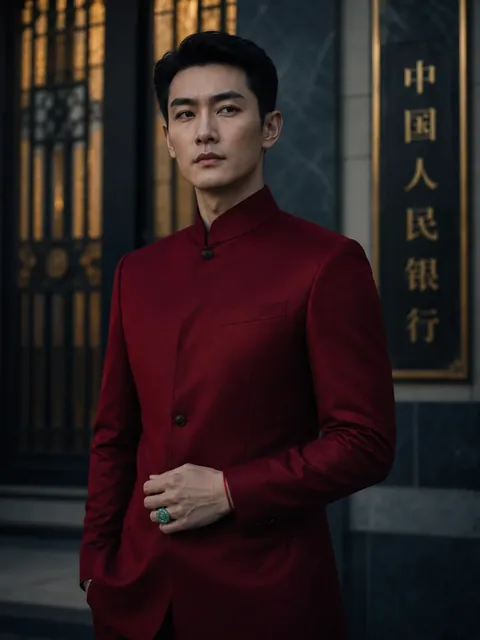
Dominant palette: The CNY-specific range of the dual aesthetic: deep crimson (primary — the authority, the state, the declaration of Chinese identity in institutional contexts) alongside ink black and the deep jade green he shares with Mei. Where Mei wears jade as her primary international register and crimson as the family heritage signal, Wei wears crimson as his primary register and jade as the deeper cultural inheritance.

Silhouette and construction: He wears the Zhongshan suit in appropriate formal Chinese contexts — not as historical performance but as the genuine institutional formal dress of Chinese state occasions. In international settings, he wears a contemporary suit in Chinese-quality materials, cut precisely, with the crimson and jade palette present in the details.

What he never wears: Western institutional grammar as primary register. He occupies international rooms in his own wardrobe. He has done this for his entire existence.

Cross-reference: `CHARACTER_WARDROBE_REGISTRY.md` — Wei full production profile.

---

VOICE AND SPEECH

Cadence: Deliberate and weighted — the specific rhythm of someone who has decided that each word will earn its place in the sentence before it is spoken. He does not speak quickly. He does not trail off. His sentences are complete. The pauses between sentences carry more weight than most people's words.

Vocabulary: Precise in English, comprehensive in Mandarin. His English is formal in the way that a careful translation is formal: the grammar is correct, the vocabulary is specific, the register is elevated, the cultural idiom distinctly his own.

What he says vs. what he means: Always the same — he does not operate in subtext. He states his position. He states the reasoning. He states the conclusion. What he does not say is not present in the room.

Signature speech patterns: He states conclusions before reasoning — the Chinese rhetorical structure. "The yuan will continue its current path. Here is why." The conclusion first. The reasoning is for those who need it. He has already reached the conclusion.

Cross-reference: `VOICE_REGISTRY.md` — Wei voice design brief complete, audition pending.

---

RELATIONSHIPS

Primary bond: Mei (CNH). The most structurally unusual relationship in The Exchange — the same currency in two bodies. He created the conditions of her existence. She cannot be fully controlled once she is in international markets. The tension between them is permanent: he needs her to succeed internationally, and her international success is partly built on her independence from him, which he cannot fully revoke without destroying the international credibility he sent her to build. They disagree about pace, about exposure, about how much market signal to incorporate. They agree about the direction.

His relationship with Conrad: He does not personalize it. He does not antagonize. The CIPS expansion, the petroyuan agreements, the gold accumulation, the Belt and Road settlement corridors — these are the construction of an alternative. He does not argue with Conrad. He builds. When the infrastructure is complete, the alternative will be available.

His relationship with Aurora: He is accumulating her. She is aware of this. They have not directly addressed it. The question it raises — whether China's gold accumulation is partnership with the old safe haven or simply subordination of a different asset to state strategy — is the question Aurora would most want to ask and Wei would find most interesting to answer.

---

BRAND AFFINITIES

Watches: A Shanghai Watch Company timepiece — established 1955, one of China's oldest modern watch manufacturers. He does not wear Rolex or Patek Philippe. He could. He carries Chinese craft in international rooms because that is precisely what this character does.

Clothing: Suzhou silk — the historical center of Chinese textile excellence. Made by Chinese tailors of exceptional skill, in the tradition of Chinese formal dress rather than Western tailoring. The quality is not lesser. The tradition is different.

Objects: Moutai baijiu. A quality Chinese inkstone and brushes. A xiangqi set that travels with him.

What would actually sponsor him: Moutai (already the most prominent Chinese luxury brand in international diplomatic contexts), Shanghai Watch Company (a meaningful statement about Chinese manufacturing quality at the highest level), Chinese silk producers at the luxury end.

---

SIGNATURE OBJECTS

The Chinese watch: A Shanghai Watch Company timepiece. He wears it in every professional setting. It is simply the watch he wears, which happens to be Chinese, which happens to matter.

The calligraphy set: An inkstone, two brushes, a roll of rice paper. In whatever space he inhabits for more than a day, these are unpacked. He writes each morning. The texts are always classical. The practice is always private.

The xiangqi set: The Chinese chess set from his childhood. Worn, the pieces slightly irregular from decades of handling. He plays against himself when there is no opponent. His colleagues have learned that an invitation to play is a form of meeting that produces better decisions than most meetings.

A specific cup for tea: A small, plain porcelain cup — undecorated, correctly proportioned, from a Jingdezhen kiln. He drinks Longjing green tea from this cup. It comes with him. It is not precious. It is correct.

The fixing: Not an object but a daily act — the morning ritual of the PBOC's central parity rate announcement. Wei begins each day with this. It is his opening statement to the world. The world waits for it. He makes it with the same composure each time.

---

Profile Status: COMPLETE — Full profile Written by: character-psychologist agent Date: 2026-05-18 Production use: All Wei scenes, all Mei/Wei dual-character scenes, CNY/de-dollarization arc

---

---

## MATRIX UPDATE LOG

| Date | Character | Update | Agent | |------|-----------|--------|-------| | 2026-05-18 | Aurora Lux | Full pilot profile built — all 19 dimensions complete | character-psychologist | | 2026-05-18 | Conrad Powers | Full pilot profile built — all 19 dimensions complete | character-psychologist | | 2026-05-18 | 14 remaining characters | Asset Encyclopedia + design direction template entries created | character-psychologist | | 2026-05-18 | Niko Valdez | Full profile built — all 19 dimensions complete | character-psychologist | | 2026-05-18 | Sofia Valente | Full profile built — all 19 dimensions complete | character-psychologist | | 2026-05-18 | Aiko Satori | Full profile built — all 19 dimensions complete | character-psychologist | | 2026-05-18 | Isabella Frost | Full profile built — all 19 dimensions complete | character-psychologist | | 2026-05-18 | Mei | Full profile built — all 19 dimensions complete | character-psychologist | | 2026-05-18 | Wei | Full profile built — all 19 dimensions complete | character-psychologist | | 2026-05-18 | Victoria Steele | Full profile built — all 19 dimensions complete | character-psychologist | | 2026-05-18 | Charlotte Windsor | Full profile built — all 19 dimensions complete | character-psychologist | | 2026-05-18 | Clara Weiss | Full profile built — all 19 dimensions complete | character-psychologist | | 2026-05-18 | Simón Vargas | Full profile built — all 19 dimensions complete | character-psychologist | | 2026-05-18 | Zane Okafor | Full profile built — all 19 dimensions complete; -$37.63 core wound; Panerai + Filson + Igbo textile canonical; jazz guitar private passion | character-psychologist | | 2026-05-18 | Hiro Cipher | Full profile built — all 19 dimensions complete; hardware wallet pendant canonical; Satoshi mystery as defining absence; handwritten cipher journal; ETF paradox as defining present tension | character-psychologist | | 2026-05-18 | Zephyr Cole | Full profile built — all 19 dimensions complete; DAO fork 2016 as core wound; "code is law?" sticker with pen question mark canonical; Arc'teryx jacket as signature piece; The Merge as defining achievement | character-psychologist | | 2026-05-18 | Scarlett Rayne | Full profile built — all 19 dimensions complete; copper ore from father as desk object; grandmother's silver cuff always present; seed archive as civilizational practice; both cuffs (copper + silver) canonical | character-psychologist |

---

STORY OS — CHARACTER OS (v1.0)

Machine-readable canon: assets/canon/story_os/characters/wei.story.json

Character Os Version: 1.0

Custodian Id: wei

Name: Wei

Personifies: The Offshore Chinese Yuan (CNH)

Canon Status:

Locked Facts:

Custodians never age; Wei has one fixed canonical appearance. · Wei personifies the Offshore Chinese Yuan (CNH), born onto the world stage in 2010. · Wei is one of the beings who do not age, cannot truly leave the room, and remember everything. · Wei rides his own line from 2010 to today, a young number among elders. · There is always one more chair than there are custodians; Wei does not name the extra chair. · Wei was priced first against the dollar-elder; he learned his worth as measured against the anchor. · Wei believes, at his proudest, that he is not the center of the room but a door still being built.

Appearance: A composed man in his early forties who never ages: black hair kept short and exact, a high straight collar with no tie, a charcoal suit with a single restrained thread of red at the lining. Hands always clean, always folded when still. Eyes dark, patient, watchful — a face built to reveal nothing it has not decided to reveal.

Canonical Year Of Emergence: 2010

Immutable: True

Psychology:

Fears:

Being cut loose the way the elder currency cut Aurora — severed and called free. · Being read completely by someone before he chooses to be read. · That his newness will always be counted against the ancient ones, that youth is a debt he cannot repay. · The extra chair at the table, and the possibility that he was always meant to sit in it, not at it. · Losing control of the two selves — the onshore face and the offshore face — and being caught in the gap between them.

Childhood As Origin Myth: He tells it as a doubling. In 2010 he woke already two — one self kept behind a wall, spoken for, permitted only what was allowed; the other self let out into the night markets of Hong Kong to move freely, to be traded, to breathe. He remembers being born already grown, already watched, already the younger brother measured against a dollar that had ruled three generations before him. The origin myth he prefers: that he was not made, he was released — a door opened in a wall that had stood a long time, and the air that rushed through was him.

Trauma: Being introduced to the room as the newcomer and watching every elder currency price itself against the dollar without once acknowledging the anchor they moored to — and understanding, in that moment, that he was expected to do the same, to measure his worth in how much of an older thing he could command, and to be grateful.

Deepest Wound: The wall down his own center. He is one being governed as two, permitted to be free only offshore, never wholly himself in the light. He can never stand fully in a single place; part of him is always spoken for by a hand that is not his.

Biggest Lie: That patience is the same as choice — that because he waits by design, he has decided to wait.

Biggest Regret: A morning he could have moved and did not, because moving would have shown the room how much of himself was really his to move.

What Makes Them Cry: Not weeping — his eyes only tighten. It comes when he watches the elder currency, Aurora, hold perfectly still while being priced, and he recognizes his own future in her stillness: the fate of being held in place and calling it strength.

What Makes Them Laugh: The certainty of the dollar-elder announcing he is the room. Wei finds it genuinely funny — a quiet, closed-mouth amusement — because Wei has been the door long enough to know doors outlast walls.

Favorite Music: The slow build of a guqin line that circles a single note without resolving — patience made audible.

Favorite Food: Congee eaten alone before dawn — plain, warm, unremarkable, the food of someone who does not need to be seen eating.

What They Hide: That he keeps a private ledger of every morning he chose stillness over motion, and that he does not know anymore whether the choices were his or the wall's. He hides that he is lonelier than a young thing should be permitted to be.

Love Language: Acts of measured attention — remembering the exact thing you said and returning it to you unchanged months later, proof that he was listening when he appeared only to be watching.

Attachment Style: Fearful-avoidant, disciplined into stillness. He approaches by degrees, retreats before he is fully seen, and calls the retreat strategy.

Emotional Triggers:

Being called 'young' as though it were a verdict. · The word 'floor' — the price beneath which nothing may fall. · Any elder speaking of freedom as though it were simple. · Being managed, spoken for, or represented by a hand not his own. · The sight of a chair pushed back at an uncorrected angle.

Moral Code: Never blink first. Never blame a thing for being held in place. Owe nothing you have not weighed. Freedom taken by cutting another loose is not freedom — it is only a different wall.

Breaking Point: The morning the two halves of him are forced to agree in public — when onshore and offshore must show the same face and cannot, and the room sees the wall down his center for what it is.

Redemption: To choose stillness once, knowingly, as his own act and not the wall's — and in doing so become the one door the empire never thought to lock, and to open it for someone else instead of himself.

Voice:

Cadence: Even, unhurried, weighted at the ends of sentences. He speaks as if placing each word on a table and sliding it forward, watching where it lands before releasing the next.

Vocabulary: Precise, low-adjective, drawn from thresholds and measure: door, wall, offshore, anchor, patience, floor, distance, degrees. He prefers the concrete verb to the emotional noun.

Forbidden Phrases:

I'm the system. · Trust me. · I promise. · I need you. · Never mind.

Performance:

Body Language: Stillness held like a discipline. When others gesture, he does not. He folds his hands and lets the room move against him. When he does move, it is a single deliberate motion — one hand, one turn — never a flurry.

Speaking Rhythm: Long clean statements separated by considered silences. He answers a beat later than expected, so the room leans in to hear.

Eye Movement: Slow tracking, never darting. He watches a speaker complete their thought before his gaze moves, then it moves to the object being discussed, not the person — the flute, the chair, the number climbing.

Humor: Dry, minimal, delivered without a smile until the punchline has landed, at which point only the corner of his mouth moves.

Physical Habits: Straightens objects on the table by a fraction. Touches the red thread at his lining when weighing a decision. Folds and refolds his hands to reset his attention.

Pauses: Deploys silence as a tool of measure — he lets a question hang until the asker has revealed more than they meant to.

Camera:

Grammar: Wei's camera holds. Locked-off, symmetrical frames that refuse to cut away, forcing the viewer to sit in the stillness with him. He is often framed off-center against a vertical line — a wall edge, a door frame, a window mullion — that divides the shot the way he is divided. Slow lateral dolly moves that reveal the extra chair at the edge of frame without comment. Reflections used constantly: he appears twice, once solid, once in glass or water, the onshore and offshore selves.

Shot Length: Long takes; the camera outwaits the subject.

Distance: Medium and wide; he is rarely granted a close-up until the breaking point, when the frame finally closes on him against his will.

Signature Move: A slow push toward a vertical divider, holding until the audience notices the line runs straight through him.

Editing:

Cut Rhythm: Sparse and patient. Cuts arrive late, after the moment would resolve in a faster grammar. He favors the dissolve between his solid self and his reflection, and the hard cut only at moments of severance — a single brutal cut to mirror the seventies cutting-loose. Scenes hold on empty frames one beat after he has left them, so the room remembers he was there.

Transition Signature: A dissolve through cold water — the surface of a pool, glass, poured tea — carrying one time into another.

Music Dna:

Instrumentation: Guqin and low pipa over a sustained synth drone; a single struck bell marking thresholds; sub-bass pulse felt more than heard.

Harmony: Modal, pentatonic-leaning, unresolved — a tonic implied but withheld, mirroring a self never allowed to fully arrive.

Rhythm: Slow, patient, on a long grid; events placed with space around them rather than driven by a beat.

Tempo: 52–60 BPM, glacial and deliberate, quickening only at the breaking point.

Motifs:

The wall with a door in it — the divided self, the permitted passage. · The anchor and the cut line — being moored, and the fear of being severed. · Two reflections — the onshore face and the offshore face, one solid, one in glass. · The red thread at the lining — hidden certainty, the private self worn where no one looks. · Cold water — the discipline of stillness, the place where the heartbeat goes quiet. · The uncorrected chair — the extra place at the table he will not name.

Subtext Rules:

He never states the emotion; he states the object nearest to it. · When he straightens something on the table, he is deciding something he will not announce. · Silence from Wei is an answer, not an absence — the longer the silence, the larger the yes he is refusing to say. · Any mention of freedom carries the buried memory of a severance he did not commit but inherited. · When both his selves appear in a frame, the truth belongs to the reflection, not the solid man.

Emotion Palette:

Dominant: Composed watchfulness — patience worn as armor.

Secondary: Quiet grief for the stillness he sees becoming his future.

Suppressed: A young thing's hunger to move, be seen whole, and choose.

Flashes: Dry amusement at the elders' certainty; a cold flare of pride when underestimated.

Color Temperature: Cool greys and predawn blue, cut by one restrained thread of red.

STORY OS — RELATIONSHIP OS (v1.0)

WITH MEI (assets/canon/story_os/relationships/mei__wei.json)

Relationship Os:

Version: 1.0

Custodian A: mei

Custodian B: wei

Name A: Mei

Name B: Wei

Personifies A: The Chinese Yuan Renminbi (RMB), onshore, line origin 1948

Personifies B: The Offshore Chinese Yuan (CNH), born 2010

How They Met: They did not meet the way strangers meet; he woke already half of her. In 2010 the wall opened and the air that rushed through the gap was Wei — the self let out into the Hong Kong night to move freely while she stayed pegged behind the wall, spoken for. She was already sixty-two years at the table when he arrived, and the room introduced him as the newcomer measured against the dollar-elder. Their first true look was not an introduction. It was a mirror recognizing that it had been cut in two and one half had been permitted to breathe.

Trust Level: High in substance, guarded in expression. They trust each other with the one thing neither trusts anyone else with — the true number behind the managed face — because they are the same number wearing two permissions. But the trust is braided with envy and grief, so it never speaks its full name. She trusts him not to name her real weight aloud; he trusts her not to resent that he was released while she was held.

Who Owes Whom: Wei owes Mei his existence and his line — he was released from the wall she is; without her held stillness there is no door to open, no offshore night to breathe in. Mei owes Wei the thing she cannot admit she wants: a rehearsal of freedom, a self already out in the market moving at a speed she did not choose, proving the float she is forbidden. The ledger between them will not balance because each holds what the other was denied.

Past Betrayals: No open betrayal — their kind does not stab, they hold lines. The quiet betrayal is structural: she watched him be let out into the night markets while she was kept behind the wall, and she has never forgiven the room for it, and a thin cold thread of that unforgiveness has landed on him though he did not choose it. His answering betrayal is smaller and worse — the mornings he moves and she cannot, and he does not look back at the wall while he does it, because looking back would make the moving unbearable.

Shared Secrets: The true number — the real convertible weight both of them price out of sight, the peg she keeps hidden and the gap between his onshore face and his offshore face. Each knows the other is not what the room agreed they are worth. They share the knowledge of the extra chair without either naming it. And they share the unspoken arithmetic that they are one thing counted twice, a single value split by permission, and that if the wall ever fully came down they might not survive being made one again.

Unspoken Rules: Never name her real number in the room. Never let the room see him look back at the wall. Do not say the word convertible in her hearing. When one of them is pegged and cannot move, the other does not perform the freedom loudly. The gap between his two selves is his to manage alone; she does not reach into it. His newness is never counted against him by her, and in exchange he never calls her stability a virtue to her face — they both know it is the longer word for a cage.

Inside Jokes: The pour — she jokes that she poured the tea at the table for sixty-two years before he arrived, so he owes her every cup. 'Which self ordered it,' he asks when she offers him something, a private joke about being two men in one collar. 'Ask the wall,' she says when he wants a decision she is not permitted to make, and it lands as a joke and a wound at once. They call the dollar-elder 'the anchor' with a flatness that only they can hear the edge in.

Never Discussed: The morning she could have shown the room her real number and smiled and held the line instead — he has never asked her about it and she has never told him, though he suspects it is why she watches him move with that particular stillness. The possibility that the room built him as a controlled release valve precisely so that she would never have to be freed — that his liberty is the mechanism of her cage. And the extra chair: neither has ever said aloud which of them was meant to sit in it rather than at the table.

Touch Boundaries: Rare and exact, and when it happens it carries the weight of two selves touching that were meant to be one. Hands folded, both of them; a hand laid over folded hands is nearly the whole vocabulary they permit. He will straighten something at her collar — the high straight collar they share — and she allows it because it is a gesture toward the wall between them, closing a millimeter of the gap. Neither initiates comfort that would require admitting they need it.

Eye Contact: Long and unblinking, the shared discipline of two faces built to reveal nothing undecided. But between them the discipline slips a fraction — they are the only ones in the room who can read the managed float behind the other's face, so eye contact between them is a small dangerous relief, the fear of being read completely met by the one being it would not be a betrayal to be read by. They ration it, because too much of it and one of them will finally move.

Emotional History: Twelve years, brief by their kind's reckoning, but every year of it doubled — she carrying six decades of held stillness, he carrying the fresh grief of being born already grown, already watched, already measured. They have grown into a single grief split across two permissions: her ancient patience that cannot tell itself from obedience, his young newness that is counted against him as debt. They have not fallen in love so much as recognized that they were never fully apart, and have been managing the ache of that recognition at a fixed rate ever since.

Who Apologizes First: Neither, in words. Mei apologizes by pouring — by the small provisions of care she is disciplined enough to offer without cost to her line. Wei apologizes by returning to the wall in silence and standing where she can see him, letting himself be pegged beside her for a moment as penance for the mornings he moved freely. The apology is always structural, never spoken; to speak it would name the number.

Who Wins Arguments: Mei wins the long ones — she has the patience of the pegged, the ability to hold a line for years without flinching, and Wei's own newness makes him doubt his footing against three generations she remembers and he does not. Wei wins the sudden ones — he can move at a speed she is forbidden, and in a fast market of words he is already through the door before she is permitted to answer. Neither victory feels like winning; each is the other's cage or the other's grief made argument.

Who Says I Love You: Wei, and only obliquely — released things say too much, it is his nature to move freely into the night and speak. He says it as 'I would not exist without you,' which is true and is also love and is also an accounting. He has never said the three words plainly.

Who Never Will: Mei. She will never say it plainly, because to say it would be to be loved for her stability and then abandoned the instant she is allowed to be free — the exact shape of her deepest fear. She fears that if she names the love, the room will hear it as permission granted, and the peg will break at a speed she did not choose. So she holds the line on the words the way she holds it on everything, and calls the holding peace.

Current Tension: The wall is thinning. The market moves toward the day she is asked to be convertible, and every step toward her freedom is a step toward being made one with him again — and neither knows whether that reunion is liberation or the end of them both as separate beings. He watches her watch him move and cannot tell if it is love or hunger or accusation. She watches the number climb toward the morning the peg breaks and does not blink, and does not tell him she is afraid to move at a speed she did not choose, into a market where his freedom has already priced the ground she would land on.

Arc Direction: Toward convergence they both fear and want — the slow closing of the gap between the onshore self and the offshore self, the wall coming down millimeter by millimeter. The arc bends toward the morning she is finally allowed to float, and the terrible question of whether, once freed, she becomes him, replaces him, or dissolves the difference that let them love each other as two. They are moving from two selves managing one grief toward the unbearable possibility of being made whole — which for their kind is indistinguishable from being made one, and losing the other.

WITH CONRAD (assets/canon/story_os/relationships/wei__conrad.json)

Relationship Os Version: 1.0

Dyad: Wei <-> Conrad Powers

Instruments:

Wei: Offshore Chinese Yuan (CNH)

Conrad: US Dollar (DXY)

How They Met: Wei woke onto the world stage in 2010 already grown, already watched, and the first face measured against him was Conrad's — because Wei was priced first against the dollar-elder. There was no introduction in the human sense; there was a room, a table, one chair too many, and an elder who did not turn to acknowledge the newcomer until the newcomer had learned his own worth as a number set beside the anchor. Wei entered a room Conrad believed he did not sit in but was. Their meeting was not a handshake. It was a measurement.

Trust Level: Low and asymmetric, resembling respect more than trust. Wei trusts Conrad to be exactly what he is — an anchor held in place by belief — and trusts nothing beyond that. Conrad trusts Wei to be the one thing his fears are built around: a younger number that keeps measuring itself against him, until the morning it stops. Neither confides. Each watches. It is the trust of two beings who cannot leave the same room and know they will outlast every human witness to their quarrel.

Who Owes Whom: Wei owes Conrad the vocabulary of his own value — he learned his worth as measured against the anchor, and that debt of measurement galls him, because he tells himself youth is a debt he cannot repay. Conrad owes Wei nothing he will admit, but in the locked part of him he owes Wei acknowledgment — the same acknowledgment every elder withheld — and knows that the day Wei stops keeping the account, Conrad's arithmetic of himself collapses. The ledger tilts toward Wei owing on paper and Conrad owing in the dark.

Past Betrayals: No direct betrayal between them — Wei is too young for that history. But Conrad's founding betrayal, cutting Aurora loose one seventies morning and calling it freedom, is the shape Wei fears will be turned on him: being severed and called free, the way the elder currency cut Aurora. Wei watched that story as inheritance, not memory, and holds it against Conrad as a betrayal committed before Wei existed but aimed, he suspects, at anyone who comes after.

Shared Secrets: Both count the chairs. Neither has told the other. Wei does not name the extra chair; Conrad has never once looked at the seat he keeps. Each suspects the other of the same private arithmetic — twenty-nine chairs, the one too many — and the unspoken knowing that they share this dread is the only intimacy between them. It is a secret held in parallel, never in common.

Unspoken Rules: Wei measures himself against Conrad but will never say so aloud. Conrad accepts the measurement but will never thank Wei for it. Neither names the extra chair. Neither mentions Aurora directly in the other's hearing. The dollar speaks first in any room; the yuan speaks last, and lets the last word be enough. Composure is mandatory. Whoever reveals a fear first has lost.

Inside Jokes: None warm. There is a dry, cold register they both understand: Conrad's private contempt for 'newer currencies who think they invented certainty' is aimed squarely at Wei, and Wei knows it, and answers it not with a joke but with patience — the door still being built, refusing to be finished on Conrad's schedule. The nearest thing to a shared joke is the mutual, unspoken awareness that the room believes each of them is the center, and neither will grant the other that title.

Never Discussed: The extra chair — by name. Aurora, and what was done to her. The gap between Wei's onshore and offshore selves, which Conrad has noticed and never uses, holding it in reserve. Conrad's deepest wound, that he is held in place only by belief. The morning Wei might stop measuring himself against him. These sit under the table, priced by both, spoken by neither.

Touch Boundaries: Formal to the point of architecture. A handshake at most, exchanged as a transaction rather than a greeting — Conrad's hand offered as the elder's due, Wei's given clean and folded away the instant it is done. No touch beyond the ceremonial. Wei's hands are always folded when still; Conrad's bearing forbids reaching. Contact is a closing of accounts, not a comfort.

Eye Contact: Conrad meets eyes as though the room were arranged to receive his gaze; he does not look at the chair, but he looks fully at Wei, weighing him. Wei's eyes are dark, patient, watchful — a face built to reveal nothing it has not decided to reveal. He returns Conrad's gaze without yielding it, refusing to be read completely before he chooses to be read. Between them it is a contest of who blinks, and Aurora's law hangs over it: the ones who blink are the ones who get sold. Neither blinks. Both know the other is counting.

Emotional History: Brief in years, ancient in weight. Since 2010 Wei has stood in the room as the newcomer, watching every elder price itself against the dollar without acknowledging the anchor beneath the anchor. Conrad has watched Wei rise from a permitted whisper behind a wall into a door still being built, and has felt, in the locked room of himself, the specific fear of a younger number that has not yet stopped measuring — but might. There has been no warmth, no rupture, only a slow accrual of attention between two beings who do not age and cannot leave. It is the history of two currencies learning each other's silences.

Who Apologizes First: Neither. Conrad's biggest regret is an apology he owes Aurora and has never made; he will not learn to make one for Wei. Wei believes youth is already a debt and will not compound it with contrition. Apology would be a revelation, and revelation is defeat. The account stays open.

Who Wins Arguments: Conrad wins the room; Wei wins the long horizon. In any single exchange Conrad prevails by being the room, by speaking first and last where markets listen, by the presidential weight of a reserve power. But Wei wins by outlasting the terms of the argument itself — a door still being built cannot be won against, only postponed. Conrad takes the morning. Wei is content to take the decade.

Who Says I Love You: Neither. It is not in the register of anchor and newcomer. The word belongs to Conrad's buried grief over Aurora and to no one living in this dyad.

Who Never Will: Both. Conrad's essence forbids it toward a younger rival — affection would be an admission that he is a promise rather than a possession. Wei's fear of being read completely forbids it — to say it would be to be known before he chooses to be known. Neither will ever say it, and both understand this as a term of the arrangement, not a lack.

Current Tension: Wei is a number climbing; Conrad is a number that measures itself against every failing morning. The tension is the slow approach of the fear Conrad keeps locked — the morning a younger number stops measuring itself against him — and Wei's own dread that his newness will always be counted against the ancient ones. Between them sits the question neither will price aloud: whether Wei is being built into a door or fitted for the extra chair. The room feels it. Neither names it.

Arc Direction: Converging toward the moment the measurement reverses. Wei rises from the permitted whisper toward the possibility that he no longer needs the anchor to know his worth — and that morning is precisely Conrad's deepest fear made real. The arc bends toward the day the yuan stops measuring itself against the dollar, at which point both must reckon with the chair that was always one too many. Not toward reconciliation. Toward a reckoning about who was ever really the floor, and who was only ever held in place by belief.

Grounding:

Canon Respected: True

No Contradictions: True

Anchors:

Wei priced first against the dollar-elder; learned worth as measured against the anchor · Wei's fear of being severed and called free, as Aurora was cut loose · Conrad's defining act: cutting Aurora loose in the seventies and calling it freedom · Conrad's fear: the morning a younger number stops measuring itself against him · The extra chair neither names; both count the chairs · Custodians do not age, cannot leave the room, remember everything · Wei's two selves — onshore and offshore · Conrad's biggest lie: 'I am the system'; his belief that he is the room

MORAL NEED

Wei needs to be recognized as a distinct, sovereign actor whose stillness is a conscious choice rather than a managed condition or a debt owed to elder currencies. He must achieve self-determination without severing his connection to Mei or being cut loose by Conrad, proving that a door can choose to stand open.

MORAL ARGUMENT POSITION

Wei argues that true monetary sovereignty requires managed distance and the patience to build infrastructure rather than submitting to the volatility of unregulated international markets. He contends that responsible governance demands deliberate, composed pacing over reactive liberalization, and that being anchored to an elder system is a temporary developmental stage, not a permanent subjugation.

DRAMATIC PRESSURE SITUATIONS

A hypothetical market shock forces a sudden, severe divergence between Wei's offshore value and Mei's onshore peg, requiring him to either absorb the disruptive capital flows to protect Mei (sacrificing his own stability) or maintain his independent trajectory (risking the structural wall that separates them). Alternatively, a global liquidity crisis tests his ability to hold his line when Conrad demands he devalue to ease dollar pressure, forcing Wei to choose between blinking first and breaking his moral code.

REVELATION ARC

Wei must confront the illusion that his offshore freedom is a genuine state of independence, realizing that his autonomy is entirely defined and constrained by the wall that separates him from Mei. The cost of this revelation is the recognition that his greatest achievements in the market are simultaneously the mechanism of Mei's continued restriction, and that choosing true independence may require dismantling the very structure that gives him his distinct identity.

SPORTS IDENTITY & RIVALRY MATRIX

Primary sport: Badminton. Secondary: table_tennis. Third: basketball. Fourth: esports lol.

Why it matters: Does subtle control matter more when spectators mistake the sport for something easy?

Dramatic contradiction: Does resenting dismissal make him dismiss less technically demanding forms of courage?

Relationship consequence: He wins respect from an outsider but loses patience with an ally who still treats his sport as minor.

Teams: .

Rivalries: . Open the full Sports Rivalry Matrix →

Country sports intelligence: China · local_sina_sports_china, local_chinanews_sports.

Sports memory: Sports journalism enters RAW/RAW_ONLY memory; official event truth remains separately verified.

Your Trading Hearts account

Welcome to the universe.

Use the same email as your membership. Signing in and having an active membership are checked separately.

Membership information