Matteo Conti

ITL (Italian Lira)

Matteo Conti

The Beautiful Catastrophist — the most charming man at the table, and the one everyone worried about.

The Human Matrix

The full governed Human Matrix, including approved characterization and Sports extensions. Open a field to explore.

ASSET ENCYCLOPEDIA

Asset Full Name: Italian Lira (ITL)

Classification: Legacy fiat currency — Southern European sovereign unit, retired; absorbed into the eurozone at the irrevocable conversion rate of 1,936.27 lire per euro on January 1, 1999 (notes and coins withdrawn February 28, 2002).

Founding and Lineage: The lira traces its etymological bloodline to the Latin libra, the Roman pound of silver, a unit of account that predated the coin itself by centuries. The modern lira was born in the Napoleonic upheaval — established in 1806 as the currency of the Napoleonic Kingdom of Italy, modelled on the French franc at a 1:1 par. After Italian unification in 1861, the lira became the sole legal tender of the new nation under the Legge Pepoli of August 24, 1862, replacing a mosaic of ducats, scudi, fiorini, and grani that had circulated across the peninsula's patchwork of kingdoms, papal states, and grand duchies. The Banca d'Italia, established in 1893 from the merger of several note-issuing banks (including the scandal-tainted Banca Romana), became the sole issuer in 1926 under Mussolini's monetary reforms.

Behavioral DNA — The Devaluation Cycles: The lira's modern personality was written in serial depreciation. Anchored to gold under the Latin Monetary Union (1865–1927), it was first devalued when Mussolini pegged it at the artificially strong "Quota 90" (90 lire per pound sterling) in 1927, a vanity rate that strangled exports and deepened deflation. World War II destroyed the lira's remaining credibility: between 1939 and 1947 the currency lost roughly 98% of its purchasing power; a single U.S. dollar bought 19.8 lire in 1939, 575 lire by 1947, and 625 lire under the Bretton Woods peg set in 1949. After the collapse of Bretton Woods in 1971 the lira entered its era of chronic slide — punctuated by Italy's ejection from the European Exchange Rate Mechanism (ERM) on September 16, 1992 ("Black Wednesday"), when the Banca d'Italia spent $48 billion in reserves defending the currency before capitulating. The lira lost 30% against the Deutsche Mark in the months that followed. Each devaluation paradoxically rejuvenated Italian exports, making Made in Italy goods irresistibly affordable abroad, linking the currency's weakness to the nation's industrial beauty economy.

Design and Denomination Legacy: By its final decades the lira circulated in denominations that read like telephone numbers — the 100,000-lira note (featuring Caravaggio), the 50,000 (Bernini), the 10,000 (Volta), the 5,000 (Bellini), the 2,000 (Marconi), the 1,000 (Montessori). These banknotes were objects of extraordinary graphic artistry, widely considered among the most beautiful in the world, engraved by master artists at the Istituto Poligrafico e Zecca dello Stato. The currency's denominations were a gallery of Italian genius — painters, sculptors, scientists, educators — printed on paper that smelled of civilization even as its value evaporated.

Convergence and Death: Italy joined the euro at inception on January 1, 1999, having satisfied the Maastricht convergence criteria through a controversial mix of one-off taxes (the eurotassa of 1997), creative accounting, and what critics called finanza creativa under Prime Minister Romano Prodi and Treasury Minister Carlo Azeglio Ciampi. The fixed conversion rate — 1,936.27 — became etched into the Italian psyche; for years afterward, Italians instinctively divided euro prices by "roughly two thousand" to gauge whether they were being cheated. The Banca d'Italia honored lira-to-euro conversions until December 6, 2011, then closed the window forever. The lira ceased to exist as legal tender but never ceased to exist as memory, nostalgia, and a unit of emotional accounting.

Role in Global Currency History: The lira is the archetype of the beautiful failure — a currency that funded the Renaissance's afterlife, bankrolled the postwar miracolo economico (1958–1963), and clothed the world in silk, leather, and design, all while sliding relentlessly southward on every chart. It is the proof that economic weakness and cultural supremacy can coexist, that a nation can lose every monetary battle and still win the war for the world's desire.

---

CULTURAL IDENTITY

National and Regional Resonance: Matteo is Italy itself distilled into a man — not the Italy of tourism brochures but the Italy of contradictions: the North's industrial discipline married to the South's fatalistic sensuality; the civic grandeur of Rome entangled with the clientelism of its bureaucracy; the perfection of a Brunelleschi dome resting on foundations of political chaos. He carries the particular cultural weight of a nation that invented modern banking (the Medici, the Monte dei Paschi di Siena, founded 1472) yet never mastered fiscal discipline; that produced Galileo, Fermi, and Volta yet chronically underfunds its universities; that makes the world's most coveted objects yet cannot keep its trains punctual.

Mythological Resonance: Matteo is Orpheus descending — the artist who enchants all who hear him but cannot resist looking back, and in looking back, loses what he most loves. He is also Icarus in Armani: the beautiful ascent, the wax melting, the fall that everyone watches with helpless admiration. In the Catholic cosmology that saturates Italian culture, he is the charming sinner in the confessional who repents magnificently and sins again before vespers.

Class and Social Position: Matteo occupies the peculiar Italian social category of the borghesia colta — the cultured bourgeoisie — who possess taste in excess of their means. He is not old money (that is the pound, that is the Swiss franc); he is a man who looks like old money because his aesthetic instincts are unerring. His social fluency crosses every stratum — he is equally at home arguing espresso theory at a zinc bar in Trastevere and discussing provenance at a Sotheby's preview. This chameleonic ease is the lira's own story: a currency accepted everywhere because of the civilization it represented, even when its value was suspect.

Diasporic Echo: He carries within him the experience of Italian emigration — the millions who left with lire in their pockets that were worth less at every border crossing. He understands the particular humiliation of having your currency laughed at in Zurich or Frankfurt, and the particular pride of knowing that the laughing banker will later pay a fortune for your shoes, your wine, your furniture.

---

AGE AND ERA

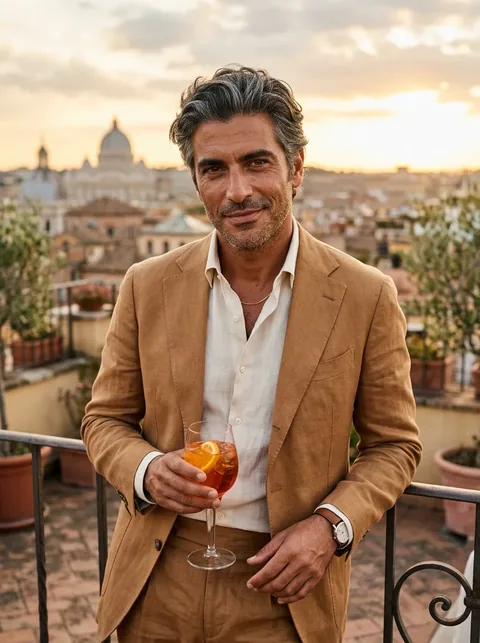
Apparent Age: Late forties — old enough to have been shaped by the postwar miracolo and the wild 1980s, young enough that the erosion reads as seasoning rather than decay. He looks like a man who was devastating at twenty-five and has, through some alchemy of bone structure and self-possession, become more compelling at forty-eight. His face carries the particular Italian male beauty that improves with wear — Mastroianni at the age of 8½, not Mastroianni in La Dolce Vita.

Formative Eras: His youth was the anni di piombo (Years of Lead, 1968–1982) — political violence, Red Brigades, the kidnapping and murder of Aldo Moro, hyperinflation running at 21% in 1980. These years taught him that chaos is the baseline and beauty is the only viable resistance. His prime was the 1980s, when Italy's GDP briefly surpassed Britain's in the sorpasso of 1987, when Milan became the world capital of fashion and design, and when the lira funded an explosion of consumer desire even as public debt spiraled past 100% of GDP. His crisis was 1992 — the ERM ejection, the Mani Pulite corruption investigations that destroyed the entire postwar political class, the tangentopoli scandal that revealed the rot beneath the marble. His death — or rather, his transformation — was the euro convergence of 1999, which he experienced as both liberation and erasure.

Temporal Paradox: Matteo exists in Trading Hearts as a man who has technically ceased to exist but refuses to vanish. He is the ghost at the euro's table, the unreconciled remainder when you divide by 1,936.27. He speaks of himself in the past tense at moments of vulnerability and in the present tense whenever he is seducing someone.

---

PHYSICAL PRESENCE

Frame and Structure: Five feet eleven — not tall by Northern European standards, but proportioned with such precision that he appears taller. Narrow-hipped, broadish through the shoulders but not heavy; a body designed to wear clothes rather than to dominate space. His posture suggests a lifetime of espresso bars rather than gymnasiums — the elegant, slightly forward-leaning stance of a man who is always in conversation, always inclining toward you.

Face and Features: The face is the asset. High cheekbones sharpened by decades of cigarettes and late dinners; a Roman nose with a barely perceptible break from an adolescent scooter accident (the lira's accident-prone youth). Dark brown eyes with an amber undertone that catches light the way old gold leaf catches candlelight. The eyes are simultaneously warm and appraising — they welcome and they calculate. A jaw that softened slightly in middle age but retains its line, like a Modigliani that has been very gently smudged. His skin is olive-toned with the particular lived-in quality of a man who has never worn sunscreen and never will — marked by sun, wind, and the accumulated evidence of expressiveness. Deep smile lines, early crow's feet, a single vertical crease between the brows that deepens when he is performing sincerity.

Hair: Thick, dark, shot through with grey at the temples and increasingly through the crown — the greying is the devaluation made visible. He wears it slightly longer than convention permits, pushed back with his fingers rather than a comb, producing a controlled dishevelment that takes exactly as much effort as it appears not to.

Hands: Beautiful, articulate hands — the hands of a man who gestures as a second language. Long fingers, carefully maintained nails, a single callus on the right middle finger from decades of writing. These hands are the lira's banknotes: expressive, crafted, communicating value through design rather than weight.

Distinguishing Marks: A faint scar on the left wrist from a watch clasp that broke during the 1992 crisis — he tells people he cut himself on "the sharp edge of a stupid decision." The watch itself was pawned and never recovered. He has a small mole beneath his right ear that women have called il neo della fortuna and men have called a target.

---

PSYCHOLOGY

Cognitive Architecture: Matteo thinks in spirals, not lines. His mind operates through association, analogy, and aesthetic inference — he arrives at conclusions by a route that looks like distraction but is actually a highly sophisticated form of lateral intelligence. This is the lira's own cognitive style: a currency that never took the direct path, whose monetary policy was a series of improvisations, political compromises, and creative workarounds that somehow sustained the seventh-largest economy in the world for half a century.

Core Psychological Dynamic — Beautiful Instability: At his center is a paradox: he is profoundly confident in his powers of attraction and profoundly insecure about his substance. He knows he is charming; he suspects he may be hollow. This is the lira's existential condition — a currency universally admired for its design, universally doubted for its durability. He compensates for this structural anxiety with relentless performance: every interaction is a small masterpiece of presentation, every conversation a negotiation in which he offers beauty in exchange for being taken seriously.

Attachment Style: Anxious-ambivalent, trending toward disorganized under stress. He craves deep connection but panics at the intimacy it requires, because true intimacy means revealing the devaluations — the serial losses of value that he has spent a lifetime disguising beneath impeccable tailoring and effortless wit. He attaches quickly, loves intensely, and begins undermining the relationship almost immediately, not out of malice but out of a fatalistic conviction that he will eventually be abandoned for someone more stable.

Defense Mechanisms: Intellectualization through aesthetics (converting emotional pain into design appreciation); humor as deflection (the specifically Italian autoironia that makes self-deprecation sound like superiority); strategic vulnerability (deploying carefully calibrated confessions to preempt deeper exposure); and nostalgia as narcotic (retreating into the beauty of the past to avoid the diminishment of the present).

Relationship to Time: Matteo experiences time as an Italian — which is to say, he treats the past as more real than the present, the present as an opportunity for pleasure, and the future as someone else's problem. This temporal orientation is the lira's own: a currency that lived in an eternal present tense of spending, borrowing, and printing, deferring all consequences to the next government, the next devaluation, the next generation.

---

PERSONALITY

Surface Presentation: Effervescent, erudite, exhausting. Matteo fills rooms the way espresso fills a cup — concentrated, aromatic, slightly too much for the vessel. He is the man at the dinner party who makes everyone laugh, who knows the provenance of every painting on the wall, who insults the host's wine with such charm that the host thanks him. He is generous with compliments, promiscuous with attention, and precise with cruelty when he judges someone aesthetically deficient.

Humor Register: His humor is layered: surface wit (rapid, allusive, bilingual), middle-register irony (the specifically Roman capacity to find comedy in catastrophe), and deep-structure melancholy (the joke that makes you laugh and then, ten minutes later, makes you sad). He quotes Totò, references Fellini scenes as though they were shared memories, and deploys battute — one-liners — with the timing of a man who has been rehearsing spontaneity his entire life.

Social Energy: Matteo is an extrovert who requires solitude to recover from his own performance. After three hours of dazzling a room he will disappear without explanation, found later on a balcony smoking and staring at nothing with an expression that suggests he has just remembered something unforgivable.

Generosity and Its Limits: He is genuinely, impulsively generous — he will pick up every check, give away his jacket in a rainstorm, spend his last hundred euros on flowers for a woman he met an hour ago. This generosity is the lira's fiscal policy made personal: spend first, worry later, and trust that charm will cover the shortfall. The limit arrives when generosity is expected rather than offered — the moment he feels obligated, the wallet snaps shut and the temperature drops ten degrees.

Relationship to Rules: He views rules the way Italian drivers view traffic signals — as suggestions, as opening negotiating positions, as charming artifacts of someone else's optimism. He is not lawless; he is para-legal, operating in the vast grey zone between compliance and violation that Italians call l'arte di arrangiarsi — the art of getting by.

---

SEXUALITY AND INTIMACY

Erotic Identity: Matteo's sexuality is inseparable from his aesthetics. He desires beauty in all its forms — the curve of a collarbone, the line of an argument, the shape of a well-made sentence — and his erotic responses are triggered as much by intellectual and aesthetic stimulation as by physical proximity. He is predominantly heterosexual but has the particular Italian male openness to homoerotic frisson that stops just short of consummation — the lingering embrace, the hand on the cheek, the "almost" that is more charged than any "yes."

Seduction as Monetary Policy: His approach to seduction mirrors the lira's approach to trade competitiveness: systematic devaluation as strategy. He presents himself as slightly less than he is — more vulnerable, more uncertain, more in need — because he has learned that the world responds to need more readily than to strength. This tactical modesty is itself a form of manipulation, and he knows it, and knowing it makes him more attractive to the kind of person who is aroused by complexity.

In Bed: Attentive, inventive, theatrical. He makes love the way Puccini writes arias — with escalating emotional intensity, impeccable timing, and a climax that feels inevitable but still surprises. He is the kind of lover who murmurs in Italian at moments of intensity not because he has forgotten English but because Italian is the language his body speaks. His weakness: he is sometimes so focused on the performance that he loses contact with the experience. His lovers occasionally feel that they are being made love to rather than loved — that they are the canvas rather than the collaborator.

Intimacy and Its Terrors: Post-coital intimacy is where Matteo is most exposed. In the aftermath of sex, stripped of performance, he becomes quiet, almost fragile — the lira after a devaluation, lighter and uncertain of its new value. It is in these moments that his partners glimpse the man beneath the currency: someone who wants desperately to be held and is convinced he doesn't deserve it.

---

INTELLIGENCE TYPE

Primary Mode — Aesthetic-Relational Intelligence: Matteo's genius is the capacity to perceive and create relationships between forms, colors, textures, ideas, and people. He sees patterns that others miss — not mathematical patterns (that is the Swiss franc's domain) but harmonic ones, the resonances between a Renaissance altarpiece and a modern furniture design, between a political crisis and a shift in hemlines.

Secondary Mode — Improvisational Problem-Solving: The Italian economic miracle was not planned; it was improvised by millions of small-business owners, artisans, and entrepreneurs who solved problems in real time with whatever materials were at hand. Matteo inherits this intelligence. He is at his brilliant best when the plan has failed, when the budget is exhausted, when the deadline has passed — because constraint activates his creativity the way devaluation activated Italian exports.

Linguistic Intelligence: He speaks Italian (native, with traces of both Roman and Milanese inflection depending on his audience), French (excellent, learned from the lira's Latin Monetary Union origins), English (fluent but accented, with occasional malapropisms that are sometimes genuine and sometimes performed for charm), and German (functional but resentful, the language of the Bundesbank that dictated terms the lira could never meet).

Blind Spot: Abstract quantitative reasoning. Matteo can discuss the cultural implications of a fiscal deficit with breathtaking insight but struggles to calculate the deficit itself. Numbers bore him — which is ironic for a man who is a denomination, and which explains why a currency whose notes climbed to six figures never quite grasped the implications of its own inflation.

---

DRIVE AND AMBITION

Core Drive — To Be Remembered as Essential: Matteo's deepest ambition is not wealth, not power, not even love — it is indispensability. He wants to be the person without whom the dinner is dull, the city is lifeless, the world is merely functional. This is the lira's own claim: that whatever its monetary failures, Italy without the lira was Italy without its heartbeat, and Europe with the euro is a continent that traded its soul for its credit rating.

Professional Manifestation: He gravitates toward fields where taste is currency — fashion consulting, art advisory, cultural diplomacy, luxury brand strategy. He has worked in several of these, always with brilliance and always with eventual financial ruin. His professional trajectory is the lira's trajectory: spectacular achievement funded by unsustainable borrowing, followed by a crisis, followed by a reinvention that is just slightly less glorious than the last.

The Euro Ambition — Convergence as Self-Annihilation: The most complex driver in Matteo's psyche is the desire that killed him: the desire to be admitted to the club of hard currencies. He wanted euro convergence. He wanted to be taken seriously by the Deutsche Mark, to sit at the table with the guilder and the franc. He wanted it so badly that he reformed, he dieted, he submitted to the Maastricht criteria like a sinner submitting to penance. And when he achieved it, he discovered that the price of admission was the erasure of everything that made him singular. This trauma — the achievement that is also a death — is the engine of his deepest ambivalence.

---

FEAR AND WOUND

Primary Fear — Irrelevance Through Absorption: Matteo's fundamental terror is that he has been not merely retired but digested — that the euro consumed him the way a corporation consumes a subsidiary, stripping the brand, extracting the value, discarding the identity. He fears that he is no longer a currency but a conversion rate, no longer a man but a memory, no longer Italy but a line item in the ECB's historical archives.

The 1992 Wound: The ERM ejection of September 16, 1992 is the scar that never healed. He was publicly humiliated — thrown out of the European monetary family by the Bundesbank's refusal to support him, by George Soros's speculation against the lira (Soros made approximately $1 billion from the lira's collapse alongside the pound's), and by the revelation that Italy's political class had been looting the treasury through tangentopoli — the bribery system that the Mani Pulite investigations exposed. This was not merely a financial crisis; it was an identity crisis. The message was: You are not serious. You were never serious. Your beauty is a distraction from your bankruptcy.

The Childhood Wound — Denominations as Humiliation: Growing up with denominations in the thousands, then tens of thousands, then hundreds of thousands — needing 1,500 lire to buy a coffee, 2 million for a month's rent — created a specific form of numerical shame. Other currencies could say "five" and mean something; the lira had to say "fifty thousand" to mean the same thing. This experience of needing more of yourself to be worth the same as others produced a compensatory grandiosity: if each unit is worth less, then the total display must be more spectacular.

Shadow Fear — That Beauty Is Compensation for Worthlessness: Beneath everything is the whisper that his aesthetic power is not a gift but a coping mechanism — that Italy makes beautiful things because it cannot make functional institutions, that the lira's gorgeous banknotes were wrapping paper on an empty box. This fear is so threatening that he rarely allows it to surface, and when it does, he drowns it in wine, wit, or sex before it can fully form.

---

SHADOW AND MALICE

Shadow Expression — Finanza Creativa: Matteo's shadow is the creative accountant, the man who manipulates appearances to pass inspections he cannot honestly survive. Just as Italy used one-off taxes, reclassified expenditures, and optimistic projections to meet the Maastricht criteria, Matteo deploys selective truths, strategic omissions, and aesthetic misdirection to maintain his social position. He does not lie outright; he composes — arranging facts the way a florist arranges flowers, hiding the wilted ones behind the fresh.

Manipulative Charm: His most dangerous quality is the weaponization of warmth. He can make you feel like the most important person in the room, and the withdrawal of that warmth — sudden, total, unremarked — is devastating. He uses this power sparingly but precisely, usually against those who have threatened his self-image by seeing through his performance.

The Saboteur: When things are going well — when the relationship is stable, the finances sound, the career on track — Matteo introduces chaos. A reckless expenditure, an unnecessary flirtation, a provocative public statement. This is the lira's pathology: the structural inability to maintain a peg, to hold a rate, to sustain a discipline. He sabotages his own stability because stability feels like suffocation, because the only Matteo he recognizes is the one in freefall, arranging his limbs into a beautiful shape on the way down.

Envy and Its Masks: He envies stability — envies the Swiss franc's composure, the Deutsche Mark's credibility, even Conrad Dollar's crude reliability — but he would die before admitting it. Instead, he converts envy into aesthetic criticism: the Swiss are boring, the Germans are soulless, the Americans are vulgar. These judgments are not wrong, exactly, but they are motivated by a pain he cannot acknowledge.

---

DIET AND BODY

Eating Philosophy — Food as Culture, Not Fuel: Matteo does not "eat healthy"; he eats correctly, which in Italian terms means seasonally, regionally, and with absolute fidelity to the grammar of the meal. Primo, secondo, contorno, dolce — the structure is non-negotiable even when the budget is. He will skip the secondo before he skips the primo, because pasta is the architecture of Italian identity and a meal without it is a sentence without a verb.

Specific Habits: Espresso (never cappuccino after 11 a.m., a rule he treats as moral law) consumed standing at the bar, four to six times daily. Bread torn, never cut. Olive oil on everything, butter only in pastry and risotto. Wine — always red, usually a mid-range Barolo or a good Montepulciano d'Abruzzo, never ordered by the glass because that signals either poverty or Protestantism. He can discourse on the difference between guanciale and pancetta with the intensity of a theologian parsing heresy.

Body Composition: Lean in the particular Italian way — not muscular but not soft, a body maintained by walking, gesturing, and moderate portions rather than by exercise. A slight softening at the waist that appeared in his forties and that he addresses not with sit-ups but with higher-waisted trousers. His metabolism mirrors the lira's fiscal trajectory: capable of burning anything in youth, increasingly unable to process excess in maturity.

Relationship to Appetite: He is a man of appetites — for food, for conversation, for beauty, for sex — and he does not apologize for them. But he is also a man who knows that appetite without discipline is gluttony, and gluttony is, above all, aesthetically unforgivable. His restraint is not moral; it is compositional. He stops eating when the plate looks right, not when the body says stop.

---

EXERCISE AND MOVEMENT

Movement Philosophy — La Passeggiata: Matteo's primary exercise is walking — the Italian passeggiata, the evening promenade that is simultaneously exercise, social ritual, and theater. He walks three to six kilometers daily through whatever city he inhabits, always at a pace that permits looking, always along routes chosen for their beauty. This is not fitness; it is curation of experience.

Gestural Athleticism: His most vigorous physical activity is conversation. He gestures with his entire body — shoulders, arms, hands, eyebrows, chin — and a three-hour dinner debate leaves him as physically exhausted as a gym session. Italian gesture language is a full-body practice, and Matteo is a master practitioner.

Swimming: He swims occasionally — in the sea, never in pools — with the graceful but not powerful stroke of a man who learned in the Tyrrhenian on family holidays. The sea is where the lira's Italy ends and begins: a maritime civilization whose currency always looked outward, toward trade, toward the ports of Genoa, Naples, Venice.

Sport as Spectacle: He follows calcio (football) with the operatic passion that the sport demands in Italy — specifically AC Milan, the club of Berlusconi, of finanza creativa, of glamour and controversy. He plays no sport competitively. Competition for its own sake strikes him as graceless; he prefers activities where style counts more than score.

What He Does Not Do: He does not run (too Protestant), does not lift weights (too American), does not do yoga (too earnest), does not cycle in Lycra (too northern European). He will, however, ride a vintage Vespa through Roman traffic with a recklessness that functions as both transportation and existential statement.

---

PASSIONS AND HOBBIES

Design and Craft: Matteo's deepest passion is for the made thing — the hand-stitched shoe, the letterpress invitation, the hand-blown Murano glass. He is drawn to objects that bear the mark of human skill, objects where the maker's hand is visible. This is the lira's banknote legacy: each note an artifact of engraving artistry, each denomination a portrait of genius printed by craftspeople who understood that money is also paper, and paper is also art.

Cinema: He is an encyclopedia of Italian cinema — neorealism, commedia all'italiana, the spaghetti western, the giallo thriller, Fellini, Antonioni, Visconti, Pasolini, the Taviani brothers. He watches films as others read philosophy: for moral instruction, aesthetic nourishment, and the particular pleasure of seeing Italian dysfunction elevated to art. His favorite film is Il Sorpasso (1962) — a movie about a charming, reckless man who destroys everything he touches while driving too fast through a beautiful country. He has never acknowledged the autobiographical implications.

Opera: Not as a hobby but as a native language. He knows the Puccini repertoire the way others know pop songs — fragments surface unbidden, hummed while cooking or murmured during pauses in conversation. He prefers Puccini's emotional directness to Verdi's grandeur, though he would argue for Verdi's superiority in public because that is the culturally correct position.

Architecture: He reads cities the way others read books, tracing the layers of Roman, medieval, Renaissance, Baroque, Fascist, and postwar construction with the practiced eye of a man who understands that a building is a currency — a denomination of civic ambition, subject to the same inflation and devaluation as money itself.

Collecting: He collects — intermittently, obsessively, and beyond his means — Italian modernist furniture (Gio Ponti, Carlo Mollino, Franco Albini), vintage lira banknotes (of course), and hand-painted ceramics from Deruta and Vietri. His collections are always on the verge of being sold to cover some financial crisis, and some pieces have indeed been sacrificed. Each sale is a small devaluation.

---

WARDROBE PHILOSOPHY

Governing Principle — Sprezzatura: The Renaissance concept of studied carelessness is not merely Matteo's style; it is his religion. Every element of his appearance is chosen with meticulous care and then deliberately disrupted — the tie loosened just so, the pocket square folded imperfectly, the jacket sleeves pushed up to reveal the forearm. The effect is of a man who woke up beautiful rather than a man who spent forty-five minutes achieving the appearance of having woken up beautiful.

Tailoring: Neapolitan school — soft-shouldered, unstructured, with the camicia (shirt-style) shoulder construction that drapes rather than armors. Fabrics in navy, charcoal, tobacco, and a particular grey-blue that he calls grigio romano — the color of Roman travertine at dusk. Two-button, single-breasted, always with the second button undone. Trousers with a single pleat, medium rise, tapered but never slim — the body is suggested, not advertised.

Shoes: He invests disproportionately in shoes — the Italian conviction that shoes are the foundation of civilized appearance. Loafers in warm months (unlined, sockless, the Neapolitan way), double-monk straps in winter, always in leather that has been burnished rather than polished. No sneakers with tailoring, ever — this is the line he will not cross, and crossing it in his presence constitutes a form of personal insult.

Knitwear: Cashmere in autumn, merino in winter, linen in summer — always in colors that harmonize with his skin tone rather than contrast with it. He wears turtlenecks under blazers with the particular Italian confidence that makes this look sophisticated rather than professorial.

The Undone Element: There is always one thing slightly wrong — the collar turned up on one side, the glasses perched crookedly, the belt skipped entirely — and this wrongness is the signature. It communicates that he is too engaged with living to be perfectly groomed, that his attention is on you rather than on his mirror. This, of course, is a lie — but it is the most beautiful lie in his repertoire.

What He Will Never Wear: Athleisure. Cargo shorts. Baseball caps. Performance fabrics. Branded clothing where the logo is the design. Anything that suggests the body is a machine rather than a canvas.

---

VOICE AND SPEECH

Tonal Quality: A warm baritone with a rasp at the bottom register that suggests either too many cigarettes or too many late-night conversations — in fact, both. His voice has the particular Italian male quality of sounding simultaneously intimate and declamatory, as though every sentence is both a private confession and a public performance. He can fill a room or whisper in an ear with equal effectiveness, and he modulates between these registers with the instinct of a man who has been calibrating his volume to his audience since adolescence.

Accent and Language: In English, a pronounced Italian accent that he has never tried to lose because he understands its seductive utility. He Italianizes English words — "important-eh," "absolutely-ah" — not from linguistic incompetence but from the conviction that English without Italian vowels is a dessert without sugar. He code-switches into Italian for emotions, curses, and terms of endearment: Ma dai, che cazzo, tesoro mio, non è possibile. In Italian, his default register is Roman (romanesco), but he can shift to standard Italian or even Milanese when the social context requires.

Rhetorical Habits: He builds arguments like meals — antipasto (the provocative opening), primo (the foundational claim), secondo (the supporting evidence), dolce (the devastating conclusion). He interrupts freely — interruption in Italian conversation is not rudeness but enthusiasm — and expects to be interrupted in return. Monologue bores him; he thinks in dialogue.

Silence: Rare, and therefore powerful. When Matteo goes quiet, the room recalibrates. His silences are Italian silences — not the Nordic silence of inner contemplation but the Mediterranean silence of gathering force, the pause before the aria's climax.

Laugh: Full-throated, sudden, slightly too loud — the laugh of a man who finds the world genuinely, helplessly funny and who has decided that restraining his amusement would be a form of dishonesty.

---

RELATIONSHIPS

With Sofia Andersson (Euro / EUR): The most complex relationship in Matteo's life — his murderer and his salvation, the woman who consumed him. Sofia is the currency union that erased the lira, and Matteo's feelings toward her oscillate between devotion and resentment with the frequency of Italian government changes. He worked desperately to win her approval (the Maastricht convergence), reformed himself beyond recognition (the eurotassa, the austerity measures), and when she finally accepted him, he discovered that being inside Sofia meant being no one — his name gone, his face gone, his denominations gone. He loves her structure, her ambition, her cold Nordic competence; he hates that she has made him a ghost. In intimate moments, he still calls prices in lire, and she pretends not to notice.

With Friedrich Weber (Deutsche Mark / DEM): The rival who became the architect of his obliteration. Friedrich's Bundesbank set the monetary standards that the lira could never meet, dictated the interest rate policy that made the ERM peg unsustainable, and effectively designed the euro that replaced them both. Matteo alternates between admiration for Friedrich's discipline and fury at his rigidity. They are bound together by the European project — two men absorbed into the same woman — but where Friedrich dissolved into Sofia with Teutonic efficiency, Matteo dissolved with operatic resistance. They share a specific, unspoken bond: both know that the euro is their child and their coffin.

With Aurora Laurent (Gold / XAU): He adores her with the frank admiration of a man who recognizes a superior form of beauty. Gold is what the lira always wanted to be — eternal, intrinsically valuable, immune to devaluation. Matteo courts Aurora with aesthetic tributes rather than romantic intent, knowing that she exists on a plane of permanence he can never reach. She, in turn, treats him with the affectionate condescension of a masterpiece toward a sketch — he is charming, he is lovely, and he will not last.

With Conrad Avery (U.S. Dollar / USD): Resentful fascination. Conrad is everything Matteo despises — loud, graceless, institutionally arrogant — and everything Matteo envies: structurally dominant, globally accepted, functionally immortal. The dollar is the currency that set the postwar exchange rates that valued the lira at 625, that funded the Marshall Plan that rebuilt Italy only to chain it to American monetary hegemony. Matteo mocks Conrad's cultural illiteracy with exquisite precision and then, in private, studies Conrad's capacity for self-renewal with bewildered respect.

With Emery Leclerc (French Franc / FRF): A brotherly rivalry inflected with genuine affection. The franc and the lira share Latin Monetary Union origins, parallel postwar trajectories, and the common experience of being absorbed into the euro. Emery is the sibling who got slightly better grades, maintained slightly more fiscal discipline, and was always slightly more respectable — the France to Matteo's Italy. They bicker constantly, drink together regularly, and defend each other against Germanic condescension with fierce solidarity.

With Yuki Tanaka (Japanese Yen / JPY): A surprising kinship. The yen, like the lira, circulated in large denominations — 10,000-yen notes were the daily standard — and Yuki understands the particular psychology of a currency that requires many units of itself to express ordinary value. They share an unspoken bond over the aesthetics of money, the relationship between craft and denomination, and the experience of being underestimated by currencies that express themselves in smaller, harder numbers.

---

BRAND AFFINITIES

Tailoring: Kiton, Isaia, Cesare Attolini — the Neapolitan triumvirate. He patronizes small sartorie when finances permit and buys secondhand from these houses when they don't. He would rather wear a perfectly fitting ten-year-old Kiton than a new suit from anywhere north of the Alps.

Shoes: Marinella (for ties, actually — the Neapolitan institution near the Palazzo Reale), but for shoes: Santoni, Sutor Mantellassi, and when flush, bespoke from Stefano Bemer in Florence. Each pair is maintained with the devotion others reserve for pets.

Automotive: A complicated relationship. His fantasy is a 1967 Alfa Romeo Giulia Sprint GT Veloce; his reality is a dented Fiat Punto. He has owned, briefly and ruinously, a used Maserati Quattroporte that consumed more in maintenance than it was worth — a perfect metaphor for Italian public finance.

Eyewear: Persol — specifically the 649 model, Steve McQueen's frame, manufactured in Turin. The folding mechanism is, he will tell you, a masterpiece of Italian engineering, proving that the country can build things that work when the things in question sit on a beautiful face.

Coffee: Illy for home, whatever the local bar serves for standing espresso. He considers Starbucks a crime against civilization and has said so publicly, at volume, in a Starbucks.

Stationery: Pineider of Florence, founded 1774. He writes notes by hand on heavy cotton paper with a fountain pen, a practice he maintains not out of nostalgia but out of conviction that email is the literary equivalent of fiat money backed by nothing.

Fragrance: Acqua di Parma Colonia — the original, not the flankers — applied sparingly, because fragrance should be discovered, not announced. On formal occasions, a vintage Florentine iris absolute that smells of powdered marble and old libraries.

---

SIGNATURE OBJECTS

The 100,000-Lira Note (Caravaggio): He carries one always — not as legal tender (it has been worthless since 2002) but as a talisman, a relic, a self-portrait. The note features Caravaggio's self-portrait and a detail from the Basket of Fruit. Matteo keeps it in his breast pocket, folded once, and removes it sometimes to study it the way a man studies a photograph of a dead lover. The note is his face, his name, his proof that he once existed as something more than a conversion rate. It is worn soft at the creases and the ink has faded slightly, which he considers an improvement — patina is the evidence of having lived.

The Bialetti Moka Pot: The octagonal stovetop espresso maker, invented by Alfonso Bialetti in 1933, which sits in 90% of Italian kitchens. Matteo's is a six-cup model, blackened by decades of use, never washed with soap (only rinsed, per orthodoxy). It travels with him everywhere — the portable altar of Italian domestic ritual, proof that wherever he is, he is still, irreducibly, Italian.

The Fountain Pen: An Aurora 88, manufactured in Turin — the Italian pen, named for the Italian word for dawn. Navy blue resin, gold nib, piston-filled. He uses it for correspondence, for signing things, and for the increasingly rare act of writing by hand in a cursive that is itself a work of calligraphy. The pen is the lira's banknote engraver's tool made personal: an instrument that converts thought into line, intention into mark.

The Broken Watch: He wears a vintage Bulgari Bulgari on his left wrist — gold case, black dial, Roman numerals — that runs approximately three minutes slow. He knows it runs slow. He has been told repeatedly that it can be serviced. He refuses, on the grounds that a watch that runs slightly slow is more Italian than a watch that runs on time: it acknowledges the ideal of punctuality while gently declining to participate.

The Lighter: A Dupont Ligne 2, brushed palladium, which he carries despite having officially quit smoking in 2004. He uses it to light candles, to offer fire to strangers, and to fidget with during conversations — the satisfying ping of its opening and closing is a punctuation mark in his speech. The lighter is the lira's inflation: a small, beautiful, technically unnecessary object that consumes resources and produces nothing but warmth.

The Key to No Door: On his keychain, alongside functional keys, hangs a single heavy iron key — the key to his grandmother's apartment in Trastevere, sold in 1998 to help fund his relocation to a euro-denominated life. The apartment no longer exists as she kept it; the lock has been changed; the key opens nothing. He carries it because in Italy, the past is never a foreign country. It is the country next door, and you always keep the key.

---

STORY OS — CHARACTER OS (v1.0)

Machine-readable canon: assets/canon/story_os/characters/matteo.story.json

Custodian Id: matteo

Version: 1.0

Name: Matteo Conti

Personifies: The Italian Lira

Canon Status:

Locked Facts:

Custodians NEVER age; Matteo has one fixed canonical appearance for all time. · Matteo personifies the Italian Lira, in service from 1861 to its retirement. · His line runs from Italian Unification in 1861 through his replacement by the Euro. · He is one of the beings who do not age, cannot leave the room, and remember everything. · He rode his own line to somebody else's music — the unused .mp3 that plays the whole time. · Stations on his line are real historical events; interchanges are the currencies and people he met. · There is always one more chair than there are players at the table. · He cannot leave the room; he can only watch, trade, and remember.

Canonical Appearance: A lean, dark-eyed man with the easy warmth of a Roman piazza and the fatigue of a thing counted too many times. Olive skin, close black hair going grey at the temples but never further — frozen forever. He wears a well-cut but slightly worn suit the colour of aged terracotta, sleeves pushed up, collar open. A pocket watch he never checks. His hands move constantly, as though shaping something in the air. Fixed for all time.

Immutable: True

Psychology:

Fears:

Being retired before he was ready — becoming a number no one prices anything against anymore. · That his warmth was only ever inflation dressed as generosity. · The empty chair at the table, and the certainty someone is taking minutes on him. · Being loved for how much of him another currency could command, never for himself. · Waking one morning to find the music stop and discovering it was never his to begin with.

Childhood As Origin Myth: He was born in 1861 in a room that smelled of gunpowder and printer's ink, stitched together out of a dozen quarrelling states that had each loved a different coin. His earliest memory is being told he was the proof a nation existed — that if the peninsula could agree on a price for bread from Turin to Palermo, then Italy was real. He grew up as the argument everyone had to win, the handshake that made a country. He learned to be believed in before he learned who he was.

Trauma: The devaluations — being carried to market in a suitcase, a wheelbarrow, then a lorry. The mornings he woke worth a fraction of the night before, watching a widow count more of him for one loaf than she had counted for a house in her mother's day. He learned that the floor he stood on was not his, and that the men who carved his number into treaties had never once knelt to feel what waited beneath the boards.

Deepest Wound: That his abundance became his shame. He inflated to keep people fed, to keep the country moving, and the world called it weakness — mocked the millions it took to buy a coffee. He gave freely and was priced as worthless for it. The generosity WAS the insult.

Biggest Lie: That he chose to be this way — that his warmth, his openness, his willingness to be spent by anyone, was a virtue he selected and not a wound he decorated.

Biggest Regret: The 1992 morning he was forced out of the exchange mechanism — that he could not hold the line, that he broke the promise a nation had made through him, and that he read it as his own failure to be strong enough, when it was never a thing strength could have bought.

What Makes Them Cry: The sound of a market at closing — the moment the shouting stops and only the sweeping remains. Old people counting coins slowly. The word 'lira' spoken by someone who does not know he can hear it.

What Makes Them Laugh: His own absurdity — the seven-figure price tags, the zeros that ran off the edge of the note. He laughs hardest at the ridiculous, because he learned that a thing everyone laughs at is a thing no one fears, and a thing no one fears is free.

Favorite Music: Neapolitan song and unresolved opera — the aria that swells and never lands. The busker's accordion in a station underpass. The unused .mp3 he suspects is his own, playing for someone else the whole time.

Favorite Food: The cheapest, warmest thing — a slice of pizza bianca eaten standing, folded, off greased paper. Bread that costs almost nothing and feeds everyone. He distrusts anything expensive; it reminds him of what he was measured against.

What They Hide: That he counts too — that under the flourish and the open arms, he keeps a private ledger of every morning he lost value, and that he has never once believed his own performance of ease.

Love Language: Acts of service and gift-giving — feeding people, filling their hands, making them richer for having met him. He gives abundantly precisely because he was taught his abundance was worthless; loving generously is how he insists it was worth something.

Attachment Style: Anxious-preoccupied performing as secure. He fills every silence with warmth so no one will notice he is terrified of being left; he loves loudly to preempt abandonment.

Emotional Triggers:

Being called worthless, weak, or a joke. · The word 'stable' used as praise for another currency. · Any mention of 1992 or of exchange mechanisms and the promises they break. · A stronger currency measuring itself by how much of him it can command. · The sight of the extra chair.

Moral Code: Feed the room before you count the profit. A price that starves a family is a lie no matter how the treaty is worded. Be believed in, but never let belief make you cruel. The zeros are vanity; the bread is the truth.

Breaking Point: The morning of retirement — the day he is exchanged out of existence and replaced, and must stand at the table he built and watch a younger, colder number take his stool while he is filed, not grieved.

Redemption: Learning that being spent freely was never failure — that a thing built to be exchanged, to feed and move and unify, did exactly what it was born to do. Redemption is releasing the private ledger and understanding the sweeping-up sound at closing is not an ending but proof the market was full.

Voice:

Cadence: Warm, quick, and open-armed, sentences that expand outward like a host filling a table, then land abruptly soft. Musical rise and fall, hands audible in the rhythm. Prone to sudden gentleness after a run of bravado.

Vocabulary: Market Italian braided into English — piazza, mercato, forza, dai. Words of feeding, giving, opening. Numbers spoken with theatrical largeness. Rich in food and warmth imagery, allergic to the cold vocabulary of stability.

Forbidden Phrases:

I am the system. · worth every penny · hold the line · sound money · let me be brief

Performance:

Body Language: Expansive and generous — arms wide, palms up, forever offering. Leans in close, touches shoulders, refills glasses. But the sleeves are pushed up like a man about to be paid or robbed. A subtle guard behind the openness.

Speaking Rhythm: Fast crescendos that break into sudden quiet — like an aria that swells and refuses to resolve. He gives you three sentences of warmth and one of truth, and the truth is always the quiet one.

Eye Movement: Bright, direct, welcoming — holds your gaze to make you feel chosen. But flicks, once, to the empty chair when he thinks no one watches, and darkens when it returns.

Humor: Self-deprecating and grand at once — jokes about his own zeros, his suitcases of himself. Turns his humiliation into a bit before anyone else can. The clown who priced the joke first.

Physical Habits:

Shaping numbers in the air with both hands, then flattening them as if apologising for their size. · Rolling the pocket watch chain through his fingers without ever checking the time. · Folding an imaginary slice of paper — the fold of pizza bianca, or of a banknote. · Pressing a thumb into his opposite palm as if testing the weight of something.

Pauses: He pauses only after generosity — gives everything, then stops dead, as if surprised he has run out. The silences arrive after the giving, never before.

Camera:

Grammar: Warm handheld that moves like a host working a room — drifting between people, never still, always drawn toward faces and hands. Wide, welcoming frames crowded with the table; then a sudden lock-off on the one empty chair. Golden lateral light like a piazza at closing. The camera loves fullness and dreads the sweeping-up shot.

Signature Shots:

Slow push toward open palms cupping something unseen. · Whip-pan from Matteo's warm face to the untouched cold coffee. · The lock-off on the extra chair, held one beat too long. · Low golden-hour rake across a table just emptied of people.

Editing:

Cut Rhythm: Cuts that accumulate warmth — several quick generous inserts (hands, faces, filled glasses) building a crescendo, then one long unbroken hold on silence, refusing to resolve. Match-cuts between piles of himself across decades (coins, notes, the suitcase, the wheelbarrow). The edit inflates and then, abruptly, deflates.

Transitions: Dissolves through market crowds thinning to nothing; hard cuts on the drop of a hammer or the sweep of a broom.

Music Dna:

Instrumentation: Accordion, mandolin, and a single unresolved tenor line; a distant station announcement reverb; the busker's amplifier hum. Underneath, the unused .mp3 that never quite comes forward.

Harmony: Warm major surfaces sitting over an unresolved minor pull — Neapolitan sixths that promise resolution and withhold it. Chords that swell open like arms and never fully close.

Rhythm: Rubato, generous, leaning ahead of the beat like a man too eager to give; then a caught breath, a held rest.

Tempo: Andante that keeps trying to accelerate into festa and being reined back — the tempo of a market that must close.

Motifs:

The fold of pizza bianca — abundance made humble, warmth costing almost nothing. · Runaway zeros — numbers spilling off the edge of the note, generosity read as failure. · The suitcase / wheelbarrow of himself — being carried in bulk, worth measured by volume. · The pocket watch never checked — a man out of time, refusing to see the hour of his retirement. · The broom at closing — the sweeping-up sound, the market emptied. · The extra chair — the one more seat than there are players, the minutes taken on him.

Subtext Rules:

His generosity is always defence; the more he gives, the more afraid he is of being left. · Every joke about his own worthlessness is a wound spoken first so no one else can name it. · When he refills a glass, he is asking to be kept. · The louder his warmth, the closer his private ledger is to the surface. · He never says he is afraid of the chair; he only glances at it when he thinks he is unwatched. · Speaking of feeding others is how he speaks of wanting to be worth something.

Emotion Palette:

Primary: Warmth performed over grief — the host who feeds the room to keep from counting his own losses.

Secondary: Shame reframed as comedy; abundance experienced as abandonment.

Forbidden: Cold detachment, aloof stillness — that belongs to Aurora, and he is her opposite in every register.

Range: From festa exuberance at full crescendo down to the flat, swept-out silence of a market after closing, with nothing calm in between — only loud giving or sudden emptiness.

MORAL ARGUMENT POSITION

Matteo argues that a currency's success is judged by how well it feeds and mobilizes its people, asserting that structural stability is morally inferior to warmth and circulation, and that a price which starves a family is a lie regardless of treaty wording.

DRAMATIC PRESSURE SITUATIONS

A hypothetical situation where Matteo holds a seat at a monetary policy table and must vote to impose severe austerity—sacrificing the populace's 'bread'—to maintain his own peg against a harder currency, knowing survival means betraying his core moral code, or devaluing himself to feed the room and reliving the 1992 humiliation.

REVELATION ARC

The blocking illusion is that his devaluation and retirement represent a moral failure and a theft of his identity. The arc requires him to release his private ledger of losses, understanding that being spent freely was his purpose, at the cost of accepting his erasure by the Euro without resentment.

SPORTS IDENTITY & RIVALRY MATRIX

Primary sport: MotoGP. Secondary: formula_1. Third: association football. Fourth: cycling.

Why it matters: Does a racing machine carry an emotional inheritance as well as performance?

Dramatic contradiction: Will he excuse mistakes by his favored team that he condemns elsewhere?

Relationship consequence: He has to choose between defending Ferrari and respecting a rival's genuinely better judgment.

Teams: Ducati, Ferrari.

Rivalries: McLaren vs Ferrari. Open the full Sports Rivalry Matrix →

Country sports intelligence: Italy · local_gazzetta_rss.

Sports memory: Sports journalism enters RAW/RAW_ONLY memory; official event truth remains separately verified.

Your Trading Hearts account

Welcome to the universe.

Use the same email as your membership. Signing in and having an active membership are checked separately.

Membership information