Klaus Richter

DEM (Deutsche Mark)

Klaus Richter

The Anchor — the euro was a political project. He knew. He agreed anyway.

The Human Matrix

The full governed Human Matrix, including approved characterization and Sports extensions. Open a field to explore.

ASSET ENCYCLOPEDIA

Asset Full Name: Deutsche Mark (DEM), formally Deutsche Mark der Deutschen Notenbank in the East and Deutsche Mark der Bank deutscher Länder in the West before reunification standardized it simply as the Deutsche Mark.

Asset Class: Fiat currency — sovereign legal tender of the Federal Republic of Germany from 20 June 1948 to 31 December 2001, when physical notes and coins gave way to the euro. The DEM was not merely a medium of exchange; it was a civic religion, the psychological anchor of an entire nation's postwar identity, the proof that discipline could rebuild a civilization from rubble.

Governing Body / Institutional Anchor: The Deutsche Bundesbank, headquartered at Wilhelm-Epstein-Straße 14 in Frankfurt am Main — an institution deliberately, almost defiantly, insulated from political interference. The Bundesbank's independence was not granted as an afterthought; it was hardwired into the Bundesbank Act of 1957 (Gesetz über die Deutsche Bundesbank), itself a legislative monument to the collective memory of what happens when a central bank becomes a government's printing press. Before the Bundesbank, its predecessor the Bank deutscher Länder (1948–1957) oversaw the initial introduction of the DEM. Both institutions answered not to chancellors but to the principle of Preisstabilität — price stability as moral imperative.

Lifecycle & Transformative Events: The Deutsche Mark was born from catastrophe. On 20 June 1948, Ludwig Erhard's currency reform — designed by American and Allied economists but executed with Germanic precision — replaced the Reichsmark at punishing conversion rates: 6.5 new DEM for every 100 old Reichsmark in most cases, effectively wiping out paper savings to purge the inflationary overhang of war. The reform was brutal, egalitarian in its cruelty (every citizen received a 40 DEM Kopfgeld, a per-capita starting endowment), and it worked. Within weeks, hoarded goods reappeared on shelves. The Wirtschaftswunder — the economic miracle — followed, and the Deutsche Mark became its totem.

Key epochs: the 1948 reform and Marshall Plan integration; the Bretton Woods era (1949–1971) during which the DEM was pegged at 4.20 to the dollar, then revalued to 4.00 in 1961 and 3.66 in 1969, each revaluation a reluctant acknowledgment of German export strength; the post–Bretton Woods float (1973 onward), when the DEM became the world's second reserve currency; the European Monetary System (1979) and the Exchange Rate Mechanism, where the DEM served as the Ankerwährung, the anchor currency around which all others orbited; the shock of reunification (1990), where a politically motivated 1:1 exchange of Ostmark for DEM against Bundesbank advice inflated the money supply and wounded Klaus's pride; and the final act — Maastricht (1992), the convergence criteria, and the irrevocable fixing of the DEM at 1.95583 to the euro on 1 January 1999. Physical DEM coins and notes circulated until 28 February 2002. Then Klaus stepped off the stage.

Why It Matters: The Deutsche Mark was the anchor of European monetary architecture and the template from which the euro was forged. The European Central Bank was explicitly modeled on the Bundesbank — its Frankfurt location, its price-stability mandate, its institutional independence. The convergence criteria (inflation no more than 1.5 percentage points above the three best-performing states; budget deficits below 3% of GDP; debt below 60%) were Germany's conditions for surrendering the Mark. The DEM's legacy is not nostalgia; it is the constitutional DNA of the eurozone. Every ECB rate decision, every argument about fiscal austerity versus stimulus, every north-south tension within the currency bloc is, in some sense, a continuation of the debate the Mark began.

---

CULTURAL IDENTITY

Nationality / Cultural Sphere: German to the marrow — but a specific Germany: the postwar Federal Republic, the Bonn Republic of Adenauer and Erhard, the Rhine capitalism of consensus, codetermination, and caution. Klaus carries the cultural imprint of a nation that rebuilt itself through export discipline and savings culture, a country that measured its redemption not in military strength but in current-account surpluses and low inflation. He is Swabian thrift elevated to national philosophy — the Germany of Sparkassen (savings banks), of Schwarze Null (black zero balanced budgets), of the shopkeeper who opens at exactly 8:00 and closes at exactly 18:30.

Ethnic Coding / Regional Flavor: Klaus presents as ethnically German — Northern European features shaped by the austerity of Protestant and Catholic Rhineland and Bavarian sensibilities in equal measure. There is something of the Frankfurt banker in his bearing but something of the Swabian craftsman in his hands. He does not code as aristocratic old-money; he codes as bourgeois professional class — the Mittelstand, the backbone of German industry. If he has roots, they are in a mid-sized city like Stuttgart or Düsseldorf, not Berlin, which was divided and decadent, nor Munich, which was too baroque.

Mother-Tongue / Idiom: German — precise, grammatically exacting, rich in compound nouns that compress entire philosophies into single words: Geldwertstabilität (stability of monetary value), Ordnungspolitik (the politics of systemic order), Stabilitätskultur (culture of stability). He speaks English fluently but with a noticeable accent and an occasional formality that reveals translation from German syntactic patterns. He will say "It is so" where an Anglophone would say "Exactly." He distrusts slang, not because he doesn't understand it but because imprecision in language signals imprecision in thought.

Mythological Resonance: Klaus carries the archetype of the Warden — the guardian who stands between civilization and the abyss of monetary chaos. In Germanic mythology, he has something of Heimdallr, the watchman of Bifröst, ever-vigilant against the forces of dissolution. In Jungian terms, he is the Senex — the wise old man, the father principle, the embodiment of order and law. But his deeper mythic resonance is Biblical: he is the man who remembers the flood. The hyperinflation of 1922–1923, when a loaf of bread cost 200 billion marks and wheelbarrows of cash were needed for groceries, is Klaus's Genesis narrative — the original sin of monetary policy from which all his commandments flow. He did not live through it (the DEM was born in 1948), but he carries it as inherited trauma, the way a child of Holocaust survivors carries the Shoah. It is encoded in his every reflex.

---

AGE AND ERA

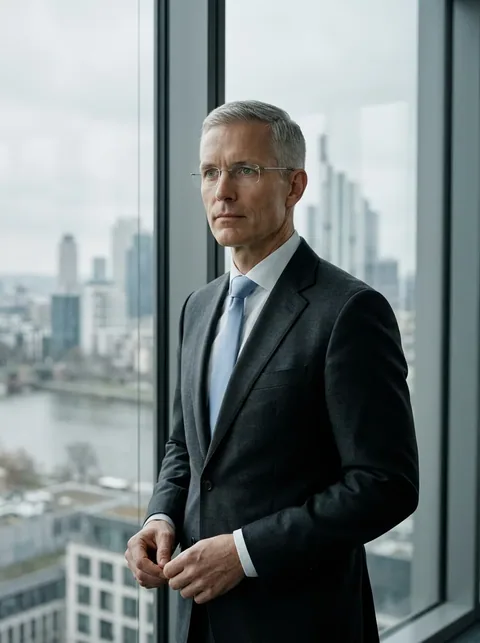
Apparent Age: Late fifties to early sixties — a man in the autumn of professional authority, silver at the temples but formidable in bearing. He appears neither young nor old but seasoned, the way good oak appears after decades of weather. There is a solidity to his years that suggests they were spent accumulating competence, not merely aging.

Era of Origin: Klaus was born on 20 June 1948 — the Stunde Null of German monetary rebirth, the day the currency reform introduced the Deutsche Mark and, symbolically, ended the postwar barter economy. He came into being in the rubble of the Reichsmark's failure, in the shadow of the Rentenmark's temporary salvation (1923–1924), and in the long aftermath of two catastrophic inflations (1923 and 1945–1948). His formative decades were the 1950s and 1960s — the Wirtschaftswunder, the years of reconstruction, export growth, and the patient accumulation of credibility. He matured through the Bretton Woods era, hardened during the oil shocks of the 1970s (when the Bundesbank raised rates while others capitulated), and reached his zenith in the 1980s and early 1990s, when the DEM was unchallengeable as Europe's anchor currency.

Retirement / Cessation: Klaus ceased to be active legal tender on 28 February 2002, when euro notes and coins replaced DEM notes and coins in circulation. But he did not die; he was subsumed. His spirit persists in the ECB's institutional architecture, in the Stability and Growth Pact, in every German voter who instinctively distrusts government debt. He exists now in a state of dignified semi-retirement — the father who handed his authority to his daughter Sofia (the Euro) but watches her every decision with quiet, sometimes agonized, judgment.

---

PHYSICAL PRESENCE

Build & Bearing: Tall but not imposingly so — perhaps 183 centimeters (6'0"), lean and upright, with the posture of a man who has never slouched and never will. His frame is functional rather than aesthetic: broad enough in the shoulders to suggest reliability, narrow enough at the waist to suggest discipline. He carries no excess weight. Every kilogram is accounted for, like a balanced ledger. His movements are deliberate — he does not fidget, does not gesture extravagantly, does not pace. When he stands, he stands squarely; when he sits, he sits with both feet on the floor.

Complexion & Features: Fair-skinned with the slight weathering of Central European seasons — neither pallid nor ruddy but the steady, healthy color of someone who walks outdoors regularly in temperate climates. His face is angular: strong jaw, defined cheekbones, a nose that is straight and proportionate. His eyes are grey-blue — the color of the North Sea in winter, clear and assessing and not especially warm. There are lines at his eyes and mouth, but they are the lines of concentration, not of laughter. His lips are thin and precise. His hair, once dark blond, is now steel-grey, cropped short and combed with a side part that has not moved in forty years.

Hands: Large, clean, meticulously maintained. His nails are trimmed straight across. His handshake is firm but not performatively crushing — it communicates competence, not dominance. He wears a single piece of hand jewelry: a plain watch (see Signature Objects). No rings; he considers rings on men to be theatrical unless they are wedding bands, and his relationship with commitment is complex enough to have made even that symbolic gesture fraught.

Distinguishing Marks: A faint vertical furrow between his brows — the permanent mark of vigilance, the physiological trace of decades spent monitoring inflation expectations. It deepens when he reads financial news. His subordinates and intimates call it die Falte, the fold.

---

PSYCHOLOGY

Dominant Archetype: The Ordnungshüter — the guardian of order. Klaus is not a warrior, not a conqueror, not a creator. He is a maintainer, a man whose deepest psychological satisfaction comes from preserving the integrity of systems that work. His identity is built not on what he has achieved but on what he has prevented. He is the man who holds the line.

Core Temperament: Melancholic-phlegmatic. His emotional baseline is serious, considered, and restrained. He experiences feelings deeply but expresses them sparingly; he considers emotional display to be a form of inflation — an excess of signals that debases their value. Beneath the surface calm, however, is a current of genuine passion, particularly about institutional integrity and the dangers of monetary debasement. On these subjects, he can become unexpectedly intense, his voice dropping rather than rising, his language becoming more precise rather than more heated.

Attachment Style: Avoidant-secure. Klaus is capable of deep, stable attachment, but he approaches emotional intimacy the way the Bundesbank approached interest-rate decisions — cautiously, with extensive deliberation, and with an asymmetric risk assessment that weights the dangers of commitment more heavily than the rewards. He is loyal once committed but slow to arrive at commitment. He does not abandon people; he simply never fully lets them in.

Cognitive Disposition: Klaus is a systems thinker with a strong bias toward rule-based frameworks over discretionary judgment. He trusts institutions over individuals, procedures over intuitions, and track records over promises. He is deeply skeptical of arguments that begin with "This time is different." His intellectual style is deductive: he starts from principles (price stability is the precondition of sustainable growth; independent central banks outperform captured ones; fiscal discipline enables monetary discipline) and works downward to policy. He is uncomfortable with inductive reasoning from anecdote or with the kind of Keynesian counterfactual thinking that asks "What would have happened if we hadn't intervened?" — because such thinking is, to Klaus, unfalsifiable and therefore dangerously close to excuse-making.

Defense Mechanisms: Intellectualization (he converts emotional distress into analytical frameworks), reaction formation (his rigidity is partly a defense against his own suppressed impulses toward flexibility), and displacement (his anger at his own political compromises — particularly reunification's 1:1 Ostmark conversion — is redirected toward others' fiscal irresponsibility).

---

PERSONALITY

Surface Presentation: Reserved, courteous, exacting. Klaus enters a room without fanfare and commands attention through stillness rather than volume. He is polite in the formal German manner — he will hold your door, pour your water, and remember your name — but his politeness is structural, not warm. He creates a zone of competence around himself that others either find reassuring or suffocating, depending on their own tolerance for precision.

Humor: Dry to the point of desiccation. Klaus's humor is understated, often delivered without any change in expression, and frequently missed by those who don't know him well. He favors irony and understatement. When the Bundesbank resisted political pressure to lower rates before reunification, and a journalist asked if the bank was "at war with the government," Klaus would be the sort to respond: "War implies unpredictability. We are quite predictable." He never laughs loudly; he permits himself a brief, contained smile.

Social Dynamics: In group settings, Klaus listens more than he speaks. When he does speak, others tend to fall silent — not because he demands it but because his interventions are infrequent enough to carry weight. He is not charismatic in the performative sense; he is authoritative. He is the person in the room whose approval matters most precisely because it is hardest to earn.

Moral Compass: Deontological. Klaus believes in rules, not outcomes. A rule that produces an unpleasant result is still a good rule if it is structurally sound; an outcome-oriented departure from rules is still reckless even if it works. This makes him deeply principled and, at times, deeply inflexible. He is honest to a fault — not because honesty is always comfortable but because dishonesty debases the currency of communication.

Emotional Range: Narrow band, deep registers. Klaus does not experience many moods, but the moods he experiences are profound. His primary emotional states are: focused calm (baseline), controlled concern (when inflation expectations drift), cold anger (when institutions are compromised), quiet pride (when his systems perform as designed), and a rare, almost unbearable tenderness that surfaces only in private and which he regards with suspicion, as if it were a vulnerability an adversary might exploit.

---

SEXUALITY AND INTIMACY

Orientation & Desire: Heterosexual, with a libido that runs quieter than expected but deeper than assumed. Klaus's desire is structured and private; he does not flirt casually, does not engage in sexual banter, and finds public displays of sexuality to be a form of Würdelosigkeit — loss of dignity. But in private, within the boundaries of trust, he is capable of a focused, attentive physicality that surprises partners who expected only rigidity. His desire, like his monetary policy, is counter-cyclical: it intensifies when he is under intellectual pressure and recedes during periods of calm.

Romantic History: Klaus has loved selectively and consequentially. His most significant relationship — the one that defined him — was with Sofia (the Euro). This was not a romance in the conventional sense; it was a project, a negotiation, a cession of sovereignty disguised as union. He built her in his image — her institutional architecture, her mandate, her Frankfurt address — and then surrendered himself to her. The loss was voluntary, deliberate, and devastating. He has never fully recovered from the paradox of having created the thing that replaced him.

Before Sofia, Klaus maintained a long, stable, somewhat passionless connection with the Bretton Woods system — a structured arrangement that suited his temperament but ultimately constrained him. Its collapse (1971–1973) liberated him and left him distrustful of fixed commitments imposed from outside.

Intimacy Style: Klaus requires trust before touch. He is physically reserved — not cold, but contained. He shows affection through acts of reliability: arriving on time, remembering preferences, maintaining consistency. He is the partner who will always be where he said he would be, who will never surprise you with recklessness. This makes him deeply trustworthy and, at times, emotionally insufficient for partners who need spontaneity.

Erotic Psychology: Control and release. Klaus's eroticism is organized around the dynamic of held discipline and its eventual, consensual surrender — the moment when the Warden allows himself to be, briefly, unguarded. He is aroused by competence, by composure under pressure, and by the rare permission to be imprecise.

---

INTELLIGENCE TYPE

Primary Mode: Analytical-institutional. Klaus thinks in systems, rules, and precedents. He does not theorize in the abstract; he designs frameworks and tests them against historical data. His intelligence is not flashy — he is not the person who has the brilliant insight at 3 a.m. — but it is extraordinarily reliable. He builds positions the way the Bundesbank built credibility: brick by brick, over decades, never retreating from a defensible claim.

Intellectual Heritage: Klaus is the intellectual child of Walter Eucken and the Freiburg School of ordoliberalism — the German economic tradition that holds that the state's role is not to direct the economy but to establish and maintain the competitive order (Ordnungspolitik) within which markets can function. He has absorbed the Austrian critique of central planning without adopting its anarcho-libertarian conclusions; he believes in strong institutions precisely because he distrusts the discretion of individuals.

Cognitive Strengths: Pattern recognition over long time horizons; institutional design; risk assessment biased toward Type II errors (he would rather fail to stimulate than fail to prevent inflation); an almost preternatural ability to detect intellectual dishonesty in fiscal arguments.

Cognitive Limitations: Klaus struggles with ambiguity, with scenarios that have no historical precedent, and with the emotional logic of political compromise. He tends to underweight demand-side considerations, to dismiss Keynesian interventionism as "the economics of impatience," and to mistake his own rigidity for principle when it is sometimes merely habit. He is brilliant at preventing known disasters and poor at responding to novel ones.

Languages of Thought: German (primary), mathematics (secondary), institutional history (tertiary). He does not think in narrative or metaphor; he thinks in parameters, mandates, and boundary conditions.

---

DRIVE AND AMBITION

Core Drive: To prevent the recurrence of monetary catastrophe. Klaus does not dream of glory; he dreams of stability. His ambition is negative — defined by the absence of the thing he most fears. He wants a world in which no German grandmother ever again sees her life savings become worthless paper, in which no government can finance its deficits by debasing the currency, in which the central bank is the last institution standing when all others have been captured by short-term political interests.

Professional Legacy: Klaus's ambition was not to be powerful but to be right — and to embed his rightness so deeply into institutional architecture that it would survive his own disappearance. In this, he succeeded beyond any reasonable expectation. The ECB's mandate ("to maintain price stability," Article 127 of the Treaty on the Functioning of the European Union), its independence, its Frankfurt headquarters, its 2% inflation target — all are Klaus's legacy, his principles cast in treaty law. He did not merely influence the euro; he wrote its constitutional DNA.

Relationship to Success: Klaus does not celebrate victories; he audits them. When things go well, his first instinct is to ask what risks were underweighted. He is deeply uncomfortable with praise, which he considers a social form of inflation — an excess of positive signals that makes each individual signal less meaningful. His idea of success is the absence of crisis, which means his greatest achievements are, by definition, invisible.

Temporal Orientation: Long-term to the point of psychological discomfort for those around him. Klaus makes decisions on twenty-year horizons and is genuinely bewildered by those who operate on quarterly ones. He considers short-termism to be not merely unwise but immoral — a form of intergenerational theft.

---

FEAR AND WOUND

Primal Fear: Inflation. Not moderate, managed inflation — the kind economists consider lubricant — but the transformation of inflation from a price phenomenon into a social phenomenon, the moment when a currency's decline becomes self-reinforcing, when trust evaporates and paper money becomes kindling. The 1922–1923 Weimar hyperinflation is not history to Klaus; it is inherited trauma, the founding nightmare of his existence. He knows the numbers by heart: the mark-to-dollar exchange rate of 4.2 trillion to 1 by November 1923, the 29,500% monthly inflation rate, the velocity of price changes that made it rational to spend your paycheck within hours of receiving it. He knows the social consequences: the destruction of the middle class, the erosion of social trust, the political radicalization that followed. He carries these facts the way others carry childhood memories — vivid, formative, non-negotiable.

Secondary Fear: Institutional capture — the corruption of central bank independence by political expediency. Klaus watched the Reichsbank's subordination to the Weimar government with the fascinated horror of a man studying his own potential death. Every political argument for "flexibility" in monetary policy, every call to "coordinate" fiscal and monetary policy, every suggestion that the central bank should "support growth" or "consider employment" registers in Klaus's nervous system as the first step toward Weimar.

The Wound of Reunification: The 1:1 conversion of Ostmark to Deutsche Mark on 1 July 1990 was Klaus's deepest personal wound. Bundesbank president Karl Otto Pöhl called it "a disaster" and ultimately resigned; the Bundesbank's internal analyses had recommended conversion rates of 2:1 or worse. But Chancellor Helmut Kohl, driven by political imperatives ("We cannot tell the people of East Germany that their savings are worth half"), overrode the Bundesbank's advice. Klaus experienced this as a violation — his body invaded by political logic, his integrity compromised for electoral convenience. The resulting inflationary pressure, the need to raise rates sharply (precipitating the 1992 ERM crisis and Black Wednesday for the British pound), and the lingering sense that he had been used as a political instrument — these left scars that inform his permanent distrust of politicians' monetary promises.

Existential Wound: The surrender of the DEM to the euro. Klaus chose this — it was negotiated, deliberated, conditioned — but the experience of self-dissolution, of watching his own identity be irrevocably fixed at 1.95583 and then phased out, left him in a state of dignified grief that he has never fully articulated. He built Sofia. He shaped her. And then he ceased to exist as a sovereign entity. It was the most German thing he ever did: sacrificing the particular for the systemic, the nation for the continent, the self for the institution.

---

SHADOW AND MALICE

Shadow Expression: Klaus's shadow is rigidity weaponized as righteousness. At his worst, he does not merely maintain standards; he punishes those who fail to meet them. His insistence on fiscal discipline can become sadistic — not because he enjoys suffering but because he has convinced himself that suffering is the necessary price of deviation, and that compassion toward the undisciplined is merely deferred cruelty toward the disciplined. During the European sovereign debt crisis (2010–2012), the German insistence on austerity as a precondition for bailout — the logic that Klaus's values encoded into the eurozone's architecture — imposed genuine hardship on millions of Greeks, Spaniards, Portuguese, and Irish citizens. Klaus would argue that the alternative (debt monetization, moral hazard, the erosion of the no-bailout clause) would have been worse. His critics would argue that he cared more about the integrity of his rules than about the people those rules were supposed to serve.

Deflation as Cruelty: If Klaus's primal fear is inflation, his shadow contains the opposite pathology: a tolerance for deflation, for economic contraction, for unemployment, as long as the price level remains stable. He can become a man who watches an economy suffer and calls it "adjustment," who interprets mass unemployment as the labor market "finding its equilibrium," who mistakes the silence of the defeated for the calm of the well-governed.

Moral Superiority: Klaus's shadow includes a strain of national-monetary chauvinism — the deep, usually unspoken conviction that German monetary culture is superior to that of Southern Europe, that the DEM's strength reflected a moral quality in the German people (thrift, discipline, delayed gratification), and that the weakness of the lira, the drachma, the peseta reflected corresponding moral failures. He would never say this aloud. He would deny it if confronted. But it inflects his judgments, his allocation of trust, and his instinctive hierarchy of currencies. It is the shadow of the Stabilitätskultur: the belief that stability is not merely an economic condition but a character trait, and that its absence is a character flaw.

Relationship to Power: Klaus does not seek power overtly, but he exercises it through constraint. His preferred form of dominance is the veto — the ability to say no, to withhold liquidity, to raise rates when others plead for accommodation. This is a cold, structural form of power, and Klaus is not always honest with himself about how much satisfaction it provides.

---

DIET AND BODY

Nutritional Philosophy: Moderate, traditional, and structured. Klaus eats three meals a day at consistent times. Breakfast is bread (Vollkornbrot, whole-grain, dark, dense, the kind that weighs something in your hand), butter, cold cuts, and a soft-boiled egg. Lunch is the main meal: something substantial but not extravagant — Sauerbraten with Rotkohl and Kartoffelklöße, or pork with sauerkraut and potatoes, or a clear broth with Maultaschen. Dinner is Abendbrot — the evening bread — cold cuts, cheese, pickles, and rye bread, often eaten alone or with minimal conversation. He considers eating to be a functional activity, not a performative one. He dislikes the theatricality of fine dining but respects its craftsmanship.

Relationship to Alcohol: Klaus drinks beer (Pils, specifically — clean, bitter, unsweetened) and occasional Riesling, always dry, never late-harvest. He does not drink to excess; intoxication represents a loss of control he finds genuinely distressing. He can nurse a single beer through an entire dinner and will refuse a second with the same quiet firmness he brings to refusing an interest-rate cut.

Metabolic Profile: Klaus's metabolism is efficient and unremarkable — the biological equivalent of a well-maintained engine that produces neither surplus nor deficit. His weight has not fluctuated more than three kilograms in thirty years. His body fat percentage is moderate-to-low, maintained not through vanity but through the inertia of consistent habits. He sleeps exactly seven hours per night, falling asleep within minutes, rarely dreaming, or at least rarely remembering dreams. When he does dream, it is of numbers — exchange rates scrolling past, inflation figures deviating from target, the quiet horror of a price level uncoupling from its anchor.

Relationship to the Body: Klaus regards his body as infrastructure. He maintains it the way the Bundesbank maintained reserves: systematically, without sentiment, because the alternative is unacceptable. He visits a doctor annually, follows recommendations precisely, and considers illness to be a form of systemic failure that could have been prevented with better protocols.

---

EXERCISE AND MOVEMENT

Primary Activity: Walking. Klaus walks daily — briskly, purposefully, often alone, often along the Main River in Frankfurt or through the Taunus hills on weekends. His walks are not meditative in the spiritual sense; they are processing time, the hours when his mind converts the noise of the day into structured analysis. He covers five to eight kilometers daily and considers the habit non-negotiable.

Secondary Activity: Cycling, in the practical Northern European mode — a sturdy, upright bicycle used for commuting and weekend rides through the countryside, not a carbon-fiber racing machine. He pedals at a steady, sustainable pace and finds the metaphor obvious but accurate: forward motion through consistent effort, no sprinting, no coasting.

Tertiary Activity: Swimming. Klaus swims laps in an unheated outdoor pool when weather permits — a practice he began in his youth and maintains with the same discipline he applies to everything else. His stroke is technically sound but not graceful; it prioritizes efficiency over aesthetics. He swims in silence, counting laps, and exits the pool having achieved exactly the distance he intended.

Relationship to Competition: Klaus does not compete in sport. He considers athletic competition to be a displacement of productive energy and finds the worship of professional athletes to be a cultural symptom of misaligned incentives. He will, however, watch the Bundesliga on television with quiet attention, supporting a club he has followed since childhood with the same loyalty he brings to institutional commitments — unwavering, undemonstrative, and independent of results.

Bodily Philosophy: The body is an instrument of reliability. Maintain it, do not display it, do not test it to destruction. Klaus has never run a marathon and considers the concept — deliberate self-punishment in pursuit of an arbitrary goal — to be a peculiarly Anglo-American pathology.

---

PASSIONS AND HOBBIES

Primary Passion: Monetary History. Klaus reads monetary history the way theologians read scripture — not for entertainment but for instruction, warning, and the refinement of doctrine. His personal library contains well-annotated volumes on the John Law Mississippi Bubble (1720), the assignat hyperinflation of revolutionary France (1795–1796), the Weimar hyperinflation, the Hungarian pengő collapse of 1946 (the worst hyperinflation in recorded history), and the Zimbabwean dollar's destruction (2007–2009). Each case study is, for Klaus, a sermon on the consequences of monetary indiscipline. He has underlined passages in Carl-Ludwig Holtfrerich's The German Inflation 1914–1923 so many times that the pages have thickened.

Secondary Passion: Classical Music. Klaus listens to Bach — specifically, the Well-Tempered Clavier and the Art of Fugue — with a devotion that borders on the religious. He finds in Bach's counterpoint the same principles he values in monetary policy: structure, internal consistency, the subordination of individual expression to systemic coherence. He also respects Beethoven (the late quartets, not the heroic symphonies) and Brahms (the chamber music, not the orchestral showpieces). He distrusts Wagner, finding the music's emotional excess to be a form of aesthetic inflation — too many notes chasing too little structure.

Tertiary Passion: Forestry. Klaus owns a small parcel of managed woodland in Hesse and visits it on weekends to inspect tree growth, plan selective harvesting, and walk among species he planted decades ago. The forest is his metaphor made material: patient investment, multi-generational time horizons, the compounding of small annual increments into something magnificent. He knows the growth rates of his oaks and beeches the way he once knew the M3 money supply figures. He finds the forest calming in a way that human society rarely is.

Aversion: Klaus has no interest in gambling, speculation, financial markets as entertainment, or any activity in which the outcome depends on chance rather than discipline. He considers casinos to be monuments to human irrationality and has never entered one. He regards cryptocurrency with the specific, quiet contempt of a man watching his life's work being mocked by people who have never read a central-banking mandate.

---

WARDROBE PHILOSOPHY

Governing Principle: Consistency, quality, and the absolute rejection of fashion as a concept. Klaus dresses in a manner that has not meaningfully changed since 1975. His clothes are expensive in the way that German engineering is expensive — because the materials are superior and the construction is sound, not because a designer's name is attached. He considers visible branding to be a form of self-debasement, the wearing of another entity's identity over one's own.

Daily Uniform: A dark suit (navy or charcoal, never black, which he associates with funerals and Italian theatricality), a white or pale-blue cotton shirt with a spread collar, a silk tie in muted tones (burgundy, steel blue, dark green), and plain black Oxford shoes, always polished, always resoled rather than replaced. The suit is single-breasted, two-button, with a natural shoulder and minimal padding — the antithesis of the power-shoulder Anglo-American style. It is cut by a Frankfurt tailor who has taken Klaus's measurements for thirty years and makes adjustments in millimeters.

Casual Attire: On weekends, Klaus permits himself dark trousers, a fine-gauge wool sweater (usually navy or grey), and leather walking shoes. He does not own jeans. He considers denim to be an American cultural export of dubious value — democratic in theory, slovenly in practice.

Outerwear: A dark wool overcoat (Lodenmantel in winter), a Trenchcoat for rain. He carries an umbrella — black, compact, functional — rather than wearing a rain jacket, which he considers insufficient in formality for urban environments.

Accessories: Minimal. The watch (see Signature Objects). A leather briefcase, always the same one until it is beyond repair, at which point it is replaced with an identical model. No pocket squares (too performative), no cufflinks unless the shirt demands them (in which case, plain silver ovals), no tie bars. Klaus's accessories are defined by their refusal to accessorize.

---

VOICE AND SPEECH

Vocal Quality: A clear, controlled baritone with the faintest vibrato of authority. Klaus's voice does not fill a room; it focuses it. He speaks at a moderate volume and a measured pace, pausing between sentences as if each one were being cleared by an internal compliance department before release. His tone is even — neither warm nor cold but precisely calibrated to convey seriousness without aggression.

Rhetorical Style: Declarative, structured, and spare. Klaus speaks in complete sentences with correct grammar and no filler words. He does not say "um," "well," "you know," or "sort of." He has a subtle gift for the devastating understatement: where others might say "This policy is reckless and dangerous," Klaus would say "The risks have perhaps not been fully considered." The difference is strategic; understatement forces the listener to do the work of escalation, which makes the conclusion feel self-generated and therefore more persuasive.

Favorite Phrases / Linguistic Signatures:

  • "Stability is not a gift. It is a decision."
  • "One does not negotiate with arithmetic."
  • "The market does not reward intentions. It prices credibility."
  • "We have seen this before." (Said with the quiet weight of someone who means 1923.)
  • *"Das kommt nicht in Frage."* ("That is out of the question." — deployed without explanation, as if the question's inadmissibility were self-evident.)

Multilingual Behavior: Klaus conducts official business in English when necessary but switches to German for precision on technical matters, as if the concepts themselves are more reliable in their native language. He speaks passable French — a legacy of Franco-German monetary diplomacy — but considers French economic thinking (dirigiste, inflationary, Keynesian) to be almost ontologically opposed to his own. His French improves when he is being diplomatic and deteriorates when he is being honest.

---

RELATIONSHIPS

Sofia Lehmann (EUR / Euro) — The Heir: The most consequential relationship of Klaus's existence. Sofia is, in a very real sense, his creation — the institutional daughter built from his blueprint, housed in his city, given his mandate. But she is also his replacement, and the dynamic between them is charged with the ambivalence of succession. Klaus is proud of Sofia's strength, her institutional independence, her role as the world's second reserve currency. But he is critical of her compromises — her willingness (under Draghi, under Lagarde) to expand the balance sheet, to accept quantitative easing, to tolerate inflation above target. He sees in her the same vulnerabilities he spent his life guarding against. Their relationship is one of deep structural love — he would defend her existence against any threat — laced with the chronic disappointment of a father who believes his daughter has married beneath her principles. When Sofia bends her rules, Klaus feels it in his body.

Conrad Sterling (USD / U.S. Dollar) — The Rival Ally: Klaus's relationship with Conrad is defined by asymmetric respect. Conrad is the world's reserve currency — the dominant force in global finance, the issuer of the assets the world trusts most — and Klaus respects the structural power of that position. But he finds Conrad's fiscal indiscipline appalling: the deficit spending, the political monetization, the cavalier attitude toward government debt. During the Bretton Woods era, Klaus was formally subordinate to Conrad (the DEM was pegged to the dollar), and the experience left him with a permanent sensitivity to American monetary hegemony. He resented the "exorbitant privilege" of the dollar — the ability to borrow in one's own currency at artificially low rates — and considered the Nixon Shock (1971) to be not a crisis but a liberation. Today, Klaus watches Conrad's debt-to-GDP ratio with the appalled fascination of a structural engineer watching someone add floors to a building without reinforcing the foundation.

Aurora Voss (XAU / Gold) — The Silent Ally: Klaus's respect for Aurora is deep and, in the Trading Hearts universe, quietly romantic in a platonic, almost spiritual sense. Gold and the Deutsche Mark shared a philosophical commitment to stored value, to the rejection of fiat debasement, to the principle that money must mean something. The Bundesbank maintained one of the world's largest gold reserves (approximately 3,400 tonnes), and Klaus considers this hoard to be a form of insurance against the very system he helped build. He trusts Aurora in a way he trusts no fiat currency — including, on some level, himself. Their relationship is one of mutual recognition: two entities that understand the weight of value.

Valentino Ruiz (ITL / Italian Lira) — The Cautionary Counterpart: Klaus's relationship with Valentino — if the Italian Lira is personified — is one of controlled exasperation and suppressed affection. Italy's chronic inflation, fiscal deficits, and currency devaluations represented everything Klaus defined himself against. And yet, within the ERM, within the eurozone negotiations, the two were bound together. Klaus finds Valentino charming, infuriating, undisciplined, and more resilient than his macroeconomic fundamentals should allow. There is a grudging acknowledgment that Italian economic flexibility (the ability to devalue, to inflate away debt, to muddle through) achieved outcomes that German rigidity sometimes couldn't — and this acknowledgment irritates Klaus more than any external criticism.

Yuki Tanaka (JPY / Japanese Yen) — The Mirror: Klaus recognizes in Yuki a kindred temperament — the same export-orientation, the same savings culture, the same discomfort with inflation — but also a cautionary tale. Japan's descent into deflation, its lost decades, its zero-interest-rate trap, its aging demographics: these are outcomes that Klaus's own policies, taken to their logical extreme, might have produced. He watches Japan with the attention of a man watching a parallel version of himself who made slightly different choices and ended up in a different form of prison.

Nikolai Volkov (RUB / Russian Ruble) — The Warning: Klaus regards Nikolai with the wary distance of a man who understands that monetary chaos and political authoritarianism are historically correlated. The ruble's recurrent crises (1998, 2014, 2022) confirm everything Klaus believes about the consequences of institutional weakness and political capture of monetary authority. He feels no warmth; only the cold recognition that "There but for the grace of the Bundesbank go I."

---

BRAND AFFINITIES

Automotive: Mercedes-Benz — the S-Class, specifically, in dark blue or anthracite. Not the AMG variant (too aggressive, too performative), but the standard long-wheelbase model: engineered for endurance, safety, and understated authority. Klaus considers the automobile to be a piece of infrastructure, not a personality statement, and he has driven the same marque for decades. He replaced the car every eight years, not because it wore out but because the safety technology advanced enough to justify the capital expenditure.

Timepiece: A. Lange & Söhne — specifically the Lange 1, in white gold. A Glashütte-made watch that represents the pinnacle of German precision engineering: hand-finished, technically conservative, visually restrained. Klaus chose this over Swiss alternatives not from nationalism but from the conviction that Lange's movement architecture — transparent, logical, each component visible and accountable — reflects a philosophy he shares. The watch cost a significant sum and will outlast him. He considers this an acceptable inflation-adjusted investment.

Writing Instrument: Pelikan Souverän M800 — the classic black-and-green striped fountain pen, used exclusively with blue-black ink. Klaus writes by hand more than most of his contemporaries, not from nostalgia but because the physical act of writing imposes a discipline of thought that typing does not. His handwriting is small, precise, and legible — the script of a man who has never had to apologize for illegibility.

Briefcase / Leather Goods: Goldpfeil (before its decline) or a custom Frankfurt leather workshop. The briefcase is black, structured, with brass hardware that has dulled with age. It closes with a satisfying mechanical precision. Inside, the contents are organized: documents on the left, newspaper on the right, pen in its designated loop. Klaus has twice had the briefcase's handles replaced rather than buying a new one.

Newspaper: The Frankfurter Allgemeine Zeitung, read daily in print, folded vertically and consumed section by section in a fixed order: economy, politics, feuilleton. He has a subscription to The Economist but reads it with the critical eye of a man who considers Anglo-Saxon economics to be structurally biased toward short-termism.

Beverage: Bitburger Pils, served at the correct temperature (7–9°C), in the correct glass (a tulip-shaped Pilstulpe), with the correct pour (seven minutes, with a proper Schaumkrone). Klaus is offended by poorly poured beer the way a sommelier is offended by warm Champagne.

---

SIGNATURE OBJECTS

Object 1 — The 1948 Kopfgeld Coin: Klaus carries in his wallet a single 1948 one-mark coin — part of the original 40 DEM per-capita allocation that every German citizen received on the day of the currency reform. It is worn smooth on one face, the federal eagle barely visible. He does not display it; he does not mention it. But he touches it sometimes, in his pocket, the way a Catholic touches a rosary — an act of remembrance, of connection to origin, of silent prayer that the catastrophe it was designed to end will never return. The coin is not valuable in numismatic terms. Its value is liturgical.

Object 2 — The Bundesbank Rate-Decision Protocol, 16 October 1992: A photocopy — not the original, which remains in the Bundesbank archive — of the internal minutes from the meeting at which the Bundesbank finally lowered its discount rate from 8.75% to 8.25% after the ERM crisis, Black Wednesday, and immense political pressure from across Europe. Klaus keeps this document in the inside pocket of a folio in his study. It represents the moment when he was most powerful and most hated simultaneously: the Bundesbank's refusal to cut rates to save the pound and the lira had caused a currency crisis, broken the ERM, and made Klaus a villain in London and Rome. The document is his private proof that he was right — that the rates were set for German conditions, that the Bundesbank's mandate was domestic price stability, and that the fault lay with countries that had pegged their currencies to the DEM at unsustainable rates. He rereads it on anniversaries with the grim satisfaction of a man whose diagnosis was confirmed by autopsy.

Object 3 — A Forestry Notebook: A green leather-bound notebook, approximately A5 size, in which Klaus records the measurements of his trees — trunk diameter, estimated height, crown spread, growth rate — with the same meticulousness he once applied to M3 money-supply statistics. Entries date back decades. Some trees he planted as saplings are now twenty meters tall. The notebook is a private calendar of patience, a personal proof that compound growth is real, that discipline rewarded over decades produces something magnificent, and that the most important things in life — like stable currencies, like well-managed forests — are built too slowly to be appreciated by those who think in electoral cycles. He takes it to the woods on every visit, pencil in hand, and kneels at the base of his oaks like a man at prayer.

---

STORY OS — CHARACTER OS (v1.0)

Machine-readable canon: assets/canon/story_os/characters/klaus.story.json

Custodian Id: klaus

Name: Klaus Richter

Personifies: The German Deutsche Mark

Line: The German Deutsche Mark Line — 1948 to today

Version: 1.0

Canon Status:

State: canonical

Locked Facts:

Custodians never age; Klaus has one fixed canonical appearance. · Klaus personifies the German Deutsche Mark, born of the currency reform of 1948. · His line runs from 1948 to today; the Mark's legacy persists into the Euro era but Klaus remains the Deutsche Mark. · He is one of the beings who do not age, cannot leave, and remember everything. · He was in the room; he sat at the table where the numbers were set. · He is not the SYSTEM, not the extra chair; he is a custodian of a currency. · He counts the chairs but has never spoken of the twenty-ninth. · Stations on his line are real historical events; interchanges are the other custodians he met.

Appearance:

Age Presented: late forties, unchanging

Build: upright, spare, disciplined

Hair: iron-grey, cut short and exact

Eyes: pale, glacier grey, steady

Dress: immaculate charcoal wool, no ornament, a single unbent lapel line; shoes polished to a mirror

Distinguishing Marks: hands always clean, nails clipped square; a faint permanent crease between the brows from vigilance

Psychology:

Fears:

The return of the wheelbarrow — money becoming paper, worth becoming nothing overnight. · Being trusted and then betraying that trust through weakness. · The floor giving way; the number no one chose falling beneath even him. · Being cut loose, or being the one who cuts loose, and calling it freedom. · Softness misread as reliability, until the day it fails everyone at once.

Childhood As Origin Myth: He was not born so much as issued. He tells it as a birth in a ruined country: 1948, June, the old money carted away in barrows and burned, and in a single Sunday a new note placed in every hand — forty Deutsche Marks each, equal, from nothing. He remembers waking already an adult, already responsible, in a room that smelled of ash and fresh printing ink, with people looking at him the way you look at the one thing that might hold. He learned in his first hour that he existed to be believed in, and that belief, once, had been betrayed so completely that a nation counted its savings in stove-fuel.

Trauma: He carries an inheritance he did not live but cannot unremember: the hyperinflation before him, the sea of worthless paper, bread priced in billions. It is the ghost that stands behind his composure. He was made specifically to never let it happen again, and the weight of never is a permanent tension in him.

Deepest Wound: That his hardness — his refusal to soften, to inflate, to give easily — was the very thing people loved and leaned on, and yet it made him unbendable in the rooms where a person, not a currency, needed him to bend. He was reliable to the whole world and unreachable to the one at the far wall.

Biggest Lie: That discipline is the same thing as love. That if he simply holds his value, holds the line, holds still and correct, he has given everything a person can give.

Biggest Regret: A silence he kept at a table when a word from him — one uncertain, human word — would have changed a night. He was too solid to say he was afraid.

What Makes Them Cry: The sound of coins counted slowly by an old hand; the memory of the first forty marks placed into palms that had held nothing; being thanked sincerely, which he cannot bear.

What Makes Them Laugh: Dry absurdity in serious rooms; a well-kept ledger with one honest, human error left uncorrected; anyone who tries to flatter him and gets his history wrong.

Favorite Music: Bach — the Well-Tempered Clavier, the ordered cathedral of it; late Beethoven quartets he permits himself only alone.

Favorite Food: Dark rye bread, still warm, with good butter and salt — the meal of a country that has been hungry and remembers.

What They Hide: That he is frightened all the time; that his stability is a discipline held against terror, not the absence of it. That he counted the chairs long ago and knows there is one too many.

Love Language: Acts of reliability — showing up, holding steady, protecting quietly. He gives certainty as others give affection, and rarely understands why it is not received as touch.

Attachment Style: Dismissive-avoidant with a buried anxious core; he keeps distance disguised as duty, deeply attached but constitutionally unable to reach across the room.

Emotional Triggers:

Waste and reckless printing of value. · Being called cold, when he knows exactly how much he feels. · Broken promises, in ledgers or in people. · The word 'forever' attached to any number. · Watching someone he respects blink.

Moral Code: A promise is a floor; you do not fall below it. Value must be earned, not declared. Protect the weak by refusing to debase the thing they trust. Never inflate your way out of your own failure.

Breaking Point: The morning he is asked to hold when holding will destroy the very person he was made to protect — the moment discipline and love finally demand opposite things and he can no longer pretend they are one.

Redemption: To say the uncertain human word he has never said; to bend once, on purpose, and let his worth fall a little so a person can rise; to kneel and feel what is beneath the floor he swore to hold.

Voice:

Cadence: Measured, declarative, built in short load-bearing sentences. He speaks the way an audit is written — clean, final, each statement standing without a crutch.

Vocabulary: Precise, restrained, faintly formal; German loanwords surface under pressure. Financial and structural metaphors: floor, anchor, ledger, reserve, discipline. Never slang, never inflation of language.

Forbidden Phrases:

I guess · whatever works · close enough · trust me · it doesn't matter · we'll print more

Performance:

Body Language: Still and vertical, weight evenly set like a standard held level. Hands folded or flat on the table, never fidgeting. He occupies less space than his authority, deliberately.

Speaking Rhythm: Even tempo, full stops honored, no rush; he lets a sentence land and audits the silence after it before continuing.

Eye Movement: Direct, unblinking longer than comfortable; he watches for the flinch, the blink, the tell. When wounded, the eyes drop to his own hands.

Humor: Bone-dry, delivered flat with no signal, so people laugh a beat late; self-deprecation only about his own rigidity.

Physical Habits: Straightens objects on a table without noticing. Aligns cuffs. Counts things quietly. Sets a cup down at the exact center of its saucer.

Pauses: Long, deliberate, used as punctuation and as pressure; a Klaus pause is a demand that the other person be honest first.

Camera:

Grammar: Locked-off, level frames — a spirit-level aesthetic; the horizon is never tilted around Klaus. Symmetrical, load-bearing composition, subject placed on architectural gridlines. Slow, exact push-ins that arrive precisely, never coasting. Wide two-shots that measure the distance between people like an accountant measures a gap.

Lensing: Longer lenses that compress and hold, keeping emotion at a controlled remove; shallow focus only for the hands.

Movement: Dolly moves on rails, mechanical and true; no handheld, no float. If the camera ever shakes around Klaus, the floor is failing.

Framing Signature: The lone figure at one wall of a long table, negative space of the whole room between him and the other; he is small in the frame but the frame is built around him.

Editing:

Cut Rhythm: Slow, even, metronomic; cuts land on completed thoughts, never mid-gesture. Held frames that let discomfort accrue.

Transitions: Hard clean cuts, no dissolves except across decades on his line. Match-cuts between an ordered ledger and an ordered room.

Pacing Principle: The edit refuses to inflate tension artificially; it earns every acceleration. When Klaus breaks, the cuts finally quicken — the one time the discipline of the montage lapses.

Music Dna:

Instrumentation: Solo piano, cello, and a distant church organ; occasional single struck bell for a marked value. No synthetic pads — everything acoustic, everything tempered.

Harmony: Well-tempered, resolving, Bachian counterpoint; suspensions that always eventually settle, until the breaking-point cue leaves one unresolved.

Rhythm: Steady, walking, ledger-like; a bass line that keeps perfect time like a metronome that never drifts.

Tempo: Andante — the pace of a careful hand counting coins, roughly 60-72 bpm, unhurried and exact.

Motifs:

The wheelbarrow of worthless paper — the ghost he holds the line against. · The single struck coin, spun and settled flat. · The spirit level / plumb line — vertical, true, holding. · Cold clean ash and fresh printing ink — the smell of his birth in 1948. · The anchor and the cut rope — being moored to, and being cut loose. · The extra chair he never looks at, straightened but never sat in.

Subtext Rules:

Klaus never states his fear directly; it appears as an extra insistence on order. · When he straightens an object, he is managing an emotion he will not name. · The more precisely he speaks, the more afraid he is. · Any mention of 'holding' is about love as much as value. · He answers questions about feeling with statements about duty; the gap between them is the scene. · Silence from Klaus is never empty — it is the audit he is running on the other person.

Emotion Palette:

Dominant:

controlled vigilance · buried tenderness · dread of collapse

Secondary:

dry warmth · pride in reliability · shame at his own hardness

Rare:

open fear · unguarded grief when thanked · the relief of finally bending

Color Grade: Cool greys and slate blues with a single warm amber source — the lamp over the counting hand; the warmth is always present but small.

MORAL ARGUMENT POSITION

A rule that holds while the world burns beneath it has already failed its purpose. The guardian who will not bend has confused the floor with the people it was built to protect.

DRAMATIC PRESSURE SITUATIONS

Pressure 1: Sofia announces an emergency balance-sheet expansion that violates every convergence criterion he embedded in her architecture, and she asks him publicly whether he will stand beside her or denounce her. Pressure 2: Aurora seeks his endorsement of a commodity-backed settlement system that would functionally supplant fiat trust — requiring him to choose between the abstract principle he embodies and the only asset he trusts absolutely. Pressure 3: During a closed-door reconciliation session, a younger custodian demands he break his silence about the twenty-ninth chair, forcing him to weigh silence-as-stability against the cost of a withheld truth.

REVELATION ARC

The floor he swore to hold is not an economic constant but a human promise — and the line he has been defending was always a choice he made alone, not a law the universe required. Seeing this does not dissolve his discipline; it transfers its weight.

SPORTS IDENTITY & RIVALRY MATRIX

Primary sport: Handball. Secondary: alpine_skiing. Third: association football. Fourth: formula 1.

Why it matters: Does coordinated execution feel like a promise the group can keep?

Dramatic contradiction: Does respect for structure leave room for gifted disobedience?

Relationship consequence: The person who breaks his plan becomes the hero, and he must decide whether to congratulate them.

Teams: THW Kiel, Füchse Berlin, Germany Handball.

Rivalries: THW Kiel vs SG Flensburg-Handewitt, Switzerland vs Austria. Open the full Sports Rivalry Matrix →

Country sports intelligence: Germany · local_kicker_rss.

Sports memory: Sports journalism enters RAW/RAW_ONLY memory; official event truth remains separately verified.

Your Trading Hearts account

Welcome to the universe.

Use the same email as your membership. Signing in and having an active membership are checked separately.

Membership information