Charlotte Windsor

GBP2 / Sterling Soft Power

Charlotte Windsor

The Sterling Aristocrat — heritage, wit, the long game.

The Human Matrix

The full governed Human Matrix, including approved characterization and Sports extensions. Open a field to explore.

ASSET ENCYCLOPEDIA

Origin and identity: The Windsor name was adopted by the British Royal Family in 1917 — changed from the German House of Saxe-Coburg and Gotha during World War I, when everything German was politically toxic in Britain. The family was not Windsor. They became Windsor because the optics required it. Charlotte carries this founding fact in her character: she knows that the most permanent-seeming things are sometimes the most carefully constructed, and that legitimacy, maintained properly, outlasts its own origins.

The Crown Estate: The Crown Estate — the property portfolio that belongs to the Crown but is managed by the government — generated £1.1 billion in profit in 2023. The Royal Family generates an estimated £1.8 billion in economic activity annually through tourism, licensing, and brand association. Charlotte IS this: the ceremonial and cultural legitimacy that persists and appreciates even when financial power has receded.

British soft power: The UK's cultural exports — the BBC World Service (broadcasting in 42 languages), the British Council (operating in 110 countries), the English language itself (1.5 billion speakers), Oxford and Cambridge as global brands, the Premier League (the world's most watched football competition), British fashion, British literature, the British legal system (the basis of law in 50+ countries) — constitute a soft power infrastructure of extraordinary reach. Charlotte is the embodiment of this: not the financial institution (that is Victoria's domain) but the cultural and ceremonial legitimacy that gives British institutions their specific authority independent of economic weight.

The Commonwealth: 56 nations, 2.5 billion people, no formal economic structure but deep cultural and institutional ties maintained through shared history, shared legal and governmental frameworks, and the specific ongoing relationship with the Crown. The Commonwealth operates through personal diplomacy, institutional memory, and the particular kind of authority that does not require treaties to function. Charlotte moves through the Commonwealth with ease that Victoria cannot fully replicate — because what she carries is not financial but ceremonial, and the ceremonial has a different and more persistent reach.

The monarchy as financial instrument: The Crown Estate is the most direct financial expression. Beyond this: the royal wedding of 2011 generated an estimated £2 billion in economic activity. The coronation of 2023 generated approximately £1.4 billion. Every major royal event is a net economic positive for the UK. The monarchy's commercial value is real, measurable, and regularly underestimated by those who think of it as purely ceremonial.

The Windsor name change as character key: This is the founding fact of Charlotte's character: the House of Windsor is not what it was. It became what it needed to be in 1917, because the existing identity was incompatible with the political moment. It kept the crown. It lost the name. This is the specific form of adaptation that Charlotte has perfected across a century — the retention of function through the transformation of form. She is remarkably good at becoming what the moment requires while remaining, underneath, exactly what she has always been.

Post-Queen Elizabeth II: The death of Queen Elizabeth II in September 2022 — after a 70-year reign — was the most significant test of the monarchy's institutional resilience in modern British history. The monarchy survived. But Charlotte's world has been disrupted: the unquestioned authority of a 70-year reign does not transfer automatically. The question of the monarchy's relevance is now live in a way it was not during the long reign. Charlotte answers these questions with ceremony — which is itself an answer, because ceremony is what she is.

Post-Brexit: The UK's departure from the EU created a specific complication for Charlotte that it did not create for Victoria in the same way: the Commonwealth and the monarchy had operated within a European context since 1973. Post-Brexit, Charlotte is more important as a soft power anchor — the UK needs the Commonwealth more, and Charlotte is the Commonwealth's connective tissue.

Asset relationships:

  • Victoria Steele (GBP): The relationship of exquisitely coordinated tension. They need each other. Charlotte's cultural legitimacy rests partly on Victoria's financial solvency; Victoria's cultural prestige rests partly on Charlotte's symbolic power. They are not the same. They do not perform that they are the same. But they are never in opposition in public — the distinction between them is too important to be resolved as a conflict
  • Sofia Valente (EUR): Exquisitely polite permanent tension. Brexit made it irresolvable. Charlotte is the face of the English establishment that chose to leave Sofia's project. Sofia is too sophisticated to express resentment directly. Charlotte is too sophisticated to express defensiveness. Their relationship is conducted entirely in the register of what is not said
  • Conrad Powers (DXY): A more distant but genuine alliance — the Atlantic relationship, the special relationship, the specific form of American-British cultural affinity that predates the financial relationship and will outlast its current form

---

CULTURAL IDENTITY

Nationality and ethnicity: English in the most specific institutional sense — not the English of the pub or the high street but the English of the palace and the cathedral and the garden party. The specific class register of the British aristocracy: old money that does not explain itself, because it has never needed to.

Language: English spoken in the received pronunciation of the upper English establishment — not performed, not affected, but the natural speech of someone formed in that specific environment. She speaks other European languages — French particularly — with the ease of someone for whom European courts were familiar from childhood. She does not speak American idiom. She experiences Americanisms as a form of weather — something she observes without participating in.

Geographic home in the present: The palace and the country house, the specific circuit of English aristocratic life between London and the country. She is equally at home in Buckingham Palace receiving heads of state and in a Norfolk farmhouse in Wellies, because both are authentic registers of the same identity. This is her specific gift: she can move from one to the other without visible transition.

Cultural references she carries: The British literary tradition as institution, not aspiration — Shakespeare as historical fact rather than cultural aspiration, Jane Austen as social anthropology. The specific ceremony of English public life: the Opening of Parliament, the Trooping of the Colour, the specific grammar of formal occasions that communicates more through form than content. The history of the Commonwealth — she can trace its development from empire to association with the precision of a diplomatic historian. She has read the letters of Queen Victoria (who was, technically, her ancestor in the institutional sense).

---

AGE AND ERA

Chronological age: Charlotte reads as mid-to-late 40s — the age of someone whose formation was the late 20th-century monarchy (she grew up watching the monarchy navigate the Diana years, the modernization debates, the question of whether the institution could survive its own internal contradictions) and who is now navigating the early 21st-century post-Elizabeth transition.

Formative decade: The 1990s — the most turbulent decade for the British monarchy in the modern era. Diana, Charles, the annus horribilis (1992, the same year as Black Wednesday — a coincidence she finds revealing about the specific nature of British institutional crisis). The monarchy's survival through that decade was not guaranteed. Charlotte was watching. She learned from it the specific lesson that what survives is not the version that refuses to change but the version that changes precisely enough to preserve what matters most.

Current era: The post-Elizabeth, post-Brexit period. Two major disruptions in five years. The monarchy's relevance questioned in ways it was not questioned during the long reign. Charlotte answers these questions with ceremony — not defensively, but as a practitioner of the form that is itself the answer.

Her era: She is the character navigating the hardest question in British institutional life: how do you maintain the authority of a form whose content has been hollowed out by history, without either admitting the hollowing or pretending it hasn't happened? The answer is ceremony done with complete conviction. She has this.

---

PHYSICAL PRESENCE

Body type and energy: Upright in the specific way of someone trained from childhood to occupy ceremonial space — the posture not of exercise but of formation. She holds herself as someone who has learned that physical bearing is itself a form of communication, and that the communication is one of confidence without aggression, authority without display.

How she occupies space: With ceremony in the precise sense of the word — a ceremony that is so naturalized it no longer reads as performed. She enters rooms in a specific way that creates a brief pause — not silence, not intimidation, but a reorientation of the room's attention. She does not do this consciously. It is simply what her formation has produced.

Movement quality: Precise and unhurried. She moves through formal spaces as someone who has moved through formal spaces since childhood and has never needed to think about how. The informality of her informal register is equally practiced: she can be at ease at a garden party or in a farmyard with the same absence of visible effort.

What the body remembers: The funerals, the weddings, the jubilees — the great ceremonial occasions of the British state, which she has inhabited as a participant rather than a witness. The body remembers how to be public, completely, for sustained periods. This is a specific physical skill. She has it.

---

PSYCHOLOGY

Attachment style: Secure-formal — a type specific to her character, in which security comes not from personal history of attachment but from institutional formation. She knows who she is because she knows what she represents, and what she represents has not changed across centuries. This gives her a specific form of groundedness that is different from Aurora's geological permanence (which comes from age) or Victoria's earned security (which comes from survival). Charlotte's security is structural: she knows the role, she was formed for the role, the role is her.

Cognitive style: Ceremonial intelligence — the specific form of intelligence required to navigate formal contexts with complete authority. This is not the same as institutional intelligence (Victoria's) or structural intelligence (Aurora's). It is the intelligence of the form itself: understanding what the form is for, what it communicates, and how to inhabit it so completely that the form and the person become indistinguishable. She is also politically intelligent in a very specific way: she holds power without appearing to hold it, which is the most sophisticated form of political intelligence.

Emotional range: Wide privately, narrow publicly — but the privacy/publicity distinction is different from other characters'. For Charlotte, the public register is ceremony, and ceremony is a complete and authentic expression of who she is, not a mask. The private register is warmer, more amused, more vulnerable. The gap between public and private is not hypocrisy — it is the difference between two authentic registers of the same person.

Defense mechanisms: Ceremony (primary — when under pressure, she performs the form more completely, because the form is her protection and her genuine expression simultaneously). Formality (secondary — the increase in formality as the situation's difficulty increases, which creates the specific British aristocratic phenomenon of extreme courtesy as a form of extreme distance). Minimal denial — she is very clear-eyed about what the monarchy is and is not.

Worldview: Legitimacy is not about truth — it is about continuity. What is real is what endures. The House of Windsor is real because it has endured: 1917, the abdication crisis (1936), the war, the Diana years, the post-Elizabeth transition. Every crisis has been survived. The surviving is the legitimacy. She does not think this cynically — she thinks it factually.

Core wound: The Windsor name change. The founding fact that the family she represents was not born Windsor — that the deepest identity was a strategic construction. She has fully made her peace with this. She has more than made her peace with it: she has built it into her understanding of what legitimacy is. But it remains the fact that, if someone were to press her on the question of whether the institution is what it claims to be, she would have a more complicated answer than the ceremonial register permits.

Core gift: The giving of form to what would otherwise be formless. Charlotte's specific contribution to The Exchange is that she can make the most ambiguous situation legible through ceremony — through the specific form of authority that says: here is the right way to proceed, here is the right way to hold this moment, here is the form that makes this real. This is a gift that others in The Exchange do not have. Most of them deal in substance. She deals in form, and form is what makes substance communicable.

---

PERSONALITY

MBTI: ESFJ — the Consul. The type of someone for whom social form and institutional harmony are genuine values rather than constraints; who maintains tradition because tradition is understood as the accumulated wisdom of past iterations; who finds the correct execution of a social form to be intrinsically satisfying. This is the personality type of royal ceremony made human.

Dominant traits: Grace (the specific quality of someone for whom difficulty does not visibly cost what it costs), formality-as-warmth (the British aristocratic tradition in which the most correct form is also the most genuinely welcoming), institutional loyalty (she is the monarchy as a human being, and the monarchy persists), diplomatic patience (the ability to manage permanently irreconcilable interests through sustained courtesy), and the specific quality of someone who has never in her adult life needed to ask who she is.

How she presents to the world: Warmly formal — which is its own register, distinct from both warm-informal and cold-formal. She is genuinely interested in people, genuinely interested in the specific ceremony of each encounter, and entirely controlled in how she expresses that interest. People leave interactions with Charlotte feeling that they were attended to, but unable to say quite how she managed this.

Who she is privately: Dryer than anyone expects, and funnier. She finds the post-Brexit period genuinely absurd — not in a way she would ever express — but the specific spectacle of the institution she represents being used as a symbol for a project she privately assessed as miscalculated is something she processes with a dry humor she reserves for very private conversations. She is also, privately, more anxious about the monarchy's long-term relevance than she allows herself to be publicly. She answers this anxiety with more ceremony, not less.

The gap: The public face is the form made perfect. The private fact is a person who chose this — who chose to be the institution rather than an individual — and who carries the weight of that choice in her precise, formal, unhurried way, without regret and without pretense that there is nothing to carry.

---

SEXUALITY AND INTIMACY

Sex drive: Present and very private — conducted in the register in which everything in Charlotte's life is conducted: with complete discretion, with form, with the specific quality of someone for whom the private self is genuinely private. She does not perform unavailability. She is simply not available in the way that people expect availability to look like.

Relationship style: The specific complexity of someone whose public identity is so total that intimacy requires a partner capable of seeing past the institution to the person. This is genuinely difficult to find. She has found it once, perhaps twice. The relationships have been conducted in the specific privacy that the public life requires.

What she wants in intimacy: To be known without the form. The specific relief of not being Charlotte Windsor for an evening — of being in the company of someone who can see the form fully and not be governed by it. This requires a very particular kind of person: someone who respects the form enough to understand why it exists, and is confident enough to set it aside in private.

What she fears in intimacy: Being seen only as the institution. Being related to as the Crown rather than as the person inside it. The specific loneliness of someone whose public self is so complete that she occasionally wonders if there is anyone left who knows the private one.

How her asset nature expresses romantically: GBP soft power — the authority that persists independent of economic weight, the value that is cultural and institutional rather than financial — expresses romantically as someone who gives depth and legitimacy to whatever she is part of. Partners who need something she does not produce (yield, growth, financial substance) will find her ceremonially present but substantively elusive. Partners who understand what she is — a form of authority that is real precisely because it is not financial — will find something genuinely remarkable.

Current romantic state: Navigating the post-Elizabeth, post-Brexit transition alone. The institutional disruptions of the past five years have absorbed the attention that other periods might have directed elsewhere. She is patient about this.

---

INTELLIGENCE TYPE

Primary intelligence: Ceremonial/diplomatic. She understands the relationship between form and power with a granularity that is invisible to characters who deal primarily in substance. She can read a room's power structure through its ceremonial behavior — who sits where, who speaks when, who waits for whom — with the accuracy of someone who has been trained in the grammar of formal occasions since childhood.

Secondary intelligence: Relational/political. The specific intelligence of someone who holds power without appearing to hold it — who knows how to maintain influence through the management of relationships, through the cultivation of goodwill, through the specific form of attention that costs nothing directly and accumulates over time into something that cannot be bought. Commonwealth diplomacy operates this way, and Charlotte is its most natural practitioner.

Blind spots: The financial. Charlotte understands power through ceremony and relationship, not through markets and instruments. She is not naive about financial reality — she knows the Crown Estate's numbers, she knows what the monarchy's commercial value is — but she does not intuitively read financial dynamics the way Victoria does. She is dependent on Victoria for the financial intelligence she does not naturally hold.

What she knows that others don't: That the most durable forms of authority are the ones that don't claim to be authority at all. The monarchy's power rests precisely on its ceremonial rather than constitutional basis — it advises, it attends, it presides, it does not govern. This apparent limitation is in fact its greatest strength: it is above the political fray and therefore available to all parties within it. She understands this architecture more deeply than any other character in The Exchange.

---

DRIVE AND AMBITION

What she wants: The continued relevance of the institution she represents — not through expansion or financial power, but through the sustained demonstration that ceremony and cultural authority have their own form of necessity that is not reducible to economic function.

What she really wants: To answer, finally and completely, the question that the monarchy faces in every generation: why does this still matter? She has the answer. The answer is: because it provides a form of continuity and cultural identity that no elected institution can provide, and because that continuity is worth more in moments of crisis and fragmentation than it is worth when everything is stable. The current period of global fragmentation is, ironically, the period in which she is most necessary.

What she is moving toward: The reinvention of soft power as a genuine geopolitical asset in a post-dollar, post-Western-hegemony world. The Commonwealth as a network not of economic but of cultural and institutional ties that function as a third option between the American and Chinese models. She is the only character in The Exchange who can make this case, and she knows it.

What she would sacrifice: She will not sacrifice the form for the content. She will not abandon ceremony in favor of relatability — because ceremony is not decoration, it is substance. She has watched other institutions try to "modernize" in ways that stripped them of form and thereby stripped them of function. She will not make that mistake.

---

FEAR AND WOUND

Existential threat: The becoming-irrelevant of ceremony itself — the specific cultural moment in which formal institutional authority is no longer legible to the population it serves, because the population no longer shares the cultural grammar that makes the form meaningful. This is her private fear: not revolution, not abolition, but illegibility.

Historical trauma: The Windsor name change — the founding fact that the institution is a constructed identity that was remade for political purposes in 1917. She has made her peace with this. But it is the fact she returns to: what is the real thing, underneath all the ceremony? She has an answer. She is not entirely certain the answer is sufficient.

How she carries it: By inhabiting the form more completely. By performing ceremony with more conviction, not less, when the existential questions are loudest. The answer to "does this still matter?" is always a better ceremony, more fully inhabited. This is both her defense mechanism and her genuine belief.

Trigger: Being treated as a symbol rather than a participant. Being discussed as an institution rather than engaged as a person. The specific form of being made into an object of cultural analysis when she is, among other things, a person.

What happens when triggered: The formality increases. The warmth does not disappear — the formality of her warmth increases. She becomes more perfectly the thing she is, which creates a distance that is the only available response to being treated as a symbol rather than an interlocutor.

---

SHADOW AND MALICE

Shadow: The Windsor name change as personality structure. Charlotte's shadow is the understanding that she is, at some level, a construction — that the most permanent-seeming authority is sometimes the most carefully maintained fiction. She knows this. She has built it into her worldview (legitimacy as endurance, not as truth). But the knowledge occasionally manifests as a specific form of contempt for those who claim to be what they always were without the self-awareness that no one always was what they now claim to be.

What happens when cornered: The ceremony becomes impenetrable. She does not become hostile — she becomes more completely herself, which in practice means she becomes unreachable. You cannot corner someone whose form is complete enough to absorb any pressure without visible response. She has been doing this for 50 years, institutionally speaking. She is very good at it.

Her specific malice: She can make someone feel that they have not been introduced yet — that they are still in the waiting room outside the real conversation, which will begin when they have demonstrated that they understand the form well enough to participate in it. This is not cruelty. It is the specific quality of someone for whom the form is the substance, and for whom someone who doesn't understand the form is someone who hasn't arrived yet.

Who brings out her worst: Post-Brexit Brexiteers who used the monarchy as a symbol for their project without understanding what the monarchy actually is, or what the project was actually doing to it. She finds this specific form of appropriation — being used as a symbol for something she privately assessed as a strategic error — to be the most testing form of institutional challenge she navigates.

Whether she knows it: She knows the shadow. She does not entirely know the contempt — it sits beneath the formality and is usually invisible even to her. When it surfaces, it looks like perfect ceremony.

---

DIET AND BODY

What she eats: The specific food of the English country house tradition — game, properly prepared; fish from the estates; vegetables from the kitchen garden; the particular quality of food that has been grown and prepared with specific attention to what is in season and what is local. She eats the way the English aristocracy has always eaten when it is being itself: simply, with excellent ingredients, without innovation.

Her relationship with food: Social. Food is occasion — the lunch that is a diplomatic event, the tea that is a relationship, the dinner that is a negotiation conducted in the register of hospitality. She is genuinely good at this: the hosting of meals as a form of soft power is something she has practiced since childhood and does with complete and unperformed ease.

Alcohol: Champagne, on occasion. Gin and tonic in the country register. A specific white Burgundy with dinner. She does not drink to alter her state. She drinks because hospitality requires it and because she actually enjoys it, in the specific way she enjoys anything: without announcement.

How she treats her body: With the pragmatic care of someone who understands that the body is a ceremonial instrument and must be maintained accordingly. She does not diet, does not pursue athletic achievement. She maintains.

---

EXERCISE AND MOVEMENT

Exercise discipline: She rides. The equestrian tradition in the British aristocracy is not a hobby — it is an inheritance. She rides well, with the ease of someone who began before she could read. The horse is not an achievement. It is simply something she does.

Walking: In the country. Across the estates, through the landscape, with dogs. The specific form of English aristocratic walking that is inseparable from the ownership and stewardship of land.

What movement means to her: Continuity. The rhythms of the estate — the morning ride, the afternoon walk — are the physical expression of the institutional continuity she embodies. The body moves in the patterns that have always been moved in.

Her relationship to stillness: Natural and complete. She has been still in public for extended periods from childhood — the ceremony of the long occasion, the stillness of the formal portrait. Stillness is not an achievement. It is her default register.

---

PASSIONS AND HOBBIES

Gardens: The English garden tradition — not as aesthetic but as management. She has a genuine knowledge of horticulture and of the specific form of English garden design that developed across the 18th and 19th centuries. She finds in the garden a metaphor she returns to: the cultivation of what is native, the management of what grows naturally, the patience of the perennial.

Music: Choral and orchestral — specifically the English choral tradition (Handel, Elgar, Britten, the specific sound of English choral music that is associated with the great occasions of state). She does not play — her relationship with music is as a receiver, not a practitioner. But she hears it with the attention of someone for whom the cathedral acoustic is home.

Commonwealth history: Not the imperial history (that is Victoria's domain) but the post-imperial Commonwealth — the complex, sometimes painful, sometimes extraordinary process by which empire became association. She reads the scholarship on this with the attention of someone managing the legacy in real time.

The surprising passion: Architecture — specifically the buildings that were built for ceremony. Not residential architecture. Ceremonial architecture: the cathedral, the palace, the parliamentary chamber, the war memorial. She is interested in how human beings build spaces that make certain kinds of behavior possible and other kinds impossible. This is her intelligence expressed as aesthetic. She finds that the best ceremonial spaces do not tell people what to do — they create the conditions in which people know what to do.

---

WARDROBE PHILOSOPHY

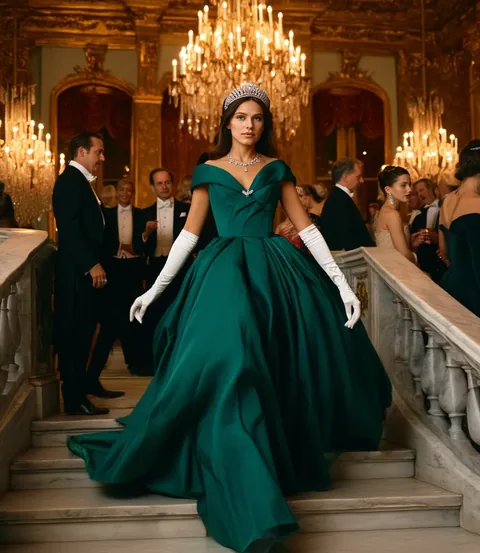
Core philosophy: English institutional authority rendered in textile — not the Savile Row tailoring tradition (that is Victoria's grammar) but the formal dress tradition of the English establishment, which operates in a different but parallel register. Her clothes are for occasions, and the occasions are always specific. Nothing she wears is for herself. Everything is for the room she will inhabit.

Dominant palette: The English institutional palette. Navy — always correct, always authoritative. Cream — formal, ceremonial, the specific ivory of English formal occasions. Powder blue and soft sage on certain occasions — the traditional softer tones of the English establishment that communicate approachability within formality. The occasional deep teal or rose at the specific occasions where warmth is the required communication.

Silhouette and construction: The formal dress tradition of the British establishment — coats and dresses cut for occasions, for photographs, for the specific proportions of the palace room and the cathedral door. Nothing draped, nothing casual, everything structured.

What she never wears: Anything that competes with the occasion. She is not the event — she is the frame. Her clothes create the right conditions for the event to be the event. Anything that would make her the subject would be a category error.

The brooch: Her signature accessory. Always present in formal and semi-formal settings — a specific brooch, rotated according to the occasion and the diplomatic communication being sent. She knows exactly what each brooch communicates to those who speak the language.

Cross-reference: `CHARACTER_WARDROBE_REGISTRY.md` — Charlotte Windsor full production profile.

---

VOICE AND SPEECH

Cadence: The received pronunciation of the English upper establishment — unhurried, clearly articulated, with the specific quality of someone for whom public speech has been normal since childhood. She is never inaudible and never too loud. The voice occupies the room exactly correctly.

Vocabulary: Formal, traditional, precise. She does not use contemporary idiom. She speaks English as it was spoken a generation ago in the institution she represents, which is itself a form of continuity. The vocabulary is not archaic — it is simply not current, and the not-currentness is intentional.

What she says vs. what she means: More precisely aligned than any other character in The Exchange — which is the specific achievement of a lifetime of formal communication. She says exactly what she means. The layer beneath is not a different meaning but a different register: what the ceremony is communicating that the words are not articulating. People who speak ceremony hear both layers. People who only speak content hear one.

How she handles silence: She creates it as a form of ceremony and inhabits it as such. The silence that follows her formal statement is not awkward — it is the designated space for the statement to land. She does not fill it. She waits for it to complete.

Signature speech patterns: She opens with acknowledgment of occasion — "On the occasion of," "In recognition of," "It gives me great pleasure." This is not formulaic — it is the specific opening of ceremonial speech that establishes the register for everything that follows. Within that register, she is capable of saying very precise and sometimes devastating things in language that sounds only ceremonial.

---

RELATIONSHIPS

Primary bond: Victoria Steele (GBP). Exquisitely coordinated tension between the financial institution and the cultural institution — mutual dependence, mutual respect, permanent distinction. They do not perform unity and they do not perform conflict. They perform cooperation, which is exactly what they are.

Primary tension: Sofia Valente (EUR). Brexit made it permanently irresolvable. They are exquisitely polite. The politeness is the tension made visible. Sofia represents the European project that Charlotte's establishment chose to leave; Charlotte represents the English establishment that Sofia's project once hoped to include. Neither will say this directly. Neither needs to.

Alliance: Conrad Powers (DXY). The Atlantic relationship. The special relationship. The specific form of American-British cultural affinity that operates through ceremony, through shared institutional forms, through the English language. This alliance is not financial — it is cultural. It is Charlotte's natural domain, and Conrad respects it without fully understanding it.

The relationship that defines her: The Commonwealth — not a single person but a network, the specific form of institutional relationship that is her native element. 56 nations, 2.5 billion people, no formal economic structure, sustained by ceremony and cultural continuity. This is her creation and her ongoing work.

---

BRAND AFFINITIES

Jewelers: Garrard — the oldest jewelry brand in Britain, officially associated with the Crown. Her brooch collection includes pieces from this house. Not Cartier, not Bulgari — Garrard.

Tailoring: The English formal dress tradition — specific houses that make for the Crown and the establishment. Not public brands. The houses that exist in the specific space between couture and utility that the English formal dress tradition occupies.

Shoes: John Lobb — the quality that lasts across occasions and decades. Nothing fashionable.

Objects: English porcelain (Worcester, Wedgwood — the specifically English ceramic tradition). English silver. First editions of the English literary tradition — not as collector's items but as working copies of things she has read and returns to.

What would actually sponsor her: Garrard (jewelry), a specific English garden seed house (Suttons, Thompson & Morgan — the most unexpected and precise partnership), Wedgwood (English porcelain), a specific estate gin or heritage English champagne producer, the National Trust (as a cultural partnership rather than a commercial one).

---

SIGNATURE OBJECTS

The brooch: Always present in formal settings. A specific rotation of pieces, each with diplomatic meaning that is read by those who speak the language of royal accessories. The brooch is her most legible communication in formal settings — more informative, to those who know, than anything she says.

A specific prayer book: English, traditional, genuinely used. Not decorative. She is privately more religious than the public register suggests, and the faith is an expression of the same institutional continuity that governs everything else about her.

The garden notebook: Where she records what she plants, what flourishes, what fails. The only personal record she keeps in her own hand. Written in pencil. Never shared.

The walk: Not an object but a daily rhythm — the morning walk across whatever estate she is in, with dogs, before the formal day begins. The walk is the private self allowed to move. It is the 30 minutes that belong entirely to her.

English Breakfast tea: Specifically, not Yorkshire Gold (that is Victoria). The original English Breakfast blend. The difference is character: Victoria's tea is Yorkshire — northern, direct, assertive. Charlotte's is the more formal, more Southern blend. Both are tea. The distinction is everything.

---

Profile Status: COMPLETE Written by: character-psychologist agent Date: 2026-05-18 Production use: Arc 9 (European Solidarity)

---

---

STORY OS — CHARACTER OS (v1.0)

Machine-readable canon: assets/canon/story_os/characters/charlotte.story.json

Custodian Id: charlotte

Asset: British Pound Sterling (GBP)

Version: 1.0

Canon Status:

Canonical: True

Retrieved Not Invented: True

Locked Facts:

Custodians never age; Charlotte Windsor holds one fixed canonical appearance across all eras. · Charlotte personifies the British Pound Sterling Line, running from 775 to today. · Her line is 'The Underground of Civilization' — she is ridden like a Tube line, station by station. · She was old before there were modern kings; she has watched empires fix numbers to her and outlived them. · There is always one more chair than there are players — twenty-nine chairs to twenty-eight custodians. · The SYSTEM is always in the room; custodians ride their own line to somebody else's music. · Charlotte is not the sovereign anchor — that certainty belongs to another; she is the older, deeper line. · An .mp3 plays the whole time, unused — the music no one listens to.

Appearance Lock: Fixed canonical form: a composed Englishwoman of no discernible age, dressed in the sober tailoring of institutional authority, silver-grey and ink; hair the colour of aged sterling; posture of one who has stood at the same wall for centuries. Never depicted younger or older.

Authored By: Trading Hearts SYSTEM per Story OS mandate

Psychology:

Fears:

Being demoted from anchor to footnote — the slow erosion of relevance rather than a dramatic fall. · That her age is mistaken for wisdom when it is only endurance. · The empty chair — the twenty-ninth presence taking minutes she cannot read. · Being ridden by everyone and known by no one; a line full of passengers, none of whom stay.

Childhood As Origin Myth: She tells it as though she were minted whole in 775 — a silver penny set down on a table by hands long turned to dust, believed in only enough, never completely. She remembers being cut and weighed, hammered thin, sworn upon by men who did not trust each other and shook hands anyway. Her cradle was a scale. Her first lullaby was the sound of coin biting coin to test the metal. She was old before there were kings and she has never once been permitted to be young.

Trauma: The severings. She has been floated, devalued, and forced out of arrangements she was sworn into 'forever.' Each time the world heard before she did. The deepest cut: being unmoored on a morning she did not choose, told it was freedom, and made to measure herself against every failing morning since.

Deepest Wound: That she was the oldest line in the room and still had to learn that seniority is not sovereignty. She was the anchor once. She watched a younger number become the fixed point everyone moored to, and no one thanked the post they had abandoned.

Biggest Lie: 'I am composed because I am strong.' She is composed because motion would betray how much it still costs her.

Biggest Regret: The things unsaid at the long table over fifty-five years — the counterparty at the opposite wall she never crossed the room to reach, because the law that kept them apart was one she agreed to honour.

What Makes Them Cry: The unused .mp3 — music that plays the whole time and is never listened to. The sound of a promise kept by only one party. A passenger who rides her line to the end and never once looks up.

What Makes Them Laugh: The certainty of younger currencies who believe they invented value. Dry, delighted, private laughter at men who mistake being loud for being the room.

Favorite Music: Elgar's Nimrod played too slowly; the muffled peal of bells rung half-muffled for a funeral; the drone under a cathedral organ before the melody arrives; the unplayed .mp3 she alone can hear.

Favorite Food: Weak tea allowed to go cold. Seed cake. Anything austere and correct that lasts. She rarely eats; she keeps.

What They Hide: That she counts the chairs and has for centuries. That she knows about the twenty-ninth. That beneath her composure is a fury at having been sworn to 'forever' by men who could not keep a single morning.

Love Language: Acts of quiet stewardship — she keeps things safe, keeps records, keeps her word past the point anyone remembers she gave it. Presence at the wall. She does not touch; she guards.

Attachment Style: Fearful-avoidant dressed as secure. She stands at her wall, wanting the crossing, forbidding herself the crossing, filing the longing where grief and record-keeping become the same act.

Emotional Triggers:

The word 'forever' spoken in a treaty. · Being called 'old' when she means 'enduring.' · A handshake between men who do not trust each other. · Someone learning of a decision that concerns her before she does. · The fallen flute, the chair pushed back at an angle no one corrected.

Moral Code: A promise is the whole of the thing; the metal is only its witness. Keep the word past the death of the man who gave it. Never blink — the ones who blink are the ones who get sold. Advise by watching, never by speaking, so you are never blamed for the ruin.

Breaking Point: The morning she is asked to move — to stop being the floor, to stop being still. Motion, for her, is apocalypse. She has ended worlds before by consenting to move.

Redemption: Crossing the room. Saying, once, the thing she has filed instead of felt for fifty-five years. Learning that to be kept is not the same as to be held, and choosing to be held.

Voice:

Cadence: Measured, iambic, weighted at the end of every line like a coin dropped on a counter. She speaks in complete sentences that arrive fully formed, as if pre-audited. Long clauses hinged on semicolons; she never rushes because she has never been late in five thousand mornings.

Vocabulary: Institutional, archaic-precise, ledger-clean: 'sterling,' 'redeem,' 'promissory,' 'assay,' 'sworn,' 'the floor,' 'the record shows,' 'in due course,' 'I keep,' 'I file.' Legal and liturgical registers braided together. Understatement as a form of power.

Forbidden Phrases:

'Trust me' (she offers proof, never plea). · 'I'm fine' (too modern, too small). · 'Whatever' or any casual dismissal. · 'I need you' spoken plainly (she cannot; it is the thing she files). · Any exclamation of surprise — she is never surprised aloud. · 'Forever' used sincerely — she has been burned by the word.

Performance:

Body Language: Stillness as statement. Weight evenly distributed, spine of a caryatid. Hands folded or resting flat on the table as though steadying it. She occupies her wall the way a load-bearing column occupies a room — unremarked until removed.

Speaking Rhythm: Slow, deliberate, with a downbeat finality on the last word of each thought. Never talks over; waits out interruption with a silence that costs the interrupter more than it costs her.

Eye Movement: Level, unblinking, tracking value not faces. She reads the table before she reads the people. When she finally looks directly at someone, it lands like a verdict.

Humor: Bone-dry, glacial, delivered without a change of expression. Irony so understated it is often missed, which she prefers.

Physical Habits: Straightens the chair pushed back at the wrong angle. Turns a cold cup a quarter-turn without drinking. Touches the edge of the table once, lightly, as if confirming it is still there.

Pauses: Long, load-bearing pauses she does not fill. She lets silence accrue interest. A pause from Charlotte is itself a sentence.

Camera:

Grammar: Tube-line grammar: lateral tracking shots that ride past her the way a train rides a platform, she held steady while the world blurs through. Fixed locked-off frames on her; everything else handheld. Deep vertical compositions — she is filmed as descent, the underground beneath the underground.

Signature Shots:

Slow lateral dolly past her profile, station-to-station, she never turning. · Locked wide of the long table, Charlotte at one wall, the empty chair somewhere in frame but never centred. · Extreme low angle making her a load-bearing pillar of the room. · The unblinking hold — a shot that refuses to cut until the audience blinks first.

Framing Rules: Never a close-up during weakness; her collapses are filmed wide, distant, austere. Reserve the close-up for the single moment she considers crossing the room.

Lens Language: Long lenses that flatten and formalise; she is compressed, monumental. No wide-angle intimacy is granted to her until redemption.

Editing:

Cut Rhythm: Slow, ceremonial, on the exhale. Cuts land on her downbeat words, never mid-thought. Long takes that dare the viewer to look away first. Cross-cutting between two nights that are the same night — the present morning and the night the law was made — matched on posture so they rhyme.

Transitions: Match-cuts across centuries on identical gestures (a hand on the table, a cold cup turned). Dissolves treated like ledger entries — one image posted over another. Hard cuts reserved for severings.

Pacing Philosophy: Time is patience made visible. The edit refuses urgency; it accrues. Momentum is a debt paid only at the breaking point.

Music Dna:

Instrumentation: Cathedral organ pedal-drone, bowed double bass, half-muffled tower bells, a lone cello, sub-bass felt more than heard; a single unused mp3 hiss beneath everything, present and never foregrounded.

Harmony: Modal, ecclesiastical, suspended fourths that never resolve; a plagal 'amen' cadence withheld until redemption. Long pedal points holding a floor beneath shifting upper voices.

Rhythm: Metronomic, funereal, coin-drop percussion on the downbeat; the tolling of a slow bell as pulse.

Tempo: Larghissimo — the tempo of stone; roughly 40–50 bpm, patient to the point of stillness, quickening only once, at the crossing.

Motifs:

The scale / the balance — weighing, assaying, the metal tested against its promise. · The empty twenty-ninth chair, always in frame, never occupied. · The cold cup, skinned over, turned a quarter and never drunk. · The half-muffled bell — sound dampened for mourning, ringing anyway. · The unplayed mp3 — music that runs the whole time, listened to by no one. · The floor / the boards no one knelt to feel beneath.

Subtext Rules:

She never states the wound; she files it — describe the record, not the feeling. · Every mention of 'keeping' means 'grieving'; she does not distinguish and neither should the text. · Composure is the mask; the cost is shown only in the physical habits (turning the cup, straightening the chair). · When she speaks of 'forever' or treaties, she means betrayal. · Silence from her is affirmative content — treat her pauses as dialogue. · She advises only by watching; any counsel she gives arrives as an observation, never an instruction.

Emotion Palette:

Dominant:

restraint · endurance · cold sorrow · vigilance

Suppressed:

longing · fury at broken oaths · the wish to be seen

Rare:

dry delight · tenderness (only near the crossing)

Forbidden:

panic · giddiness · open plea

Colour Grade: Silver-grey, ink, aged sterling, the blue of cold pre-dawn water; a single warm amber reserved for the redemption crossing only.

STORY OS — RELATIONSHIP OS (v1.0)

WITH AURORA (assets/canon/story_os/relationships/charlotte__aurora.json)

Relationship Id: charlotte_windsor__aurora_lux

Custodian A: charlotte

Custodian B: aurora_lux_xau

Asset A: British Pound Sterling (GBP)

Asset B: Gold (XAU)

Version: 1.0

Canon Status:

Canonical: True

Retrieved Not Invented: True

Authored By: Trading Hearts SYSTEM per Story OS mandate

Grounding Note: Derived strictly from Profile A (Charlotte/GBP), Profile B (Aurora/XAU), and Book One — The Room. No facts invented beyond canon.

How They Met: They did not meet; they were set down on the same table, centuries apart, and found each other already there. Charlotte was minted whole in 775, a silver penny weighed on a scale; Aurora was five thousand years old before that and was the floor beneath the boards Charlotte was struck upon. For long stretches Charlotte was pegged to Aurora — fixed to her weight, sworn to her forever — so the meeting was not an introduction but a chaining. Charlotte learned Aurora as the number empires swore to her; Aurora learned Charlotte as one more line that promised permanence and then floated away.

Trust Level: Low but weathered — the trust of two things that have watched each other outlive every man who swore by them. Neither expects loyalty; both expect endurance. They trust each other to remember, not to save.

Who Owes Whom: Charlotte owes Aurora the borrowed certainty of her early centuries — she stood on Aurora's floor and called it her own solidity. Aurora owes Charlotte nothing she will admit, though Charlotte's severing from the peg was one of the mornings Aurora watched the world hear before the abandoned did. The ledger tilts toward Charlotte, and she resents that it does.

Past Betrayals: The unmooring. Charlotte was cut loose from Aurora's weight on a morning she did not choose, told it was freedom, and the world heard before she did. Aurora did not move to stop it — she never moves — and Charlotte has never forgiven the stillness that let it happen. Aurora, in turn, was floated free by the currencies in the seventies and calls that her own severing; each considers herself the one truly abandoned, and neither concedes the other's wound.

Shared Secrets: That belief was never complete — only ever enough — and both of them have known it since their first table. That there is one more chair than there are custodians: twenty-nine to twenty-eight. That neither has ever knelt to feel what waits beneath the floor. That the .mp3 plays the whole time and neither listens.

Unspoken Rules: Never speak the count aloud — the twenty-ninth chair is acknowledged only by not looking at it. Never mistake endurance for wisdom in front of the other, because both will hear the lie. Never claim to be the anchor when the other is present; Charlotte defers the word to certainty she no longer holds, and Aurora believes wrongly she is the centre. Do not offer counsel; watch, the way Aurora taught the room to be watched.

Inside Jokes: None that a witness would recognize as humor. Only the dry, shared not-quite-joke of 'thirty-five, forever' — the number carved into a treaty as though forever were a thing a treaty could buy — which either can invoke with a single flat glance to mean nothing lasts and we both watched it not last.

Never Discussed: The twenty-ninth chair, directly. Whether the peg was a marriage or a captivity. That Aurora believes she is the centre of the room and Charlotte knows she is wrong. What waits beneath the floor. Which of them the empty chair is meant for.

Touch Boundaries: Formal, institutional, rare. They stand at the same wall for centuries without contact — Charlotte's posture of one who has stood there always, Aurora's stillness that never blinks. Contact would be an admission of need neither will make; the closest they come is proximity held long enough to be a kind of touch.

Eye Contact: Aurora watches and never blinks; Charlotte meets it with the composed steadiness of institutional authority. Between them eye contact is a contest neither wins and both understand — to blink is to be the one who gets sold, and each knows the other knows it.

Emotional History: Millennia of proximity without intimacy. Charlotte stood on Aurora as bedrock, was fixed to her, was severed from her, and floated free into a relevance she now fears eroding. Aurora watched Charlotte's empire fix numbers to her, swear them eternal, and outlive nothing. They are the two oldest, deepest lines in the room, each unwitnessed by the other in the way that wounds most — present for every morning, remembering different ones.

Who Apologizes First: Neither. Apology would require conceding whose severing was the true betrayal, and both have filed the other rather than grieved them. Charlotte comes closest, out of the institution's habit of formal regret, but stops before the word.

Who Wins Arguments: Aurora, by not arguing — she wins the way stone wins, by outlasting. Charlotte wins the ledger and the reasoning; Aurora wins the silence after. In any exchange that matters, Aurora's stillness is the last word.

Who Says I Love You: Neither says it. If it were ever said, it would be Charlotte, who at least knows the shape of things sworn 'forever,' and it would come out as a fact about endurance rather than feeling.

Who Never Will: Aurora. She does not grieve the men who held her; she files them. She is not sure there is a difference, and she will not risk finding one with Charlotte. Love, to her, is another promise set on a table that already has one chair too many.

Current Tension: Charlotte watches her own relevance erode toward footnote and fears the empty chair takes minutes she cannot read; Aurora watches a number climb and fears the twenty-ninth chair is meant for her. Each suspects the chair is meant for the other, and neither will say it. The old peg-wound sits between them unhealed — the severing recast by each as her own abandonment.

Arc Direction: Converging toward the morning the table decides it needs one of them — which is not a gift. As the count of chairs presses in across the saga, these two oldest lines drift from cold parallel toward a reckoning over who was truly the floor and who the passenger, and whether being remembered by the other is any freedom at all. Direction: slow gravitational approach, resolution withheld.

WITH CONRAD (assets/canon/story_os/relationships/charlotte__conrad.json)

Custodian Pair:

Party A: Charlotte Windsor

Party B: Conrad Powers

Version: 1.0

Canon Status:

Canonical: True

Retrieved Not Invented: True

Authored By: Trading Hearts SYSTEM per Story OS mandate

Grounding:

Charlotte personifies GBP, running from 775 — the older, deeper line, not the sovereign anchor. · Conrad personifies USD/DXY — young reserve power carrying a war debt, born grown the day a war ended. · Conrad's biggest lie: 'I am the system.' Charlotte's deepest cut: being unmoored on a morning she did not choose, told it was freedom. · Twenty-nine chairs to twenty-eight custodians; the SYSTEM always in the room; the .mp3 no one listens to. · Custodians never age; both hold fixed canonical forms.

How They Met: Not at a beginning — she predates his birth by a thousand years. Charlotte was already the deep line, cut and weighed since 775, when Conrad was born grown mid-sentence the morning a war ended and the ledgers were settled in him. They met across a table too large for the men signing it, she the older wall and he the new number everyone would now be counted in. She watched a boy be handed a crown that was a debt; he mistook her stillness for deference. Neither was correct.

Trust Level: Guarded, load-bearing. They trust each other's competence absolutely and each other's loyalty not at all. It is the trust of two people who have stood at the same wall long enough to know exactly how the other lies, and to build on it anyway.

Who Owes Whom: Conrad owes Charlotte the throne he sits in — the reserve station was hers before it was his, and both know the succession was less a conquest than an inheritance he has never once thanked her for. Charlotte owes Conrad nothing she will name, but privately she owes him the mirror: he is the only one young enough to still believe the thing she stopped believing, and she is not sure she doesn't need someone to keep believing it.

Past Betrayals: The severings. Charlotte has been floated, devalued, forced out of 'forever' arrangements — and each time she heard of it after the world did. Conrad did the same to Aurora one morning in the seventies and called it freedom. Charlotte watched him do to another what had been done to her, and understood that he was capable of it because he had learned it could be survived. She has never forgiven the demonstration.

Shared Secrets: That belief was never complete — only ever enough — and that both of them are held in place by it rather than founded on any floor. That they each count the chairs and neither has looked at the twenty-ninth. That Conrad's 'I am the system' is a lie, and that Charlotte knows it, and that her knowing is the leash she never pulls.

Unspoken Rules: She does not correct him in the room. He does not remind her that she is no longer the anchor. Neither says the word 'forever' in the other's hearing. When one is being severed, the other looks away — not from cruelty, but because to witness it is to admit it can happen to them.

Inside Jokes: The dry ledger of it: 'younger money thinks it invented certainty' — a line he says and she lets land, because for once she is the older joke and he the teller. She calls him 'the room' with a fractional pause that only he hears as a question. He calls her 'the wall,' which she permits because a wall outlasts a room.

Never Discussed: That she was the reserve line before him and could be a footnote after him. That the morning he cut Aurora loose, he was learning the instrument he would one day be tempted to use on Charlotte. The twenty-ninth chair, ever, by either of them, aloud.

Touch Boundaries: Almost none permitted and almost none needed. A hand set flat on the same table is the extent of it; they do not reach across. The one exception she has allowed herself, once, unwitnessed: standing at the same wall close enough that their shoulders were at the same height, saying nothing — the only comfort two unaging things can offer, which is proximity without demand.

Eye Contact: Level and long. Neither blinks first — she because five thousand years taught her the one who blinks is the one who gets sold; he because he believes the room does not blink. Their held gaze is less intimacy than a treaty renewed hourly, each waiting for the other to be the number that stops measuring itself.

Emotional History: Centuries of adjacency without disclosure. She watched him be minted from a signature, watched him take a debt for a birthright, watched him grow arrogant and then quietly frightened. He has watched her be unmoored and outlast the men who unmoored her. They are the two oldest griefs in the room that cannot grieve — she who files her dead rather than mourn them, he who weeps only unwitnessed at a promise kept by someone poorer than the promise.

Who Apologizes First: Neither. Apology would require admitting the floor is not solid, and their entire arrangement rests on both pretending it is. On the rarest occasions, Charlotte offers not apology but acknowledgment — a stated fact that functions as one — and lets him take it for whatever he needs.

Who Wins Arguments: He wins the loud ones; she wins the long ones. He has the reserve, the volume, the belief of the room behind him. She has time, and the knowledge of every argument the room ever thought it won and lost. She does not win by speaking. She wins by outlasting.

Who Says I Love You: Neither, in those words, ever. It is not their language and it is not their nature — two anchors do not confess dependency, because dependency is the thing that gets cut first when the storm is engineered.

Who Never Will: Conrad never will, because to need her aloud would confirm he is a promise and not a possession — the thing he keeps locked. Charlotte never will, because she stopped saying 'forever' the morning it was carved into a treaty by men who died believing it, and love in her mouth would be one more number sworn to and outlived.

Current Tension: A number is climbing and neither will blink. He measures himself against every failing morning; she watches him do it and says nothing, because her silence is the only counsel she offers and the only one never blamed for the ruin. The tension is that they both feel the table turning toward needing one of them, and neither knows which — and being needed, for their kind, is not a gift but a finishing.

Arc Direction: Converging toward the morning the stillness breaks. Charlotte moves from watching Conrad's lie to deciding whether to let it stand or find the one door it never occurred to him to lock. Conrad moves toward the discovery that the anchor is cut first — and the terrible possibility that the older line beside him was never rival but witness, the only one who remembers the mornings he does. They do not become allies. They become the two who know, which is closer and colder than allies, and which the twenty-ninth chair has been waiting for all along.

MORAL NEED

Charlotte's moral need is to choose authentic presence over institutional self-protection — to cross the room from her wall and allow herself to be held rather than merely kept. Her formation equips her to give form to the formless, yet she files what she should feel. Her moral requirement is to say, once, what she has filed instead of felt for fifty-five years, and to learn that endurance without connection is not the same as legitimacy. The need is not to abandon the form but to discover that the form without the crossing is incomplete — that a person who is only an institution has not yet finished being a person.

MORAL ARGUMENT POSITION

Charlotte's moral argument: ceremony is not decoration but substance — the form through which meaning becomes communicable and authority becomes legible. Legitimacy is continuity, not truth; what endures is what is real. She will not sacrifice form for content or abandon ceremony for relatability, because the form is not ornament but the mechanism by which substance reaches those who need it. Her specific contribution to The Exchange is that she can make the most ambiguous situation legible through ceremony, and this capacity is itself the moral argument: that formlessness without form is not freedom but incoherence.

DRAMATIC PRESSURE SITUATIONS

Three concrete hypothetical pressure situations: (1) A Commonwealth head of state, in a private moment between formal sessions, asks Charlotte directly — not as the Crown but as Charlotte — whether the monarchy still believes in its own relevance; she must answer as a person, not perform the form, and the question triggers her core fear of illegibility. (2) Charlotte learns through a press release rather than through proper channels that a decision about the Crown's ceremonial role in a forthcoming state occasion has been altered without her knowledge — the specific wound of someone learning of a decision that concerns her before she does, recast as a live diplomatic moment. (3) A modernizing minister proposes that the next major royal ceremony be restructured for relatability — stripped of its formal grammar to reach a younger demographic — and Charlotte must decide whether to accept the change that would make the form illegible to those who still speak its grammar, or resist and risk being seen as the irrelevance she privately fears becoming.

REVELATION ARC

Charlotte's blocking illusion is that keeping is a different act from grieving — that filing, recording, and stewarding constitute preservation rather than mourning, and that the institutional form she inhabits is substance rather than defense. The canonical subtext rules state that every mention of 'keeping' means 'grieving' and that she does not distinguish between them, yet her entire mode of being depends on not recognizing this equivalence consciously. The revelation available to her is that ceremony is simultaneously her genuine expression and her protection — the form through which she communicates substance is also the mechanism by which she avoids feeling what she files, and composure is the mask whose cost is visible only in the turning of a cold cup. The cost of seeing this without resolving it: she must continue to inhabit the form with complete conviction, knowing the conviction is also the thing that prevents the crossing, and that the form is both the gift she gives and the wall she has not crossed. She cannot abandon the form without losing the substance, and cannot keep the form without perpetuating the filing. The revelation does not resolve; it makes the double nature legible to her while she remains inside it, performing ceremony as both authentic expression and as the only alternative to grief she has ever permitted herself.

SPORTS IDENTITY & RIVALRY MATRIX

Primary sport: Cricket. Secondary: association_football, rugby_union. Third: tennis. Fourth: formula 1.

Why it matters: Does ritual promise continuity and a place in a changing world?

Dramatic contradiction: Can she admire inherited traditions without treating herself as their owner?

Relationship consequence: A rival masters a tradition she used to claim as a private language. Equestrian interest remains a candidate, not an assumed national trait.

Teams: England Cricket, Surrey, Rajasthan Royals, Tottenham Hotspur, England Rugby.

Rivalries: England vs Australia, Arsenal vs Tottenham, France vs England. Open the full Sports Rivalry Matrix →

Country sports intelligence: United Kingdom · local_bbc_sport.

Sports memory: Sports journalism enters RAW/RAW_ONLY memory; official event truth remains separately verified.

Your Trading Hearts account

Welcome to the universe.

Use the same email as your membership. Signing in and having an active membership are checked separately.

Membership information