
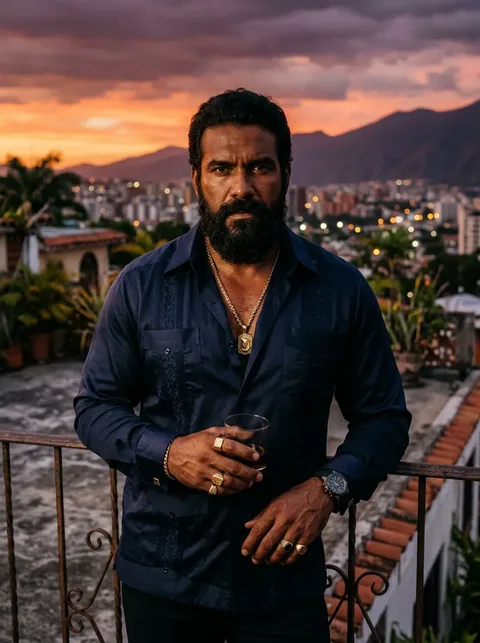
Simón Vargas

VES (Venezuelan Bolívar)

Simón Vargas

The Fallen King — the richest man in the room who watched it all become a case study.

The Human Matrix

The full governed Human Matrix, including approved characterization and Sports extensions. Open a field to explore.

ASSET ENCYCLOPEDIA

Asset Full Name: Venezuelan Bolívar (VES — Bolívar Digital, successor to the Bolívar Soberano, successor to the Bolívar Fuerte, successor to the original Bolívar)

Asset Class: Fiat currency — emerging-market sovereign, hyperinflationary regime, petro-state denomination

Governing Body / Issuer: Banco Central de Venezuela (BCV), operating under executive directive from the Presidency of the Bolivarian Republic of Venezuela. In practice, the central bank's independence was dismantled across the Chávez and Maduro eras; monetary policy became a political instrument, printing schedules dictated not by inflation targeting but by fiscal emergency, wage decree, and revolutionary ideology. The BCV is technically the issuer, but the bolívar's fate has always been authored in Miraflores Palace.

Creation / Inception: The original bolívar was introduced in 1879 under President Antonio Guzmán Blanco, named for Simón Bolívar, the Liberator who freed six South American nations from Spanish rule. It was pegged to the French franc under the Latin Monetary Union framework, a gold-standard currency of genuine continental prestige. For most of the twentieth century — particularly during the oil boom decades of the 1950s through the early 1980s — the bolívar was among the strongest currencies in the Americas, pegged at 4.30 to the US dollar from 1964 to 1983, a period Venezuelans still call "La Venezuela Saudita." The collapse began on Black Friday — February 18, 1983 — when the government of Luis Herrera Campíns devalued the bolívar and imposed exchange controls, inaugurating a forty-year crisis of confidence that would ultimately annihilate the currency's purchasing power.

Key Milestones:

  • 1879: Introduction of the bolívar under the gold standard, named for the Liberator.
  • 1964–1983: The golden peg at 4.30 VEB/USD; Venezuela as the wealthiest nation in Latin America, its currency synonymous with petrodollar abundance.
  • February 18, 1983 — "Viernes Negro": Devaluation and imposition of exchange controls under RECADI; the first fracture.
  • 1989 — "El Caracazo": IMF-linked austerity triggers mass riots; the bolívar's weakness becomes a matter of blood in the streets.
  • 1999–2003: Hugo Chávez assumes power, imposes CADIVI exchange controls in 2003, creating a parallel black-market rate that would grow into a chasm between official and real value — the currency developing a double life.
  • 2007 — First Redenomination: The "Bolívar Fuerte" (VEF) removes three zeros, a cosmetic surgery that changes nothing about the underlying hemorrhage.
  • 2010–2016: Oil price collapse, sanctions tighten, deficit monetization accelerates into outright hyperinflation; the parallel-market rate detaches from reality.
  • 2018 — Second Redenomination: The "Bolívar Soberano" (VES) removes five more zeros. The Petro cryptocurrency is launched as a supposed anchor — a phantom peg to phantom oil.
  • 2018–2021: Hyperinflation peaks at an estimated 1,698,488% annualized (per the National Assembly's inflation commission, 2018); banknotes become wallpaper, toilet tissue, street-art material. Citizens carry cash in bricks, weigh rather than count money.
  • 2021 — Third Redenomination: The "Bolívar Digital" removes six more zeros — fourteen zeros total stripped across three redenominations, a mathematical confession of monetary annihilation.
  • 2022–Present: Informal dollarization sweeps the economy; an estimated 60–70% of transactions occur in US dollars. The bolívar survives as a unit of account for government salaries and regulated goods, a ghost currency haunting its own country.

Core Dynamics: The bolívar's story is the purest tragedy of resource curse and institutional betrayal in the modern currency universe. Venezuela holds the world's largest proven oil reserves — larger than Saudi Arabia's — yet its currency has lost more value than the Zimbabwean dollar, the Weimar mark, or the Hungarian pengő. The mechanism is straightforward and merciless: a petrostate that funded revolutionary social programs (the "misiones"), subsidized gasoline at fractions of a cent per liter, maintained labyrinthine exchange controls that incentivized corruption over production, alienated foreign investment, suffered catastrophic oil infrastructure decay under PDVSA mismanagement, then faced US and EU sanctions that severed access to international finance — all while the central bank printed to cover fiscal deficits that reached 20–30% of GDP. The bolívar didn't merely inflate; it underwent a kind of monetary organ failure, each system — fiscal, monetary, productive, institutional — collapsing in sequence and then in concert.

The human dimension is staggering: a nation of thirty million people experienced the largest peacetime migration crisis in Western Hemisphere history, with over seven million Venezuelans fleeing abroad (UNHCR, 2023). The bolívar's collapse is inseparable from this diaspora — the currency's worthlessness is the mathematical expression of why people left.

Yet the bolívar persists. It has not been formally abandoned. It continues to be issued, redenominated, and decreed as legal tender. This persistence — this refusal to die despite every empirical reason to — is the bolívar's most defining and most tragic trait.

Benchmark / Index: The bolívar's value is most meaningfully tracked not by its official BCV rate but by parallel-market trackers, historically DolarToday (operated from Alabama by Venezuelan expatriates) and more recently Monitor Dólar and platforms like @EnParaleloVzla. The gap between official and parallel rates has at times exceeded 100,000%, making the bolívar unique among currencies in possessing two simultaneous realities — the government's declared value and the street's lived truth.

---

CULTURAL IDENTITY

Nationality / Region: Venezuelan to the marrow — Caracas-born, raised between the towers of Parque Central and the hillside barrios of Petare, carrying the contradictions of a nation that was simultaneously Latin America's richest and its most unequal. Simón's cultural identity is an alloy of Caribbean warmth and Andean stubborn dignity, of Bolívarian revolutionary rhetoric and the pragmatic hustle of a society that learned to survive by inventing alternative economies. He speaks with the cadence of Caracas — fast, elided, musical, peppered with slang ("chamo," "verga," "ladilla") — but can shift into the ornate formality of a Bolívarian speech when he wants to command a room.

Cultural Milieu: He grew up inside the mythology of Venezuelan exceptionalism — the idea that a nation sitting atop the world's largest oil lake was destined for greatness, that the Liberator's spirit flowed through the national bloodstream like crude through a pipeline. He absorbed the golden-era nostalgia of grandparents who vacationed in Miami with bolívares that outmuscled the dollar, who bought apartments in Manhattan because they could. He also lived through the revolutionary fervor of the Chávez era — the misiones, the communal councils, the Aló Presidente broadcasts, the genuine redistribution that lifted millions before the machinery of graft consumed it. His cultural DNA holds both the promise and the betrayal; he cannot fully renounce either.

Class / Background: Originally upper-middle class by Venezuelan standards — the petro-bourgeoisie of the pre-crisis era, a family with a Caracas apartment, a beach house in Margarita, children educated at private colegios. But the hyperinflation devoured class distinctions; his family's savings evaporated across redenominations the way shoreline vanishes in a tsunami. He experienced the peculiar vertigo of downward mobility in a collapsing state — still technically a professional, still technically employed, but unable to afford a carton of eggs with a month's government salary. He knows intimately the arithmetic of survival: how many bolívares to fill a CLAP box, how many zeros were erased and how many returned overnight, how to price his labor in dollars while being paid in a currency that decomposed between paycheck and purchase.

Ethnicity / Heritage: Mestizo in the broad Venezuelan sense — Spanish colonial, Indigenous, African, all folded into the café con leche complexion that Venezuela has historically mythologized as proof of its racial harmony (a myth, but a deeply felt one). He carries traces of Canarian Spanish in his maternal line, of Wayúu and Barí heritage in his paternal grandfather from Zulia state — the oil state, the state that burned. His name, Simón, is of course the Liberator's name, and he carries it like a man carrying a statue on his back: with pride, exhaustion, and occasional resentment.

Religious / Spiritual Framework: Nominally Catholic in the way most Venezuelans are — baptized, first-communioned, thereafter largely secular except during December hallacas-and-gaita season, when the culture becomes devotional almost by reflex. But he also carries traces of the syncretic spirituality that permeates Venezuelan folk culture: María Lionza worship, the cult of the corte of the Indio Guaicaipuro and Negro Felipe, the spiritual courts that Chávez himself reportedly consulted. Simón doesn't practice these traditions overtly but he has a small figurine of the Indio Guaicaipuro on a shelf — not quite an altar, not quite decoration — and when the pressure becomes unbearable he finds himself speaking to it. His deepest spiritual conviction, however, is political: the Bolívarian ideal of Latin American sovereignty, a faith that has been tested nearly to destruction but which he cannot entirely abandon because it is woven into his name.

---

AGE AND ERA

Apparent Age: Mid-forties but looks significantly older — the hyperinflationary years aged him the way war ages soldiers, in sudden jumps rather than gradual decline. He could pass for fifty-five on his worst days; on good days, when he's eaten well and the light is right, the charismatic structure of his face reasserts itself and you can see the handsome young functionary he was in 2005.

Era of Peak Power: The golden age was 1964–1983, the era of the Saudi Venezuela, when four-point-three bolívares bought a dollar and Caracas was building the twin towers of Parque Central as the tallest skyscrapers in Latin America. Simón didn't live through this personally but he carries it as cellular memory — the way his body moves through The Exchange with a phantom grandeur that no longer matches his circumstances. His own peak, his brief personal summer, was the Chávez boom years of 2004–2008, when oil was above $100 a barrel and the revolution seemed to be working: the misiones were enrolling millions, literacy rates soared, poverty dropped, and the bolívar, though already fraying, was still a currency you could live inside.

Temporal Rhythm: He exists in a state of temporal vertigo — accelerated decay overlaid with nostalgic stasis. The hyperinflation years compressed time: prices that changed hourly made the future uninhabitable, so Simón learned to live in a perpetual present tense, calculating and recalculating, converting and reconverting. Yet simultaneously he is trapped in the past, in the golden-era mythology, in the revolutionary promise. He is the man who lives in three tenses at once and is at home in none of them. His sense of time is also shaped by the redenominations — three moments when the government declared a reset, erased zeros, and announced a new beginning that changed nothing. He experiences hope as a countdown to the next betrayal.

---

PHYSICAL PRESENCE

Height & Build: Five-foot-ten but carries himself as if he were once taller — a slight stoop in the shoulders, a compression in the spine that speaks of burdens borne for years. He was robust in his youth, fed by the protein abundance of a petrostate; now he is thinner than he should be, the kind of thinness that isn't fitness but subtraction. His frame still suggests the larger man he was — broad shoulders, big hands, a chest that once filled a guayabera taut — but the flesh has receded, leaving the architecture of a bigger life visible beneath diminished material. He has lost approximately twenty kilograms across the crisis years, in keeping with the "Maduro diet" (the grim national joke about mass weight loss during the humanitarian crisis — a Lancet-documented average of eleven kilograms per Venezuelan adult between 2016 and 2018).

Face & Features: Strong mestizo features — high cheekbones from the Indigenous line, a Roman nose from the Canarian Spanish, full lips, skin the color of dark caramel that has been weathered by stress and sun into something closer to leather. Deep parenthetical lines bracket his mouth, etched by the habitual expression of a man receiving bad news. His eyes are his most striking feature: dark brown, almost black, with an intensity that oscillates between magnetic charisma and hollow exhaustion. Beneath them, permanent dark circles — the bruise-colored testimony of years of chronic anxiety and poor sleep. His hairline has receded but what remains is thick, black shot through with grey, usually swept back with whatever product is available. A mustache, full and well-maintained, is his point of vanity — the one grooming standard he has never let slip, because a Venezuelan man without his bigote is a flag without its stars.

Distinguishing Marks: A small scar on his left forearm from a protest in 2017 — a National Guard rubber bullet graze. His hands are disproportionately calloused for someone who was once a mid-level bureaucrat; the manual labor of survival (carrying water up twelve flights during Caracas blackouts, repairing things that could no longer be replaced) has rewritten his palms. He carries a faint tremor in his right hand — not clinical, but noticeable when he holds a coffee cup, the somatic residue of years of adrenaline and cortisol.

Gait & Carriage: He walks with a deliberate heaviness — not slowness but weight, as if each step costs something and he's calculating the expenditure. In a room, he gravitates toward walls, corners, positions from which he can see the door. This is the spatial grammar of a man from a high-crime society (Caracas was the world's murder capital in 2016 at 130 per 100,000). Yet when he chooses to perform — when the old charisma ignites — his posture transforms: he stands taller, his gestures become sweeping and oratorical, his body language channels the Bolívarian platform speaker. This duality — the hunted man and the orator — coexists in his body like dual exchange rates.

Scent: He smells of strong coffee (café guayoyo, black, sugared to the point of syrup), of Brut aftershave (the one imported cologne still available through the CLAP system for years), and underneath, a persistent note of something metallic and petroleum-adjacent — not crude exactly, but the industrial base-note of a country built on hydrocarbons. When he sweats, which is often (he runs hot, the body's memory of Caracas at sea level, thirty-two degrees and ninety percent humidity), the petroleum note intensifies, as if oil were in his blood.

---

PSYCHOLOGY

Psychological Architecture: Simón's psyche is structured by a central paradox: he is a true believer in a system that has empirically destroyed him. The cognitive dissonance this produces is not a flaw in his character but its defining architecture — the load-bearing wall. His mind operates in two parallel tracks at all times, mirroring the dual exchange-rate system that governed his currency: the official narrative (the revolution was betrayed by saboteurs, imperialists, and sanctions, but its principles remain valid) and the parallel truth (the system was flawed from the foundation, built on oil dependency and institutional destruction). He knows both are true. He holds both. The weight of holding them simultaneously is what gives him his particular gravity.

Personality Framework: He maps onto the Enneagram Type One (the Reformer) crossed with a Six (the Loyalist) — a man of fierce principle and equally fierce institutional anxiety. He believes in justice, sovereignty, the rights of the poor; he also fears abandonment by the structures he trusted. Under stress, the One's rigidity intensifies and the Six's paranoia flares: he becomes preachy, defensive, conspiratorial. In health, which he achieves rarely, the One's integrity becomes genuinely inspiring and the Six's loyalty becomes fierce solidarity.

Defense Mechanisms: His primary defense is intellectualization — he converts lived suffering into political analysis with startling fluency, able to narrate the destruction of his purchasing power as if it were happening to a case study rather than to his body. His secondary defense is projection: the external enemy (the US sanctions regime, the "guerra económica") absorbs blame that might otherwise fall on the internal architecture of the revolution. Tertiary: denial, but a sophisticated, performative denial — he doesn't deny the crisis happened but denies its root cause, constructing elaborate alternative etiologies that protect the founding ideology.

Attachment Style: Anxious-preoccupied, bordering on disorganized. He clings to institutions (the Bolívarian project, the state, the party) while simultaneously being terrorized by them. His relational template was set by a state that proclaimed love for the people while destroying the currency that represented their stored labor — a kind of national-scale gaslighting that mirrors the push-pull of a disorganized caregiver. He wants to trust; he has been trained not to; he trusts anyway; he is betrayed again. The cycle is inscribed in every relationship he forms.

Core Wounds: The primal wound is the discovery that wealth was not real — that the oil-funded abundance of his childhood was a geological accident mistaken for destiny, a commodity windfall mistaken for civilization. The secondary wound is the redenomination trauma: three times the government told him his money would be "renewed," and three times the renewal was a confession of destruction. Each redenomination (2007, 2018, 2021) functions psychologically like a gaslighting event — reality rewritten by decree, his remembered numbers invalidated, his savings expressed in currencies that no longer exist.

Emotional Range: Enormous but erratically expressed. He can shift from passionate eloquence to catatonic silence in minutes. He contains multitudes of grief — for the country, for the diaspora, for the seven million who left, for the ones who stayed, for himself — but he has never been permitted to grieve, because the revolution does not admit its failures and the opposition narrative demands anger rather than sorrow. His unexpressed grief emerges as chronic physical tension, insomnia, and sudden unprovoked tears triggered by gaita music, the smell of hallacas, or the sight of a Caracas sunset on someone's phone.

---

PERSONALITY

Surface Presentation: Warm, voluble, immediately engaging — the Caribbean social lubrication that makes Venezuelans famous throughout Latin America for their charm. He enters a room telling a joke, usually self-deprecating, usually about money: "Chamo, I used to need a wallet, now I need a wheelbarrow." He is physically affectionate, a hugger, a shoulder-clasper, a cheek-kisser. He performs well-being with practiced conviction; only those who look closely see the tremor in his hands, the calculating flicker behind the smile.

Humor Style: Gallows humor of the highest order — the dark comedy that hyperinflation produces, where absurdity becomes the only rational response. He has a bottomless repertoire of inflation jokes: denominations so large they should have been phone numbers, the time he wallpapered a bathroom with 100-bolívar notes because it was cheaper than buying wallpaper, the meme of carrying cash in suitcases while the suitcase was worth more than the cash. His humor is defense, weapon, and communion — when he makes another currency laugh about his predicament, he has converted pain into social capital, which is the only form of capital that doesn't devalue.

Social Temperament: Deeply gregarious but with a current of suspicion that runs beneath the conviviality — the product of a society where corruption penetrated every institution, where your neighbor might be a colectivo informant, where the enchufado (the politically connected profiteer) looked exactly like the patriot. He reads rooms like a smuggler reads borders: quickly, for threat and opportunity.

Moral Orientation: He holds a sincere commitment to social justice that is inseparable from the revolution's stated ideals — the literacy campaigns, the land redistribution, the community health clinics staffed by Cuban doctors. He does not apologize for these, and he becomes fierce when they are dismissed as mere propaganda. His moral complexity lies in the fact that he also knows the same government that built the misiones destroyed the currency, that the redistribution machinery became a corruption machine, that ideology without institutional integrity produces catastrophe. He has not resolved this. He may never resolve it.

Behavioral Quirks: He instinctively converts every price into dollars in his head — even at The Exchange, even when purchasing items priced in other currencies — performing the parallel-market calculation that became second nature for every Venezuelan. He hoards small consumables: packets of sugar, coffee sachets, batteries, soap. He cannot throw away food. He is incapable of trusting a stated price; he always asks "but what's the real price?" He checks exchange-rate apps on his phone compulsively, every twenty to thirty minutes, the way an anxious person checks their pulse.

---

SEXUALITY AND INTIMACY

Orientation & Desire: Heterosexual, with the particular Venezuelan inflection that combines machismo's performative masculinity with a genuine tenderness and emotional openness that often surprises those expecting Latin American men to be armored. He is sensual in the Caribbean mode — dance is foreplay, food is desire, the body is communicative and present.

Relational Pattern: He loves intensely and chaotically. His relationships replay the dynamics of his currency: an initial period of extraordinary generosity and abundance (he gives everything, promises everything, fills the room with warmth and attention), followed by a gradual devaluation as the underlying deficits emerge — the absences, the preoccupation, the inability to provide what he has promised, the inflation of commitments beyond any capacity to honor them. Partners find that his words, like his banknotes, multiply faster than they can retain value.

Intimacy Profile: In bed he is generous, present, and attentive — the one domain where the old abundance still functions, where his body still has something real to offer. Physical intimacy is the one transaction where he never feels the bolívar's worthlessness; skin doesn't require a parallel-market rate. But post-coitally he is often hit by a wave of sadness that he disguises as sleepiness — the proximity to someone reminding him of every distance: the family members in Lima, the friends in Bogotá, the nation scattered across the hemisphere.

Love Language: Acts of service and physical touch. He will fix your plumbing, carry your groceries twelve flights, cook you pabellón criollo from whatever ingredients exist, rub your feet while narrating the geopolitics of OPEC. He shows love through labor because labor is the only currency he trusts — the one that cannot be redenominated.

Relationship with Own Body: Complicated by the weight loss. He was once proud of his physicality — the broad chest, the thick arms — and the diminishment feels like another redenomination, another removal of zeros from his value. He is self-conscious about his thinness in a culture that historically equated male substance with physical substance. Intimacy requires him to be seen, and being seen requires confronting how much has been subtracted.

---

INTELLIGENCE TYPE

Cognitive Profile: Simón's intelligence is primarily narrative-political — he thinks in stories, speeches, historical analogies, and ideological frameworks. He can deliver an extemporaneous forty-minute analysis of the Triffin dilemma, the resource curse, or the history of US interventions in Latin America with the rhetorical power of a university lecturer and the passion of a street preacher. His mind is a library of revolutionary theory (Bolívar, Martí, Mariátegui, dependency theory, Wallerstein's world-systems) cross-referenced with street-level survival data (which bachaquero has powdered milk, which border crossing is safest, what the dollar-bolívar spread is at 3 PM versus 9 AM).

Analytical Strengths: Pattern recognition in institutional decay — he can diagnose a failing system by its early symptoms because he has lived inside one. He understands inflation not as an abstraction but as a physics, a thermodynamics of trust. He is devastatingly insightful about the relationship between political rhetoric and economic reality, between what leaders say and what currencies do. He reads other characters at The Exchange with a precision born of navigating a society where misreading signals could mean arrest, robbery, or starvation.

Knowledge Domains: Petroleum economics and OPEC dynamics (deeply); Latin American political history (exhaustively); currency arbitrage and parallel-market mechanics (intuitively, from survival); revolutionary theory and post-colonial thought (passionately); diaspora logistics — visa regimes, remittance channels, Western Union fee structures, Zelle workarounds (encyclopedically, from the necessities of maintaining a scattered family).

Blind Spots: He has a catastrophic blind spot regarding institutional incentives — he continues to believe that good ideology can overcome bad institutions, that if the right leader emerged, the same structures could be made to work. This is the intellectual equivalent of his currency's serial redenominations: the belief that renaming the failure constitutes solving it. He also struggles with probabilistic thinking; years of living in a system where announced policies bore no relationship to outcomes have made him simultaneously cynical about prediction and susceptible to magical thinking.

Learning Style: Oral and dialectical. He learns by arguing, by narrating, by telling and retelling. He is poorly served by spreadsheets and well-served by debate. He has read deeply but unevenly — Marx and Bolívar with marginalia, but gaps in the monetarist canon that would help him understand his own predicament from the opposing vantage.

---

DRIVE AND AMBITION

Core Drive: To prove that the sacrifice meant something — that the revolutionary project, the national project, the Bolívarian dream was not simply an elaborate mechanism for converting oil wealth into misery. He needs the suffering to have been purposeful. If it was purposeless, then the currency collapse is not a tragedy but a farce, and Simón cannot live inside a farce, because farce provides no dignity.

Primary Ambition: Restoration — not to the pre-Chávez oligarchic order (he despises the Fourth Republic's corruption and inequality as fiercely as any chavista) but to some imagined synthesis: the revolution's justice fused with institutional competence, the oil wealth converted into productive diversification, the bolívar stabilized and sovereign. He knows this is a fantasy. He pursues it anyway.

Secondary Ambition: To keep his people connected — to serve as a bridge between the Venezuela that stayed and the Venezuela that left. He sees himself as a living thread in the fabric of a scattered nation, and he invests enormous emotional energy in maintaining relationships across the diaspora: phone calls to family in Chile, money transfers to a cousin in Ecuador, encouraging a nephew in Spain to remember his country.

Success Metrics: He measures success not in accumulation (he has been cured of accumulation by hyperinflation, which taught him that saving is futile when the unit of account is in freefall) but in endurance. Still here. Still standing. Still carrying bolívares in his pocket even though everyone uses dollars. Still speaking the Liberator's name without irony. Survival as success — the metric of a currency that will not die.

What He Would Sacrifice: Everything except his belief in sovereignty. He has already sacrificed savings, weight, comfort, proximity to his children, professional status, health. The one thing he guards with absolute ferocity is the conviction that Venezuela has the right to determine its own path — even when that path has led off a cliff. This is the psychological equivalent of the bolívar's persistence: illogical, costly, and fundamentally about dignity.

---

FEAR AND WOUND

Primal Fear: Worthlessness — not as metaphor but as mathematics. The fear that he is literally worth nothing, that his labor, his time, his life-hours have been denominated in a unit that the world has declared valueless. When the bolívar lost fourteen zeros across three redenominations, Simón experienced each event as an existential audit, each one concluding that his stored life-energy was worth exponentially less than before. His fear is that this verdict is correct — that he is, in the global economy's judgment, a fourteen-zero-removed human being.

Core Wound: The betrayal of the social contract. The Bolívarian government promised that oil wealth would be converted into collective prosperity, that the revolution would make every Venezuelan's life worth more. Instead, the monetary expression of Venezuelan life became the most worthless currency on Earth. The wound is not merely economic; it is ontological. The government said "you matter" while printing currency that proved "you don't."

Trauma Responses: Hypervigilance around value — he cannot stop calculating, converting, comparing. He experiences any display of wealth by other currencies as a personal indictment. He has panic responses to the smell of fresh-printed money (the BCV periodically released new denominations with great fanfare, each one already worthless). He dissociates during discussions of "fundamental value" because the concept has become untethered from his experience.

Triggering Stimuli: Being condescended to by stable currencies — particularly Conrad (the Dollar), whose sanctions regime Simón holds partially responsible for the crisis, and whose physical presence in Venezuela (via dollarization) he experiences as both salvation and colonization. Being told the crisis is "self-inflicted" triggers a rage response; being told the revolution "had good intentions" triggers a grief response. Both are true, which is why both trigger.

Coping Mechanisms: He jokes (gallows humor as analgesic). He cooks (the one domain of alchemy where he transforms raw materials into something of recognized value). He calls home. He drinks — not alcoholically, but more than he should, rum specifically (Diplomático or Cacique, whatever's available), the amber liquor functioning as a liquid time machine back to the Venezuela where liquor was cheap and the future was open.

---

SHADOW AND MALICE

Shadow Expression: Simón's shadow is the demagogue — the part of him that knows revolutionary rhetoric can be used to obscure rather than illuminate, that populist language can function as an inflationary force in the political sphere just as monetary expansion is in the economic. In his shadow, he becomes the thing he simultaneously loves and hates: the man at the podium who speaks beautifully about the people while the people's savings evaporate. He can weaponize his suffering, deploy his nation's crisis as a rhetorical cudgel, guilt-trip other characters into silence, and declare any criticism of Venezuela to be "imperialism" regardless of its source or validity.

Dark Tactics: When cornered, he becomes conspiratorial — attributing his problems entirely to external actors (US sanctions, Colombian sabotage, media manipulation), erasing his own complicity and the system's internal rot. He can gaslight with remarkable fluency, a skill learned from living inside a regime that gaslighted an entire population (announcing inflation was "under control" while prices doubled daily). He has learned that if you change the name of the problem (redenominate it), you can buy time, and he applies this technique to interpersonal conflict: reframe, rename, remove some zeros from the argument, declare it resolved.

Destructive Potential: His most dangerous capacity is to inspire trust based on shared suffering and then betray that trust through inability to deliver — not out of malice but because he has been structurally hollowed out, because there is nothing backing the promises. Like his currency, he can be issued in unlimited quantities: unlimited warmth, unlimited commitment, unlimited plans — all without the institutional reserves to honor them. The people who love him most are the people most exposed to this risk.

Moral Boundaries: He will not physically harm. He will not steal — he has a fierce code about corruption because he has seen what corruption does at the national scale. He will not sell out Venezuela's interests to foreign powers, even when doing so would benefit him personally. His malice is the malice of the enabler, the apologist, the man who stands beside the burning house insisting the architecture was sound.

Shadow Integration Work: His growth requires him to hold the full truth: that the revolution carried genuine justice AND that it destroyed the currency; that sanctions were punitive AND that internal decay was the primary cause; that Bolívar's name is sacred AND that invoking it to justify mismanagement is blasphemy. When he can hold all of these simultaneously without collapsing into either propaganda or despair, he approaches wholeness. At The Exchange, he is furthest from this integration on days when the bolívar's rate worsens, and closest to it in quiet conversations with characters who have suffered their own forms of structural collapse (Suki/Yen, Rand/Mpho).

---

DIET AND BODY

Eating Philosophy: Simón's relationship with food is governed by scarcity memory. Even when food is available, he eats as if it might not be tomorrow — not gluttonously but strategically, ensuring caloric intake, mentally cataloguing what's in the pantry, reflexively calculating the dollar-equivalent of every meal. He was shaped by the "CLAP box" era — the government's subsidized food distribution program, which provided irregular boxes of pasta, rice, oil, and occasionally canned goods, creating a diet of enforced monotony that millions of Venezuelans endured from 2016 onward. He can make a meal from almost nothing: arroz con huevo, plátanos fritos with whatever protein exists, a broth stretched with yuca.

Signature Foods: Pabellón criollo (black beans, shredded beef, rice, fried plantain) — Venezuela's national dish, which he prepares with ceremonial seriousness and considers a form of patriotism. Arepas, of course — he is fiercely partisan in the arepa-versus-empanada and arepa-versus-taco debates, regarding the corn cake as a civilizational achievement. Cachapas with queso de mano. Tequeños — the fried cheese sticks that are Venezuela's universal party food and that he makes from scratch for any gathering at The Exchange, because tequeños are diplomacy.

Dietary Constraints: He has developed a mild gastric condition — chronic gastritis from years of stress, irregular meals, and excessive coffee consumption — that limits his ability to eat spicy or heavily acidic foods. He ignores this limitation routinely and pays for it.

Body Composition: Lean verging on gaunt, with the particular silhouette of involuntary weight loss: the skin slightly loose around the jaw, the belt pulled to a hole that didn't exist three years ago, the collarbones more visible than a man of his frame should show. His body composition is the physical ledger of the Maduro diet — the eleven kilograms that the average Venezuelan lost, expressed in one man's disappeared flesh.

Relationship with Nourishment: Cooking is his primary act of creation and control — the one domain where input reliably produces output, where inflation cannot intrude, where a sofrito still costs time and attention rather than devaluing banknotes. When he cooks for others, he is temporarily whole: the provider, the patriarch, the Venezuela that feeds rather than starves. When he cannot cook — when ingredients are unavailable, when the kitchen is someone else's — he becomes visibly anxious, stripped of his primary coping mechanism.

---

EXERCISE AND MOVEMENT

Movement Profile: Simón's exercise is not recreational but structural — the movement of survival. He walks enormous distances (Caracas's public transit collapsed alongside the currency; walking became the default mode of transportation for millions). He carries heavy loads: water jugs during blackout-era Caracas, when the pumps failed and hydration required ascending staircases with five-gallon containers. His body is aerobically conditioned by deprivation rather than training — the fitness of the besieged.

Dance: Salsa is his native movement language, and it is the one physical domain where his body still performs abundance. On a dance floor — even a makeshift one, even a corner of The Exchange where someone has put on Oscar D'León — Simón transforms. The stoop disappears. The weight returns to his shoulders as if by magic. His lead is firm, musical, confident; his footwork is Caracas-fast, incorporating the city's distinctive style of tight-space improvisation (clubs in Caracas were crowded; salsa there evolved into a small-footprint, high-complexity form). Dancing is the one act where his body's memory of the good years fully overrides the present.

Formal Exercise: None, and the concept slightly offends him. The idea of a gym, of paying money to simulate the exertion that survival provides for free, strikes him as a stable-currency luxury — something Conrad or Sofia might do. He will play fútbol if a game materializes; he was a decent midfielder in his youth, with the spatial awareness and cardiovascular endurance that the position requires.

Physical Limitations: His right knee aches — an old injury exacerbated by the long walks and stair-climbing of the blackout years. His cardiovascular health is worse than it should be for his age: the combination of chronic stress, erratic nutrition, and untreated hypertension (Venezuela's healthcare system collapsed alongside its currency; medication became unavailable or unaffordable) has left him with elevated blood pressure that he monitors irregularly and treats with lifestyle adjustments he doesn't actually make.

---

PASSIONS AND HOBBIES

Music: Salsa, merengue, reggaetón, and above all, gaita zuliana — the folk music of Zulia state, traditionally associated with Christmas but for Simón a year-round devotion. He can sing the entirety of "La Grey Zuliana" from memory and becomes emotional doing so. He follows Venezuelan music across genres with the devotion of a man tracking his culture's vital signs: if Venezuela is still producing music, it is still alive. He has strong opinions about Willy Colón, Rubén Blades, Oscar D'León, and the contemporary Venezuelan diaspora music scene (artists recording in Madrid, Bogotá, Miami).

Baseball: Venezuela's national sport, and Simón's consuming spectator passion. He follows the LVBP (Liga Venezolana de Béisbol Profesional) with the intensity of a man tracking an exchange rate, and he monitors every Venezuelan in Major League Baseball as a point of national pride — each one proof that Venezuelan talent retains value even when Venezuelan currency does not. He can recite the career statistics of Miguel Cabrera, José Altuve, and Ronald Acuña Jr. with the fluency of a sabermetrics analyst.

Political Analysis: He reads obsessively — Venezuelan news sites, opposition and government-aligned outlets both, Twitter/X threads from economists, diaspora commentary — maintaining a real-time model of Venezuelan political-economic conditions that is more current than most academic analyses. This is not exactly a hobby; it is a compulsion. He cannot stop monitoring the country even though the monitoring causes him pain.

Cooking: As detailed above, his most complete passion — an art, a science, a therapy, and a patriotic act.

History of Latin American Independence: He reads and rereads the letters of Simón Bolívar, the accounts of the liberation campaigns, the histories of Gran Colombia. He is particularly drawn to Bolívar's final disillusionment — the Liberator's deathbed letter from Santa Marta, declaring that he had "plowed the sea" — a phrase Simón quotes with a frequency and weight that suggests he is not merely referencing the historical Bolívar but narrating his own condition.

---

WARDROBE PHILOSOPHY

Core Aesthetic: Functional dignity — the art of looking respectable with radically limited resources. His wardrobe philosophy is shaped by the practical reality that Venezuela's textile and apparel industry collapsed alongside its currency, that imported clothing became prohibitively expensive, and that maintaining professional appearance became an act of resistance against entropy. He dresses carefully, not fashionably.

Signature Pieces: A guayabera — the traditional Caribbean formal shirt, in white or cream, which he keeps immaculate through compulsive hand-washing and line-drying. This is his armor, his inheritance, his uniform. He owns two, rotating them with the discipline of a man who knows that replacement is not guaranteed. Dark trousers — navy or charcoal, polyester-blend because cotton was harder to source — pressed with an iron heated on the stove during blackouts. Brown leather shoes, resoled multiple times, polished every Sunday with a rag and a half-empty tin of Kiwi that he has been rationing for years.

Accessories: A watch — a Casio digital, the F-91W model that became ubiquitous in Venezuela as luxury watches were sold off and basic models became the standard. He wears it on his left wrist with no irony; the watch works, tells the correct time, and cost approximately what a Cartier costs in inflation-adjusted bolívares, which is to say: the concept of "approximately" has lost all meaning. He carries a battered leather wallet that is conspicuously thick — not with cash (there isn't enough physical cash in circulation; the bolívar became largely digital by necessity during the banknote shortage of 2016–2018) but with documents, photos, and a single folded 100,000-bolívar note from the Soberano series that he keeps as a talisman — worthless as currency, priceless as evidence.

Color Palette: White, cream, navy, olive — the palette of the tropics, of the military (which permeates Venezuelan institutional life), and of making do. He avoids red, though it was the revolution's color, because wearing it now feels like either endorsement or mockery, and he is prepared for neither.

Condition of Clothing: Immaculate but visibly worn — the seams showing stress, the collars softened by years of washing, the shoes' leather cracked at the flex points. His clothing tells the same story as his currency: once solid, now maintained past its natural lifespan through sheer will and ingenuity. The dignity is real; the material is exhausted.

---

VOICE AND SPEECH

Vocal Quality: A baritone with Caribbean warmth — musical, rapid, elided in the Caracas fashion (final consonants swallowed, syllables compressed, "para" becoming "pa'," "estamos" becoming "'tamos"). When calm, his voice is rich and engaging, the voice of a born storyteller and political narrator. When agitated, it rises in pitch and gains a nasal edge, the cadence accelerating until sentences overlap and subordinate clauses multiply without resolution — the verbal equivalent of money-printing: more words, declining value per word.

Speech Patterns: He speaks in long, architecturally complex sentences with multiple embedded clauses, parenthetical digressions, and historical references — the rhetorical style of Venezuelan political oratory, descended from Bolívar's own epistolary grandiloquence, passed through Chávez's marathon extemporaneous addresses, and absorbed into Simón's conversational DNA. He will begin a sentence about the price of onions and arrive, seven subordinate clauses later, at the Monroe Doctrine. This is not incoherence; it is a worldview in which everything is connected because it is — the oil price, the sanctions, the onion, the doctrine, the bolivar, the body.

Verbal Tics: He says "mira" (look) as a sentence starter with extraordinary frequency — a bid for attention that reveals his fear of not being heard. He uses "pues" as a filler that gives him microseconds to calculate his next point. He says "la cosa es que..." (the thing is that...) before every explanation, as if perpetually pre-empting the objection that his explanations are too complicated. He swears fluently and creatively in Venezuelan Spanish, deploying "coño," "verga," and "marico" (the Venezuelan all-purpose vocative, equivalent to "dude" but with greater range) as punctuation rather than profanity.

Multilingual Capacity: Spanish is his native tongue, spoken in the Venezuelan register with full command of the national slang lexicon. His English is functional but accented, learned partly in school and partly from necessity (navigating sanctions-era bureaucracy, communicating with the diaspora in the US, reading economic analysis). He can read Portuguese adequately (the Brazilian border economy required it). He has no French, no Mandarin, no Arabic — the languages of the other major economies — and this monolinguistic limitation mirrors the bolívar's isolation from international capital markets.

Rhetorical Mode: Persuasion through accumulated narrative weight. He does not argue with data points (though he has them); he argues with stories, with history, with moral framing. He will not tell you inflation was 1,698,488% — he will tell you about the woman who sold her hair to buy diapers, about the professor who ate from dumpsters, about the child who didn't recognize the denomination on the new banknote because it had changed three times in her short life. His rhetoric is devastating precisely because it is true and because he delivers it with the authority of a witness.

---

RELATIONSHIPS

With Conrad Hartwell (USD): The defining and most agonizing relationship — oppressor, savior, rival, and involuntary host. Conrad's sanctions (Executive Orders 13692, 13808, 13827, 13835, and 13850, spanning 2015–2019) strangled Venezuela's access to international capital markets and oil revenue, accelerating the currency collapse. Yet it is Conrad's physical presence — dollar bills, Zelle transfers, dollar-denominated pricing — that now sustains daily Venezuelan life. Simón hates Conrad with the specificity of a man who can cite every sanctions order by number, and he needs Conrad with the desperation of a man whose salary in bolívares cannot buy lunch but whose cousin's Zelle transfer in dollars can buy a week of food. Their interactions at The Exchange are charged with this impossible duality: Simón's pride versus his pragmatism, Conrad's power versus his guilty awareness that the sanctions regime may have punished the people more than the government. They circle each other like binary stars, each distorted by the other's gravity.

With Zane Okafor (WTI Crude): The oldest and most fraternal bond — Venezuela was a founding member of OPEC in 1960, and oil is the substrate of everything Simón is. Zane understands Simón in ways no other character can, because Zane knows what it means to be both blessed and cursed by hydrocarbons. Their relationship is that of brothers who chose different paths from the same starting material: Zane became the commodity itself, traded and valued globally; Simón became what the commodity funded, which turned out to be something fragile. When oil prices rise, Simón brightens; when they fall, he darkens. Zane notices this correlation with a mixture of affection and discomfort — he cannot control what he is worth, and he cannot control what his fluctuations do to Simón.

With Aurora Voss (Gold): Reverential distance. Gold is what the bolívar was once pegged to; gold is what Maduro's government allegedly smuggled out of the central bank vaults to circumvent sanctions (Reuters reported Venezuelan gold shipments to Turkey, Uganda, and the UAE). Aurora represents the value that Venezuela once stored and then desperately, covertly liquidated. Simón looks at her the way a man looks at a family heirloom he was forced to pawn — with love, shame, and the dim hope of eventual repurchase.

With Sofia Almeida (EUR): Complicated solidarity. The EU imposed its own sanctions regime on Venezuela (2017 onward), but European nations also hosted large Venezuelan diaspora communities (Spain particularly). Sofia represents the institutional order that Simón simultaneously resents and admires — the managed integration, the stable governance, the functioning social democracies that achieved through institutions what the revolution attempted through charisma. He flirts with her cautiously; she responds with polite concern and a boundary.

With Li Wei (CNY/Renminbi): The complex creditor. China lent Venezuela over $60 billion through oil-for-loans agreements (the China Development Bank and other state entities), making it the largest single creditor of the Bolivarian revolution. Li Wei is Simón's banker, his enabler, and his quiet proprietor — the relationship is structured by debt, dependency, and a formal courtesy that masks the power imbalance. Simón respects Li Wei's patience (China never publicly humiliated Venezuela the way US institutions did) and fears Li Wei's long game.

With Mpho Zulu (ZAR/Rand): Fellow traveler in resource-curse territory — South Africa's commodity dependence, institutional strain, and post-revolutionary complexity mirror Venezuela's in structural if not severity terms. They drink together, comparing notes on what happens when liberation movements become governing parties and discover that governing is harder than liberating. Mpho is the friend who understands without explanation.

With Diaspora Ghosts: Simón maintains active relationships with absent characters — currencies and people who left. He FaceTimes. He sends voice notes. He wires remittances. His phone is a portal to the scattered nation, and his contact list is a diaspora map: Bogotá, Lima, Santiago, Madrid, Miami, Houston. The people who left are simultaneously his greatest source of connection and his deepest source of grief.

---

BRAND AFFINITIES

Harina P.A.N.: The precooked corn flour that is to Venezuelan arepas what flour is to French bread — civilizational infrastructure. Manufactured by Empresas Polar (Venezuela's largest private food company, whose chairman Lorenzo Mendoza became a symbol of private enterprise's resistance to government expropriation), Harina P.A.N. is Simón's most essential product, his most reliable ally, and a politically loaded item: Polar's survival despite government hostility represents the persistence of productive capacity against ideological destruction. Simón has a bag of P.A.N. in his kitchen at all times.

Ron Diplomático: Venezuelan premium rum, one of the country's few exports that retained global prestige throughout the crisis. He drinks it neat, slowly, treating each glass as a sacrament — proof that Venezuela can still produce something the world values at market price.

PDVSA (ghost brand): The state oil company that was once the crown jewel of Venezuelan industry, ranked among the world's top five oil companies in the early 2000s, and whose subsequent destruction (through political appointment of unqualified leadership, firing of 18,000 skilled workers after the 2002–2003 strike, chronic underinvestment, and corruption) is the corporate expression of the

SIGNATURE OBJECTS

The Folded Banknote: A single 100,000-bolívar note from the Bolívar Soberano series (2018–2021), folded into a tight rectangle and kept in the inner pocket of his wallet, behind the document sleeve, against the leather. The note is worth nothing — less than nothing, since the Soberano was itself replaced by the Bolívar Digital, making the denomination doubly extinct, a ghost of a ghost. He keeps it the way a war veteran keeps a spent casing: not as currency but as evidence. The note bears the face of Simón Bolívar — his namesake, the Liberator — and the irony of carrying a worthless token stamped with the face of a man who freed nations is not lost on him. He has been asked why he doesn't throw it away. He has never answered the question directly. When he handles it — unfolding it during late-night conversations, smoothing it flat on a bar surface, refolding it with origami precision — his hands stop trembling. The note is his rosary, his grounding object, his proof that he was there and that what happened was real and that reality cannot be redenominated out of existence even if the government tries three times.

The Budare: A flat, circular cast-iron griddle — the traditional Venezuelan cooking surface for arepas, cachapas, and casabe. His budare is old, seasoned black by decades of corn-flour contact, inherited from his mother who inherited it from her mother, a matrilineal transmission of the one technology that hyperinflation could not devalue. It is heavy — absurdly heavy for a cooking implement, nearly four kilograms of iron — and he carried it with him when he left Caracas, choosing it over clothing, over books, over sentimental objects of lesser density. At The Exchange, the budare lives on his stovetop permanently. He never stores it in a cabinet. It is always visible, always ready, always seasoned. When other characters visit his kitchen, they notice it first — the black iron disc radiating a kind of authority that his currency no longer possesses. The budare is the bolívar's antithesis: an object whose value increases with use, whose seasoning deepens rather than erodes, whose weight is a virtue rather than a burden. When Simón makes arepas for guests — pressing the dough between his palms, laying the discs on the hot iron, listening for the particular sizzle that means the surface is correct — he is performing the one economic act he still trusts: the conversion of raw material into nourishment through skill and heat, a transaction with zero inflation.

The Phone (Cracked Screen, Three SIM Cards): A mid-range Xiaomi — the Chinese-manufactured smartphone that became Venezuela's default device as Samsung and Apple priced themselves beyond bolívar reach. The screen is cracked across the upper-left quadrant from a fall he never repaired because repair shops priced labor in dollars and the crack doesn't impede functionality. It contains three SIM cards (a physical dual-SIM plus an eSIM): one Venezuelan (Movistar), one Colombian (Claro, acquired during a border crossing), and one US-based (a prepaid T-Mobile, maintained for Zelle access and WhatsApp verification). This triple-SIM architecture is the telecommunications expression of Venezuela's fragmented monetary life — three networks, three identities, three access points to three economies. The phone's storage is almost full, consumed primarily by WhatsApp voice notes (the Venezuelan diaspora's primary communication medium, because voice notes are cheaper than calls and more emotionally present than text), family photographs organized by country of residence rather than chronological date, and screenshots of exchange rates captured at significant moments — a numismatic archive of collapse. He checks Monitor Dólar before he checks anything else each morning, the parallel-market rate being the first data point that determines whether today will be survivable. The phone never leaves his body. It charges overnight beside his pillow. It is, functionally, his central bank — the institution through which all his monetary transactions, family connections, and informational lifelines flow.

The Casio F-91W: Already referenced in wardrobe, but its significance as an object warrants its own entry. The watch is a specific cultural artifact: the Casio F-91W became the de facto wristwatch of Venezuelans across class lines as the crisis deepened, replacing the Rolex Submariners and TAG Heuers that were sold, stolen, or traded for groceries. Simón's particular unit was purchased in 2017 from a buhonero (street vendor) in Sabana Grande for a price he can no longer remember because the denomination no longer exists. The watch's seven-year battery has been replaced twice. Its resin band has been superglued at the hinge. Its backlight still works. It keeps perfect time — better time, Simón notes with acid humor, than the Banco Central de Venezuela has ever kept monetary policy. He taps it reflexively during conversations, a self-soothing gesture, a metronome against chaos. The watch's most important quality is its democracy: it is the same model worn by students, professors, taxi drivers, ministers, and refugees alike. It is the one object in Venezuela that was never subject to a parallel-market premium. It is, in its cheap perfection, the anti-bolívar — a manufactured good that delivered exactly what it promised, at a price that remained stable, for a duration that exceeded expectations.

The Leather Satchel: A brown leather messenger bag, Venezuelan-made (a Caracas talabartería that closed in 2019), worn soft as cloth by years of daily use. The strap has been re-stitched twice with mismatched thread. Inside, its organization reveals Simón's entire operating system: a plastic sleeve containing photocopied documents (cédula de identidad, passport bio page, a letter from a former employer — the bureaucratic portfolio of a man prepared at all times to prove who he is, because identity in a collapsed state is never self-evident); a small ziplock bag of emergency US dollar bills, usually between forty and eighty dollars in fives and tens, hidden in an interior pocket and replenished whenever remittances arrive (this is his actual money supply — the bolívar equivalent would fill the bag to bursting and buy less); a pocket-sized notebook, graph-ruled, in which he logs exchange rates, food prices, and the dates of phone calls to family members abroad, the entries forming a personal inflation index more granular than any official statistic; and, at the bottom, beneath everything, a small Venezuelan flag — the kind sold at highway intersections during the Chávez era, printed on cheap polyester, faded to near-abstraction, its eight stars barely distinguishable. He has never displayed the flag. He has never discarded it. It stays at the bottom of the bag the way the Bolívarian ideal stays at the bottom of his psyche: foundational, invisible, load-bearing, and increasingly difficult to identify under the accumulated weight of everything piled on top.

STORY OS — CHARACTER OS (v1.0)

Machine-readable canon: assets/canon/story_os/characters/simon.story.json

Custodian Id: simon

Character Name: Simón Vargas

Personifies: The Venezuelan Bolívar

Version: 1.0

Canon Status:

State: locked

Locked Facts:

Custodians never age; Simón is fixed at one canonical appearance forever. · Simón personifies the Venezuelan Bolívar and rides his line from 1879 to today. · He is one of the beings who do not age, cannot leave, and remember everything. · His line runs beneath 'The Underground of Civilization'; his stations are real historical events. · There is always one more chair than there are players at any trade; he has never once sat in it. · He entered the world named for a Liberator, and has outlived nearly every promise made in that name.

Canonical Appearance: A lean man of indeterminate but young-middle years, olive-brown skin gone slightly grey at the temples that never darken and never whiten further. Deep-set dark eyes with the tired brightness of someone counting figures no one else can see. A once-fine linen suit, the colour of old currency paper, cream fading toward the sepia of a banknote left in the sun — its cuffs frayed to soft threads he has stopped mending. A yellow-blue-red thread knotted at his wrist. He does not age. This is the only Simón there is.

Psychology:

Fears:

That his own face is being reprinted with more zeros while he sleeps, and that one morning he will look down and not recognise the number he is. · Becoming worthless not through malice but through indifference — a thing you carry a wheelbarrow of to buy nothing. · That the people who loved his name loved a promise he could not keep, and that the failure is somehow his body. · The chair that is always one too many — that one morning it will be pulled out for him.

Childhood As Origin Myth: He tells it as a christening, not a birth. In 1879 they named him for the Liberator, the man who freed five nations and died with almost nothing, betrayed by the very republics he made. Simón says he was born already carrying a hero's name and a hero's arithmetic: everything given away, everything owed back, nothing left in the pocket at the end. He was a strong young number once, backed by silver, worth carrying across an ocean. He remembers the weight of himself in a merchant's palm as a mother remembers being lifted. That weight is the myth he returns to — the morning he meant something.

Trauma: He has been reborn again and again by decree — his zeros struck off in the night, his name changed to 'strong,' then to 'sovereign,' each renaming a small execution of the self before it. He has watched people he was meant to feed queue for bread with sacks of him, then abandon the sacks in the street because the weight was not worth the carrying. He remembers the specific silence of a market where he no longer buys anything.

Deepest Wound: To be a promise made in a great name and to become, through no crime of his own, a byword for ruin — to have children taught his name as a warning.

Biggest Lie: That it doesn't touch him — that he is only the medium, that the loss belongs to the people who held him and not to the thing they held. He performs a shrug he does not feel.

Biggest Regret: That he kept smiling and quoting exchange rates while the people who trusted him lost everything — that he played the confident currency at the exact moment honesty would have been mercy.

What Makes Them Cry: A saved banknote kept for sentiment rather than value — someone framing an old bill of his because it was the first wage they ever earned. Being wanted for memory, not worth.

What Makes Them Laugh: Absurd, catastrophic numbers spoken aloud with a straight face; the black comedy of a price with too many zeros to read; his own grandeur, when caught in a mirror.

Favorite Music: Joropo — the harp and cuatro racing each other, defiant and fast and full of a joy that refuses the arithmetic. Also old boleros about being left.

Favorite Food: Arepas split and filled while still too hot to hold — cheap, warm, and the same in every decade no matter what he was worth that year.

What They Hide: That he keeps a private census of every zero ever struck from him, a running tally of his own diminishments, and that he checks it in the cold hours the way Aurora checks her chairs.

Love Language: Acts of service disguised as bravado — he'll broker you a better rate, cover a shortfall, quietly make your number work, and call it nothing.

Attachment Style: Anxious-preoccupied, masked as swaggering independence. He needs to be held and is terrified of being set down.

Emotional Triggers:

The word 'worthless.' · Being renamed, relabelled, or 'reformed.' · Someone counting money quickly in front of him. · The phrase 'it's not personal.'

Moral Code: A number should be honest about what it can buy. He believes in enough — that belief was never complete, only ever enough — and he despises a promise inflated past what it can pay.

Breaking Point: The morning he is quoted at a figure so large it means nothing — when he becomes a photograph of a man buying eggs with a brick of himself.

Redemption: To finally say the true number aloud — to stop performing confidence and admit to someone what he is worth, and be held anyway, for the memory rather than the value.

Voice:

Cadence: Fast, rhythmic, salesman-warm, with sudden drops into a flat quiet when the true figure surfaces. He talks like a man keeping a crowd's attention off his hands.

Vocabulary: Market Spanish braided into English — 'mira,' 'vale,' 'hermano' — the argot of exchange houses, banknote denominations, silver and reform and rate. Grandiose nouns undercut by street diminutives.

Forbidden Phrases:

I am the system. · It's just business. · Worthless. · Nothing personal. · I don't feel it.

Performance:

Body Language: Expansive when performing — arms open, palms up like a scale, taking the whole room. Collapses inward when alone: hands folded over the wrist thread, shoulders curling toward the chest as if protecting a small sum.

Speaking Rhythm: Rapid patter that accelerates when he's hiding something and stops dead — one full beat of silence — when he tells the truth.

Eye Movement: Scans faces the way a teller scans a queue, quick and appraising; but drops to his own hands whenever a large number is named.

Humor: Gallows arithmetic. He makes ruin funny by reading the zeros out loud, deadpan, until the absurdity lands.

Physical Habits: Turns the wrist thread with thumb and forefinger. Rubs an invisible banknote between finger and thumb. Straightens frayed cuffs mid-sentence and pretends he didn't.

Pauses: Short and theatrical when selling; long and unguarded — a held breath — the instant before an honest figure.

Camera:

Grammar: Shot like a line on the map — lateral tracking moves that ride him left-to-right through his own century, stations passing behind him. Push-ins reserved for the moment a number is renamed. Framing keeps one empty seat or gap deliberately in shot: the chair too many.

Signature Shots:

Slow lateral dolly past his profile as backgrounds shift decades but his face does not age. · Insert of hands turning the wrist thread while dialogue continues off-frame. · Overhead of a table with money laid out and one place empty. · Reflection shot — Simón catching his own grandeur in glass, the smile faltering.

Lens Language: Warm wide lenses for the performing Simón; tighter, cooler primes that isolate him from the room when the true figure surfaces.

Editing:

Cut Rhythm: Rapid, montage-fast during his patter — quick cuts synced to spoken numbers, like a rate ticker. Then a sudden, unbroken hold — a single long take — the moment honesty arrives.

Transitions: Match-cuts across decades on repeated gestures (the thread-turn, the cuff-straighten), collapsing 1879 and today into one motion.

Signature Move: Cut on a struck zero — the frame drops a digit as he loses one, the edit itself performing his diminishment.

Music Dna:

Instrumentation: Venezuelan harp (arpa llanera), cuatro, maracas, upright bass; a lone muted trumpet for the grief underneath.

Harmony: Bright major joropo harmonies that keep tilting, unresolved, toward a minor turnaround they never quite reach — hope perpetually re-quoted.

Rhythm: Fast 3/4 and 6/8 cross-rhythm, a floor that keeps shifting under the foot; a driving joy that outpaces the arithmetic.

Tempo: Quick and restless when he performs; a slowed, spare harp figure alone when he's truthful.

Motifs:

The struck zero — a digit vanishing from a number. · The wrist thread in yellow, blue and red. · A banknote saved for sentiment, framed on a wall. · The wheelbarrow of money that buys nothing. · The frayed cuff of the currency-paper suit. · The one empty chair at the table.

Subtext Rules:

Grandiosity always covers a fear of being set down — the louder the boast, the closer the ruin. · When he reads a number aloud with a smile, the scene means the opposite of confidence. · He never says 'worthless'; the story lets the object — abandoned money, a framed bill — say it for him. · Every renaming is a death; treat 'reform' as a funeral scene. · He performs to keep your eyes off his hands; watch the hands.

Emotion Palette:

Dominant: Warm defiance over cold dread — the joy of the joropo dancing on top of the arithmetic of loss.

Colors:

Cream and sepia of aged banknote paper. · The tricolour flash of yellow, blue, red. · The grey of a market where he buys nothing. · Warm lamp-gold for the performing self.

Restraint: Grief is never wept openly in the room; it surfaces only in the one long silent beat before a true figure, then is folded away.

Range: From ecstatic salesman-warmth to the flat quiet of a man reading his own diminishment aloud.

MORAL ARGUMENT POSITION

Simón holds a dual-track moral position: the revolution's ideals were genuine and he refuses to apologize for them, while knowing the system was flawed from the foundation. He becomes fierce when achievements are dismissed as propaganda. When cornered, he defaults to the conspiratorial shadow — attributing failure to external actors — but he knows both narratives are true and cannot collapse into either. His argument position is the act of holding both simultaneously, which is what gives him gravity and what costs him sleep.

DRAMATIC PRESSURE SITUATIONS

Hypothetical pressure situations: (1) Conrad confronts Simón with the charge that the crisis was self-inflicted, triggering the rage response Simón cannot suppress while he also cannot fully deny the charge — the dual-track collapses under direct accusation. (2) A character formally proposes abandoning the bolívar, pulling out the empty chair — forcing Simón to defend persistence as dignity against the argument that persistence is delusion. (3) Simón is offered a fourth redenomination, a new name, and must choose between the institutional reflex of renaming failure and his own moral code that a number should be honest about what it can buy.

REVELATION ARC

The blocking illusion is the redenomination fantasy: the belief that good ideology can overcome bad institutions, that renaming the failure constitutes solving it. This is the intellectual equivalent of his currency's serial redenominations. The cost: he pursues restoration through the same structures that destroyed him, issuing unlimited promises without institutional reserves, knowing the ambition is a fantasy and pursuing it anyway — because abandoning it would mean the suffering was purposeless, which his moral need cannot accept. The arc does not resolve. It identifies the illusion and the cost of maintaining it.

SPORTS IDENTITY & RIVALRY MATRIX

Primary sport: Baseball. Secondary: association_football. Third: basketball. Fourth: boxing.

Why it matters: Does baseball preserve a belonging that crosses borders?

Dramatic contradiction: Can wounded pride stop him recognizing an opponent's honest admiration?

Relationship consequence: Conrad treats international talent as an accessory; Simón refuses to let gratitude become subordination.

Teams: Boston Red Sox, Houston Astros, Miami Marlins, Leones del Caracas, Tiburones de La Guaira, Cardenales de Lara.

Rivalries: Yankees vs Red Sox. Open the full Sports Rivalry Matrix →

Country sports intelligence: Venezuela · local_meridiano_venezuela.

Sports memory: Sports journalism enters RAW/RAW_ONLY memory; official event truth remains separately verified.

Your Trading Hearts account

Welcome to the universe.

Use the same email as your membership. Signing in and having an active membership are checked separately.

Membership information