Museum objects
1 shown · 4 cited but not shown. An image only appears here if it is openly
licensed and confirmed to depict the object we claim. Otherwise we cite it and link you to
the museum — we would rather show you nothing than show you the wrong thing.
◈
The Decimal Revolution exhibition materials
Reserve Bank of Australia Museum
no openly-licensed image yet — cited, not shown
View it at the museum ↗
C-Day Decimal Currency Launch Materials
Reserve Bank of Australia Museum · The Decimal Revolution exhibition materials · February 14, 1966
Original promotional and educational materials from 'C-Day,' when Australia switched from pounds to decimal dollars.
Australia gave up its British pounds and shillings for good on this day — Scarlett's very first act was declaring independence from her mother country's math.
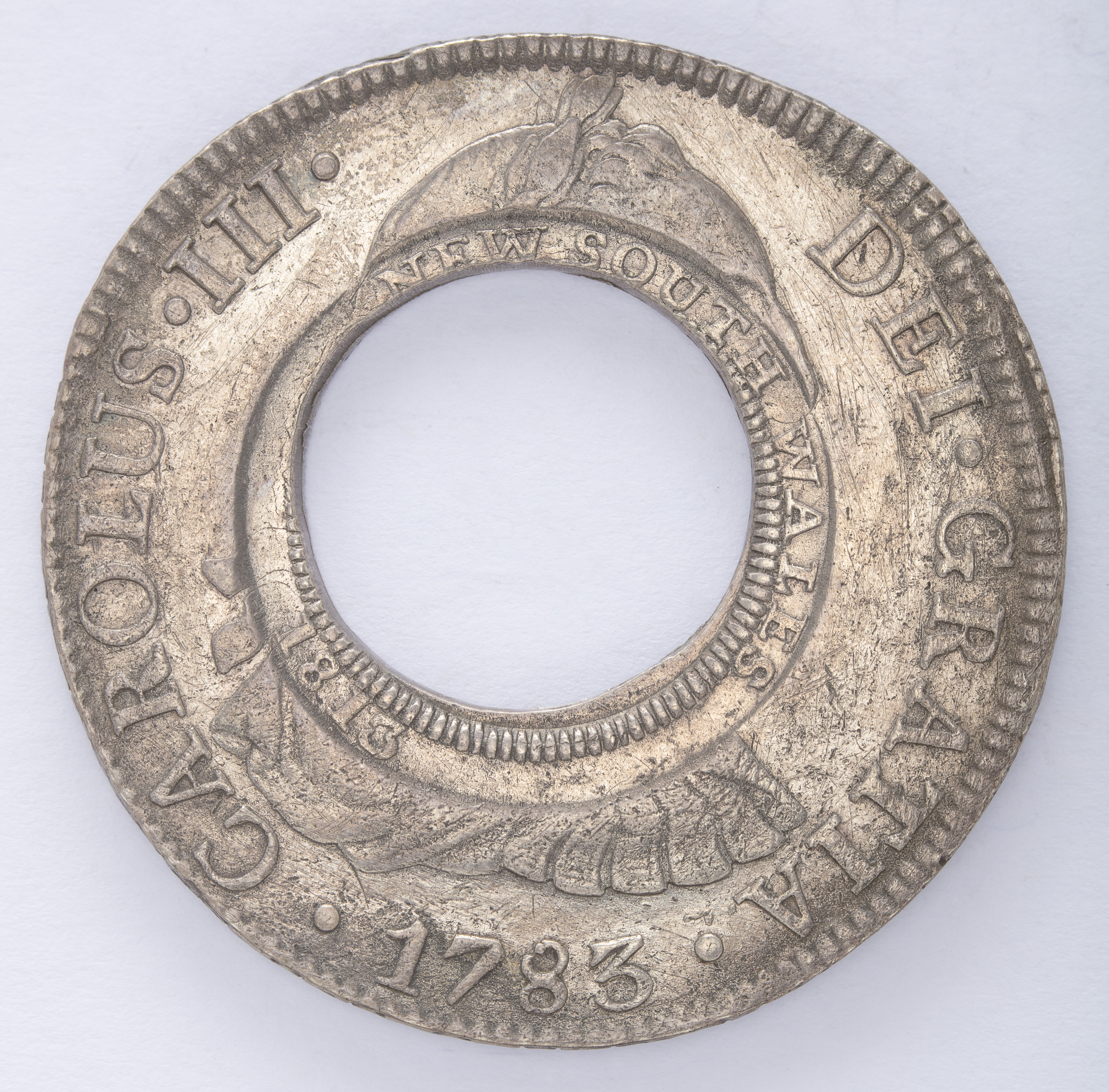
Holey Dollar
Museums Victoria · 55645 · 1813
An early Australian coin created by cutting the center out of a Spanish dollar to prevent hoarding and export.
A century and a half before Scarlett existed, colonial Australia was already improvising its own money out of pure necessity — cutting holes in someone else's currency to make it theirs.
Shown: an openly-licensed image of the same object type. The object cited above is held at Museums Victoria.
◈
1988 Bicentennial $10 polymer note
Reserve Bank of Australia Museum
no openly-licensed image yet — cited, not shown
View it at the museum ↗
First Polymer Banknote (1988 Bicentennial $10)
Reserve Bank of Australia Museum · 1988 Bicentennial $10 polymer note · 1988
The world's first polymer banknote, designed by Harry Williamson with technology developed by Australia's CSIRO.
Scarlett didn't just adopt currency technology — she invented it. This note is the reason nearly every country's banknotes today resist counterfeiting the way they do.
eGold Archive: Ballarat/Bendigo Gold Rush Photographs
State Library of Victoria · AEG000010 · 1850s-1860s
Historical photographs documenting the Victorian gold rush that first made Australia a resource-driven economy.
A century before mining stocks and iron ore exports, Scarlett's national character was already being forged in these dusty goldfields.
◈
RAM founding records 1965
Royal Australian Mint
image failed verification (wrong object) — cited, not shown
View it at the museum ↗
Royal Australian Mint Opening Records
Royal Australian Mint · RAM founding records 1965 · February 22, 1965
Official records of the opening of the Royal Australian Mint in Canberra, established just before decimal currency's launch.
This mint was built specifically to give Scarlett her own physical body — coins struck by Australians, for Australians, for the first time.
Primary sources
The documents themselves. We link and quote — that is citation, and it needs no licence.
Defining Moments: Decimal Currency
official_publication · Ongoing · National Museum of Australia · National Museum of Australia
Official national museum account of Australia's switch to decimal currency.
Australia's national museum's own account of the country's switch to decimal money.
RBA 1966 Annual Report
official_publication · 1966 · Reserve Bank of Australia · Reserve Bank of Australia
The RBA's official annual report covering the year of the decimal currency changeover.
The Reserve Bank of Australia's own official report from the year decimal currency launched.
The Decimal Revolution Exhibition
museum_exhibition · Ongoing · Reserve Bank of Australia Museum · RBA Museum
Museum exhibition documenting Australia's 1966 currency changeover.
A museum exhibition telling the full story of Australia's switch to decimal currency.
State Library of Victoria eGold Archive
photo_archive · 1850s-1860s · State Library of Victoria · State Library of Victoria
Digitized archive of photographs and documents from the Victorian gold rush era.
An online photo archive documenting Australia's 1850s gold rush.
Museums Victoria Collection Record: Holey Dollar
museum_record · Ongoing · Museums Victoria · Museums Victoria
Museum documentation of the historic Holey Dollar coin.
A museum's official record describing the old coin Australians made by cutting a hole in a Spanish dollar.
Where this money travelled
Scarlett was born on Decimal Currency Day in 1966 and grew into a resource-backed currency shaped by gold rushes, iron ore, and the vast mineral wealth of the Australian outback.
Canberra (Royal Australian Mint)-35.3439, 149.1094
Ballarat / Bendigo Goldfields-37.5622, 143.8503
Pilbara Iron Ore Region-22.6000, 118.7000
Kalgoorlie Super Pit-30.7489, 121.4708
Sydney (RBA Museum)-33.8688, 151.2093
What we don't know
The page no competitor will build.
- 4 of 5 objects on this page are cited but not shown — either the rights are not cleared, or we could not verify that an available image really depicts the object. We would rather show you nothing than show you the wrong thing.
